Ci vs ne in Italian: short answers about places and quantities
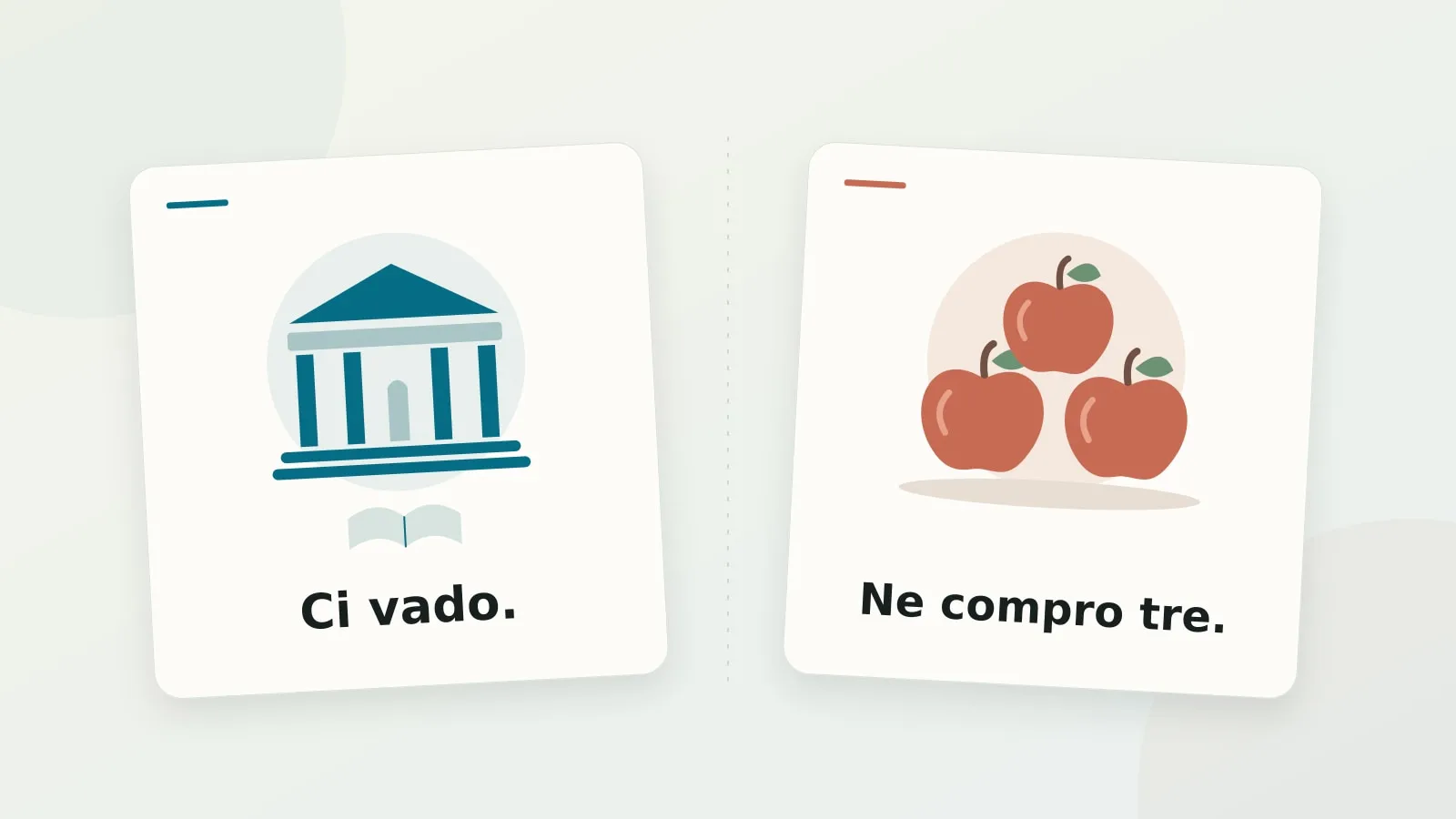
Vai al mercato? — Sì, ci vado. You are going to the market: ci refers back to the place. Quante mele compri? — Ne compro tre. You are buying three apples: ne refers to the thing being counted. These little words save you from repeating a phrase, but they are not interchangeable.
Rather than looking for one English translation, ask: Which part of the full Italian sentence does this word replace? Start with these common patterns, then try six questions with explained answers.
The main contrast
| Full sentence | Short version | Reference |
|---|---|---|
| Vado al mercato. | Ci vado. | al mercato: there |
| Compro tre mele. | Ne compro tre. | mele: three of them |
| Penso al viaggio. | Ci penso. | al viaggio: about the trip |
| Parlo del viaggio. | Ne parlo. | del viaggio: about the trip |
These are original practice examples. Notice that English “about it” can correspond to either word: the Italian construction, not the English translation, determines the choice.
Ci refers back to a place
Ci can refer to a place where something happens or somewhere someone is going. It is not limited to movement:
- Vai in biblioteca oggi? — Sì, ci vado dopo pranzo. — Are you going to the library today? Yes, I’m going there after lunch.
- Abiti a Torino? — Sì, ci abito. — Do you live in Turin? Yes, I live there.
The second sentence does not repeat the place name. Ci supplies the reference. The University of Vermont’s guide to ci and ne explains this use alongside other functions.
Learn c’è and ci sono as useful additional patterns: C’è un mercato means “There is a market”; Ci sono due mercati means “There are two markets.” Here ci belongs to esserci. Not every ci simply replaces a place phrase.
Ne with quantities: keep the number
When the thing is already known and you specify an amount of it, ne is commonly used:
- Quante mele compri? — Ne compro tre. — How many apples are you buying? Three of them.
- Vuoi del pane? — Sì, ne voglio un po’. — Would you like some bread? Yes, I’d like a little.
- Quanti biscotti mangi? — Non ne mangio nessuno. — How many biscuits are you eating? None.
Ne does not replace the quantity. In Ne compro tre, tre stays. English can simply say “I’m buying three”; this Italian short-answer pattern uses ne as well.
A useful contrast is the whole definite group: use the relevant direct object pronoun. Mangi tutti i biscotti? — Sì, li mangio tutti. — Are you eating all the biscuits? Yes, I’m eating them all. Northwestern University’s grammar chapter explicitly covers this distinction.
Learn a verb together with its preposition
Ci and ne can refer to complements even without a place or a number. Learn the complete combination:
- pensare a qualcosa → pensarci: Pensi al viaggio? — Sì, ci penso. — Are you thinking about the trip? Yes, I am.
- parlare di qualcosa → parlarne: Parlate del viaggio? — Sì, ne parliamo. — Are you talking about the trip? Yes, we are.
- avere bisogno di qualcosa: Hai bisogno di aiuto? — Sì, ne ho bisogno. — Do you need help? Yes, I do.
This is guidance, not a rule for automatically replacing every preposition. With a + a person as an indirect object, use another pronoun: Telefoni a Giulia? — Sì, le telefono. — Are you calling Giulia? Yes, I’m calling her. Do not use ci telefono to mean “I’m calling her.” Treccani describes the different functions of ci.
Ci can also mean “us,” as in Ci aiuti? — Will you help us? Ne can refer to movement away from a place, too. “Ci = there, ne = of it” is therefore only a starting point. Also distinguish unaccented ne from né, the conjunction in né oggi né domani — neither today nor tomorrow.
Where do ci and ne go?
In the simple statements practised here, they go before the conjugated verb:
- Ci vado domani. — I’m going there tomorrow.
- Non ne compro tre. — I’m not buying three of them.
With a modal verb followed by an infinitive, either position works:
- Ci voglio andare. / Voglio andarci. — I want to go there.
- Ne voglio comprare tre. / Voglio comprarne tre. — I want to buy three of them.
When attaching the pronoun, drop the infinitive’s final -e: andare → andarci, comprare → comprarne. Use the pronoun only once. Combinations such as ce ne, commands and past participle agreement are separate next steps; you do not need them for this present-tense practice.
Six questions: identify the missing phrase first
Fill in ci, ne, or the appropriate personal pronoun in question 6. Answer before looking at the key.
- Vai in biblioteca? — Sì, ___ vado oggi.
- Quante arance vuoi? — ___ voglio quattro.
- Pensi al problema? — Sì, ___ penso.
- Parlate del film? — Sì, ___ parliamo.
- Hai bisogno di tempo? — Sì, ___ ho bisogno.
- Telefoni a Giulia? — Sì, ___ telefono.
Answers and reasons
- Ci refers to in biblioteca, the destination.
- Ne refers to the oranges; the quantity quattro remains.
- Ci follows the pattern pensare a, to think about something.
- Ne refers to del film: the construction is parlare di.
- Ne replaces di tempo in avere bisogno di.
- Le refers to Giulia, the recipient of the call, not a place or thing.
Turn a short answer into a practice routine
For a difficult question, first write the full sentence: Parliamo del film. Underline del film, cover it and form Ne parliamo. Then change the topic: del libro → Ne parliamo. You are practising a reusable construction rather than memorising one gap-fill answer.
In Lingo Phrase Cards, you can select an available German → Italian set and answer phrases before turning the cards over. Target-language phrases include IPA and audio produced with Amazon Polly Neural. Regular learning updates Leitner progress; free pool, box and error-card practice lets you go through material without changing that assessment. Categorised sets may require a licence. The website language does not change this course direction.
For more practice ideas, read learning vocabulary in context with phrase flashcards. For Italian storytelling, continue with passato prossimo vs imperfetto.
Explore the available language directions and sets in Lingo Phrase Cards.