Make or do? Use everyday English collocations with confidence
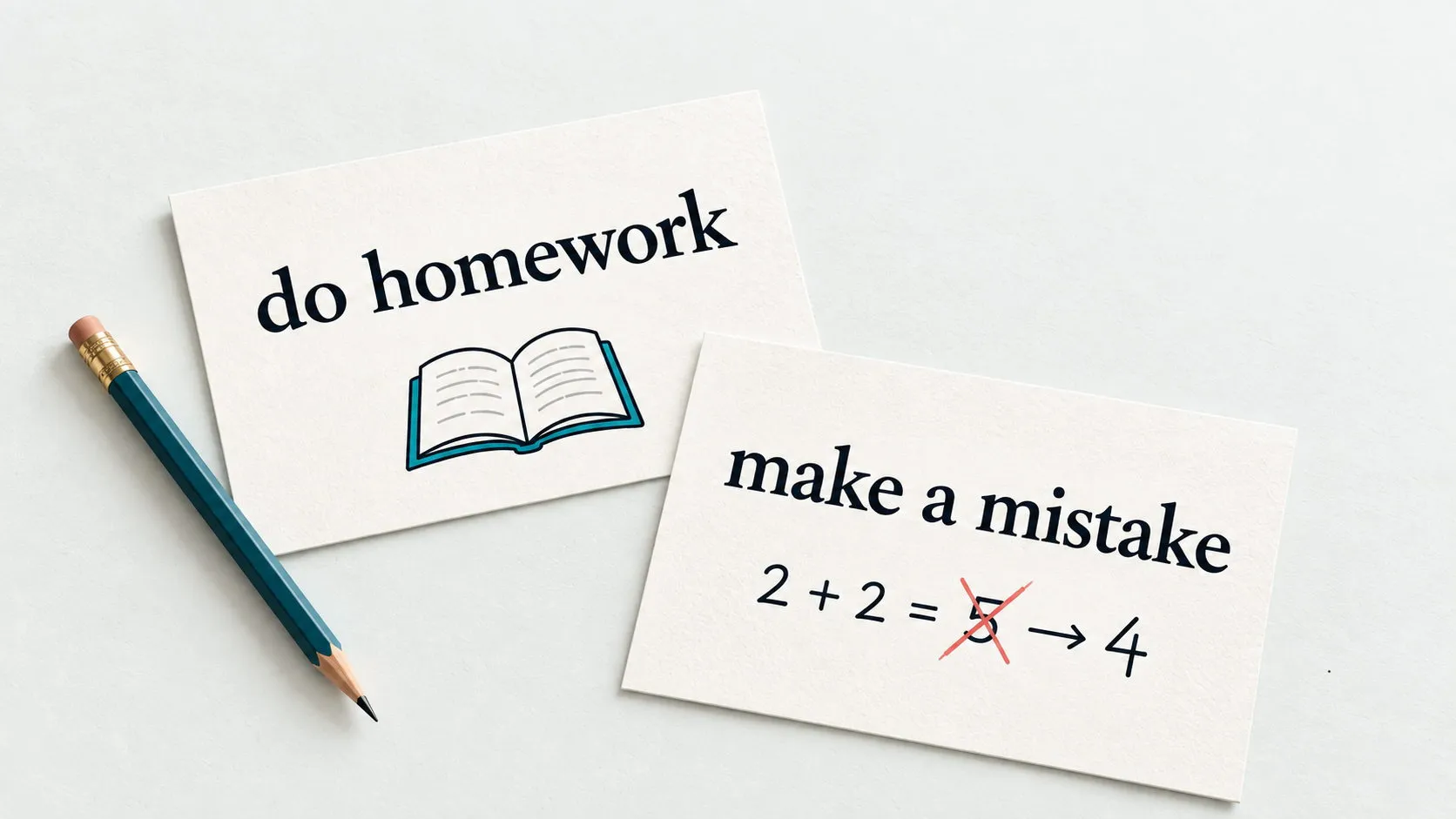
You do homework, but you make a mistake. Both verbs can describe an action, and your first language may use the same word for both. Translating that word on its own won’t always tell you which English verb fits.
The useful unit to learn is the verb together with its complement. A general guideline can help you understand the choice, but familiar word combinations help you actually speak. Start with a small set, see them in everyday situations, then try six practice questions with explained answers.
The basic idea: an activity or its outcome
Do often focuses on performing an activity: completing a task, working or exercising. Make often focuses on producing an outcome: a drink, a plan or even a mistake. Cambridge’s guide to do and make explains this difference in emphasis.
- I do my homework after dinner. The focus is on completing a task.
- I make coffee before work. The focus is on preparing a drink.
Treat this as a guide, not a rule without exceptions. An outcome needn’t be something you can touch, and a household task doesn’t automatically take do. When you already know the usual combination, use it rather than trying to rebuild it from a general rule.
Twelve combinations for everyday situations
Read each expression as a small unit. Notice a, the and my, too: choosing the right verb is only part of forming a useful phrase.
| With do | Meaning here | Example |
|---|---|---|
| do homework | complete schoolwork | I do my homework in the evening. |
| do the shopping | buy the things you need | We do the shopping on Saturdays. |
| do the laundry | wash clothes | I need to do the laundry. |
| do exercise | be physically active | I try to do some exercise every day. |
| do your best | try as hard as you can | You can only do your best. |
| do damage | cause harm | The storm did a lot of damage. |
Do your best changes with the person: I do my best, she does her best, we do our best. Learn the pattern as well as one fixed example, so you know which parts need to change in your sentence.
| With make | Meaning here | Example |
|---|---|---|
| make coffee | prepare coffee | I’ll make coffee for us. |
| make a mistake | get something wrong | I made a mistake in the email. |
| make a plan | decide what to do | Let’s make a plan for tomorrow. |
| make a phone call | call someone | I need to make a phone call. |
| make an effort | try deliberately | We should make an effort to listen. |
| make progress | move forward or improve | You are making progress. |
These combinations also appear in Cambridge’s overview. You don’t need to learn the whole table at once. Choose the expressions that will help you say something you actually need.
Where the guideline stops helping
Make the bed is a household task
I make my bed every morning.
You aren’t building a new bed. You are arranging the bedding, but the usual expression is still make the bed, not do the bed. “Household task” isn’t enough to decide the verb.
Do damage involves an outcome
A storm can cause damage, yet the expression is do damage. This shows the other limit of the guideline: “something happens as a result” doesn’t always mean you should choose make.
Do the cooking and make dinner both work
- I do the cooking at home. This describes the activity or responsibility.
- I make dinner at six. This describes preparing the meal.
Pay attention to the whole complement, not just the setting of a kitchen. VOA Learning English likewise explains that you need to learn fixed expressions alongside general guidelines.
Put the combinations into a short scene
Imagine arranging an evening with someone:
I’ll do the shopping. You can make dinner. After dinner, I need to do my homework. Then we can make a plan for the weekend.
Underline the whole combinations: do the shopping, make dinner, do my homework, make a plan. Then retell the scene using different people: She does the shopping. He makes dinner. You are practicing the expression and the verb form together.
Try changing one detail rather than replacing everything. If you change dinner to coffee, you still need make. If you change my homework to the laundry, you still need do. Check unfamiliar combinations in a learner’s dictionary instead of assuming the pattern covers every noun.
Don’t confuse the main verb with auxiliary do
In Do you make coffee at home?, the first do helps form the question. Make is the main verb that goes with coffee. The sentence needs both words; this isn’t a choice between them.
The same distinction applies to I don’t make coffee in the evening. The negative uses an auxiliary, but the word combination remains make coffee. Question formation is a separate topic. Here, focus on choosing the main verb that fits its complement.
Practice: choose the verb and its form
Complete each sentence with a form of do or make. Use the subject and time expression to choose the form. Cover the answers first.
- Every morning, Mia ___ coffee before work.
- I need to ___ my homework before the film starts.
- Yesterday, we ___ a plan for our trip.
- Please ___ your best; the task is difficult.
- The storm ___ a lot of damage last night.
- Ben always ___ his bed before breakfast.
Answers and reasons
- makes — The combination is make coffee. Mia takes makes in the simple present.
- do — Use do homework, with the base form after need to.
- made — Use make a plan. Yesterday puts it in the past.
- do — The expression is do your best, used here as an instruction.
- did — Use do damage, in the past because of last night. Don’t let the outcome guideline replace a known combination.
- makes — Use make his bed, with makes for Ben. Household tasks don’t all take do.
If you choose the right verb but the wrong form, separate the decisions. First choose make a plan, then change make to made for the past. The main forms are do – did – done and make – made – made. With he/she/it in the simple present, use does and makes.
Move from gaps to sentences of your own
Choose three expressions from the tables. Write a sentence about something you actually do or plan to do. Read it, cover it, then try saying it aloud. On your next attempt, change just one part: I make coffee becomes She makes coffee or I made coffee yesterday.
That is a separate exercise for your own notes. To continue with prepared phrases in Lingo Phrase Cards, choose an offered course with English as the target language and a source language that suits you, then explore the set previews. Target-language phrases include IPA and audio generated with Amazon Polly Neural. Some category sets require a license.
In an unlocked set’s regular study mode, try answering before turning the card over, then rate your answer. The Leitner system schedules later reviews. Bring the same practical aim to your own exercise: don’t just recognize make or do; say the whole expression you need.
Visit the Lingo page to explore the available language directions and sets. Start with one combination you want to use today.