French adjectives: before or after the noun?
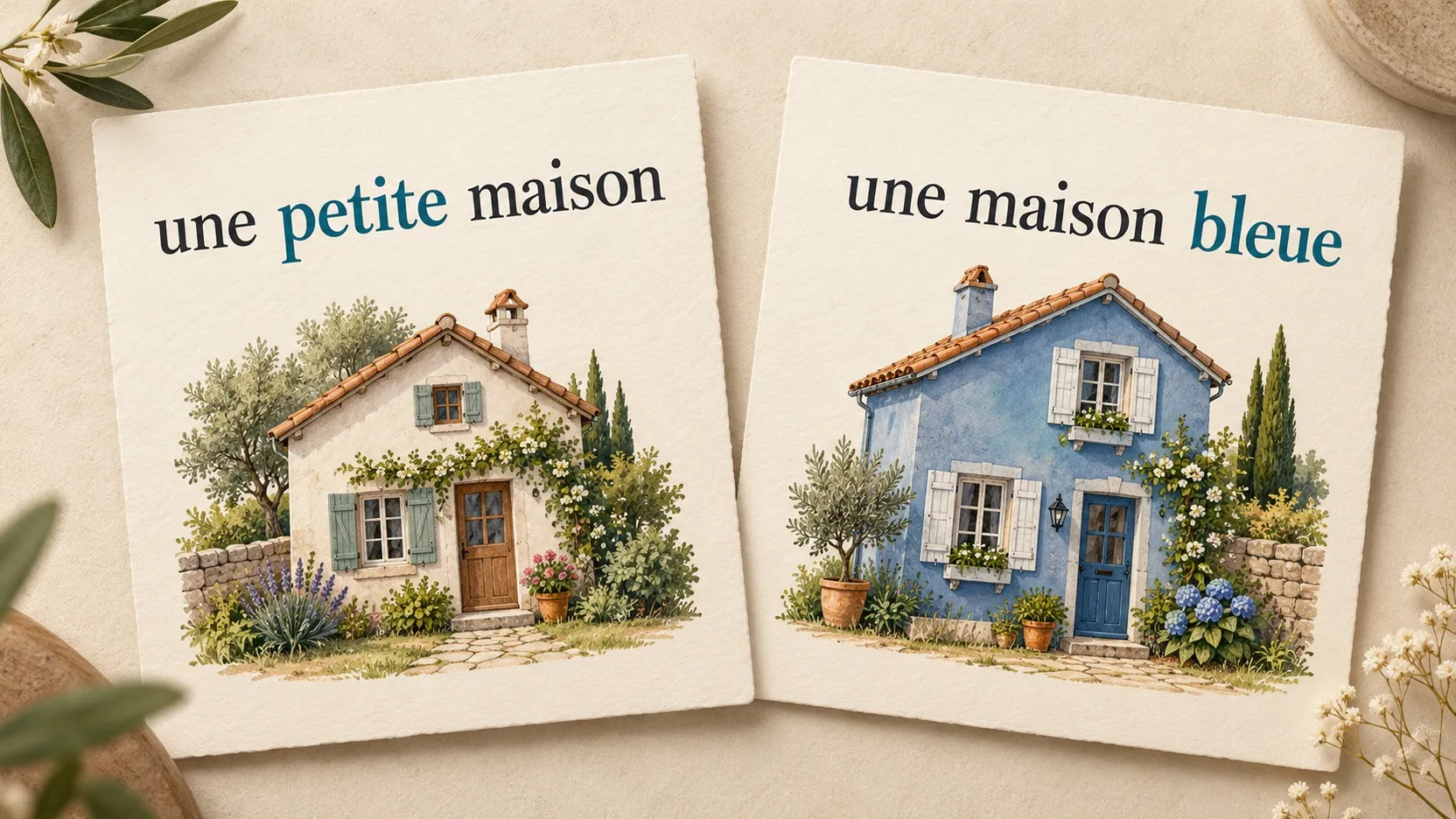
Why is it une petite maison but une maison bleue? Both adjectives describe a house, yet they sit on opposite sides of the noun. In French, position is part of the expression. Moving some adjectives even changes their meaning: mon ancienne maison is my former house, while une maison ancienne is an old house.
This guide gives you a practical way to choose the usual position, spot important meaning changes and practise with eight explained exercises. We are looking at adjectives attached directly to a noun, rather than sentences such as La maison est bleue.
Start with the usual pattern: noun, then adjective
Most French adjectives follow the noun. Unlike English, French does not normally put every description first. Learn the whole phrase:
| Description | French example | Meaning |
|---|---|---|
| Colour | une maison bleue | a blue house |
| Origin or nationality | un restaurant italien | an Italian restaurant |
| Shape | une table ronde | a round table |
| Quality | un exercice difficile | a difficult exercise |
Both the University of Texas at Austin grammar and Lingolia explain this basic pattern. It is a useful starting point for ordinary, neutral descriptions. Literary language and deliberate emphasis allow other arrangements.
Short does not automatically mean “before”: bleu and rond are short but follow their nouns here. Counting syllables is not enough.
Common adjectives often come first
A small, useful group of frequent adjectives usually precedes the noun:
- petit/petite → une petite maison, a small house
- grand/grande → une grande cuisine, a large kitchen
- bon/bonne → un bon repas, a good meal
- beau/belle → une belle journée, a beautiful day
- jeune → un jeune voisin, a young neighbour
- vieux/vieille → une vieille voiture, an old car
- nouveau/nouvelle → une nouvelle idée, a new idea
Beauty, age, goodness and size can help you remember these words. Treat the categories as a memory aid, not a rule for every adjective: magnifique, for example, often follows the noun even though it describes beauty. A reliable learning unit is une belle journée, not just beau = beautiful.
Agreement still matters wherever the adjective goes: un petit jardin, une petite maison, les petites maisons. Check the noun’s gender and number as well as the adjective’s position.
When moving an adjective changes its meaning
Learn the following as contrasting phrases, rather than interchangeable word orders:
| Before the noun | After the noun |
|---|---|
| mon ancienne maison — my former house | une maison ancienne — an old, historic house |
| ma propre chambre — my own room | ma chambre propre — my clean room |
| un grand homme — a great or important man | un homme grand — a tall man |
| un cher ami — a dear friend | un livre cher — an expensive book |
The UT Austin guide to meaning and placement explains these contrasts. Mon ancienne maison tells you that I no longer live there, not that the building is old. A grand homme need not be physically tall.
Time expressions are also worth learning as chunks: la semaine dernière means last week and la semaine prochaine means next week. By contrast, la dernière semaine du cours is the final week of the course. A position change can change what you are referring to.
Bel, nouvel and vieil: position and form are separate checks
Before a masculine singular noun beginning with a vowel sound or a silent h, three common adjectives have special forms:
| Usual form | Before a vowel or silent h | Feminine form |
|---|---|---|
| beau | un bel appartement | une belle maison |
| nouveau | un nouvel emploi | une nouvelle idée |
| vieux | un vieil hôtel | une vieille maison |
These forms are documented in UT Austin’s grammar. Check gender, number and the following sound. If you do not know whether an unfamiliar word has a silent h, check a dictionary; not every written h behaves the same way.
This is not a general rule that all adjectives change before a vowel. It applies to particular forms of particular adjectives.
Two adjectives can frame the noun
In une petite maison bleue, petite takes its usual position before the noun and bleue follows it. You do not need to put every adjective on the same side.
Try this three-step check:
- Find the noun: maison, feminine singular.
- Check each adjective: petit usually comes first; the colour bleu comes after.
- Make the forms agree: une petite maison bleue.
Start with one or two adjectives. You can explore longer descriptions and stylistic emphasis once these everyday patterns feel familiar.
Eight adjective-placement exercises
Build each phrase using the intended meaning and the ordinary neutral order. Adjust adjective endings where needed.
- A blue bicycle: un vélo + bleu.
- A small kitchen: une cuisine + petit.
- My former address: mon adresse + ancien.
- My own office: mon bureau + propre.
- A beautiful apartment: un appartement + beau.
- A new hotel: un hôtel + nouveau; the h is silent.
- Two difficult exercises: deux exercices + difficile.
- A small red car: une voiture + petit + rouge.
Answers and explanations
- un vélo bleu: The colour follows the noun.
- une petite cuisine: Petit usually goes before the noun; cuisine requires the feminine form.
- mon ancienne adresse: Before the noun, ancien means former. Adresse is feminine, so use ancienne. The possessive remains mon before the vowel.
- mon propre bureau: Here propre means own. Mon bureau propre would describe my clean office.
- un bel appartement: Beau comes first and becomes bel before a masculine singular noun beginning with a vowel.
- un nouvel hôtel: Use nouvel before the silent h in this masculine singular phrase.
- deux exercices difficiles: The adjective follows the noun and takes a plural s.
- une petite voiture rouge: Petite comes before, rouge after; both describe voiture.
Turn the pattern into your own sentence
Describe three nearby objects: une table ronde, un petit sac, une tasse bleue. Hide the examples and make complete sentences: J’ai une tasse bleue. Then explain why each adjective went where it did. Practise meaning changes with a situation too: “I have moved” → mon ancienne maison.
In Lingo Phrase Cards, you can choose prepared phrases for an offered French-learning direction and practise with target-language IPA and audio. Notice complete noun phrases in the expressions you study. In regular learning, answer before turning the card over, then assess your response; this updates its box and due date. Free pool, box and error-card practice does not change that progress. Categorised sets may require a licence.
The tasks above are editorial examples. For another way to build descriptions, see the guide to French qui and que.
Remember: most adjectives follow the noun, frequent combinations often come first, and meaning comes first with ancien or propre.
Explore the language directions and sets available in Lingo Phrase Cards.
Sources
- University of Texas at Austin: Formation and placement, Adjectives before the noun, Meaning and placement.
- Lingolia: Position of adjectives in French.