Adjective or adverb? Choose by what the word describes
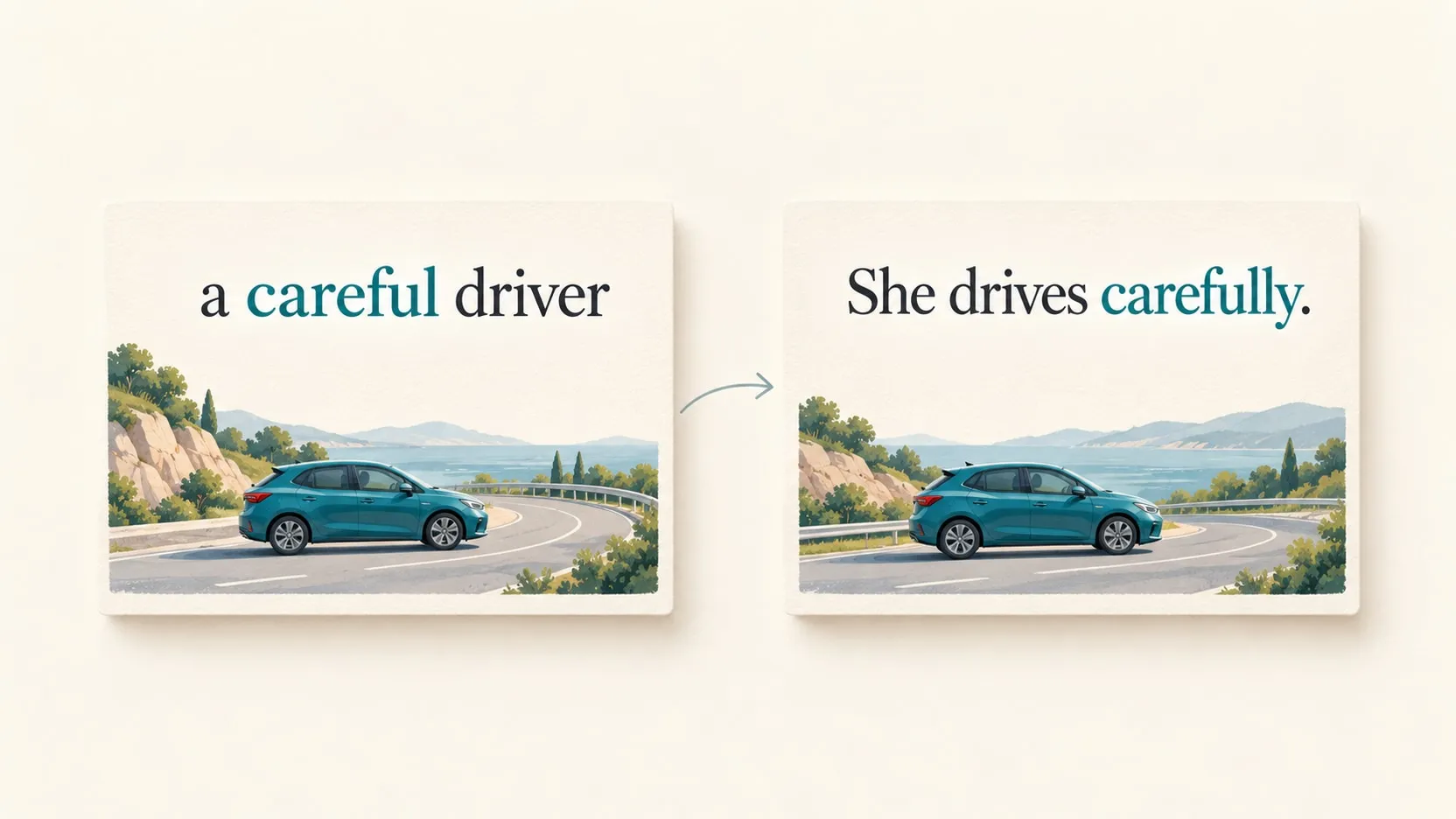
She is a careful driver. She drives carefully. Both sentences describe the same person’s driving, but careful and carefully do different jobs. Careful describes the driver; carefully describes how she drives.
Instead of asking only whether a word needs -ly, first identify what it describes. That small step helps with regular forms, linking verbs and tricky pairs such as good/well and hard/hardly. Try the eight exercises below after working through the examples.
Start with the word’s job
An adjective describes a person or thing. An adverb can describe how an action happens. This guide focuses on these adverbs of manner.
| Sentence | What is being described? | Word type |
|---|---|---|
| She is a careful driver. | The driver | Adjective: careful |
| She drives carefully. | Her driving | Adverb: carefully |
| The instructions are clear. | The instructions | Adjective: clear |
| Please speak clearly. | The way someone speaks | Adverb: clearly |
Adverbs have other jobs too. In really careful, really modifies an adjective. In very carefully, very modifies another adverb. The Cambridge overview of adjectives and adverbs introduces these word classes; the examples here concentrate on choosing the right form in everyday sentences.
Notice that an adjective can follow a verb: The instructions are clear. Its position alone doesn’t make it an adverb. Clear still describes the instructions.
Forming common adverbs with -ly
Many adverbs of manner use adjective + -ly:
- quiet → quietly: Please close the door quietly.
- careful → carefully: Read the question carefully. Keep the l in careful and add -ly, giving two l’s.
- easy → easily: You can find the station easily. Change y to i.
- happy → happily: The children played happily.
Cambridge’s guide to adverb forms explains these patterns. But an -ly ending isn’t proof that a word is an adverb. Friendly is normally an adjective: a friendly reply. To describe an action, use a phrase such as in a friendly way: She answered in a friendly way.
English adjectives also keep the same form with plural nouns: a careful driver → careful drivers, not carefuls drivers.
Good and well, plus forms that don’t follow the pattern
Learn each form with its meaning and sentence:
| Pattern | Example | Point to remember |
|---|---|---|
| good → well | He is a good cook. He cooks well. | Quality versus how an action is performed |
| fast → fast | It is a fast train. It travels fast. | Don’t add -ly. |
| hard → hard | It is hard work. She works hard. | Hard can describe effort as an adverb. |
| hardly | I can hardly hear you. | Almost not; not “with effort” |
| late | The bus arrived late. | After the expected time |
| lately | I haven’t seen Sam lately. | Recently |
She works hard and She hardly works make very different claims. The first describes effort; the second says she does almost no work. Adding -ly isn’t a harmless change of word type.
There is also more to well than “the adverb of good”. In I feel well, well can be an adjective meaning healthy. The good/well contrast is useful for quality versus performance, but it isn’t a rule for every possible sentence.
Linking verbs: why “looks happy” is correct
After be, seem, look, feel, smell or taste, an adjective can describe the subject:
- The soup tastes good. Good describes the soup’s quality.
- Maya looks happy. Happy describes Maya’s apparent state.
- Maya looked carefully at the map. Carefully describes the action of looking.
The verb’s meaning in that sentence matters. Look happy links a person to a description; look carefully at something describes an action. Don’t memorize “always use an adjective after look”. Learn the contrast instead.
For a simple action with an object, a useful pattern is She opened the door quietly. Put quietly after the object here, rather than between opened and the door. This is a practical pattern for these sentences, not a universal position rule for all adverbs.
Eight exercises with explained answers
Choose the usual standard-English form. Identify what the word describes before checking the answer.
- She is a careful / carefully driver.
- Please drive careful / carefully.
- The soup tastes good / well. You mean its flavor.
- Leo plays the piano good / well.
- This train travels fast / fastly.
- I can hard / hardly hear you. You mean “almost not”.
- Maya looked careful / carefully at the address.
- Correct: They are friendlys people.
Answers:
- Careful: an adjective describing driver.
- Carefully: an adverb describing how to drive.
- Good: a description of the soup, not an action it performs.
- Well: it describes how Leo plays.
- Fast: the adjective and adverb share the same form.
- Hardly: it means almost not; hard has a different meaning.
- Carefully: it describes the deliberate action of looking at the address.
- They are friendly people. Friendly is an adjective and doesn’t take a plural s.
Practice sentence pairs, not just endings
On paper, write She is a quiet speaker. She speaks quietly. Underline speaker and speaks. Cover quiet/quietly and supply the forms from memory. Then make your own pair with careful/carefully. This is a suggested exercise: explaining the word’s job matters more than adding an ending quickly.
Lingo Phrase Cards provides prepared words in phrases, with IPA and audio for target-language phrases. Explore an offered language direction and preview suitable sets; some categorized sets require a license. In an unlocked set’s regular learning mode, attempt your answer before turning the card over, then rate it. Free practice views offer extra review without changing card progress.
For more on connecting forms with meaning, see learning vocabulary in context with phrase flashcards. Keep today’s question in mind: Am I describing a person or thing, or how an action happens? Explore the available language directions and sets through the Lingo page.