Learn Spanish vocabulary: Turn basic words into everyday sentences
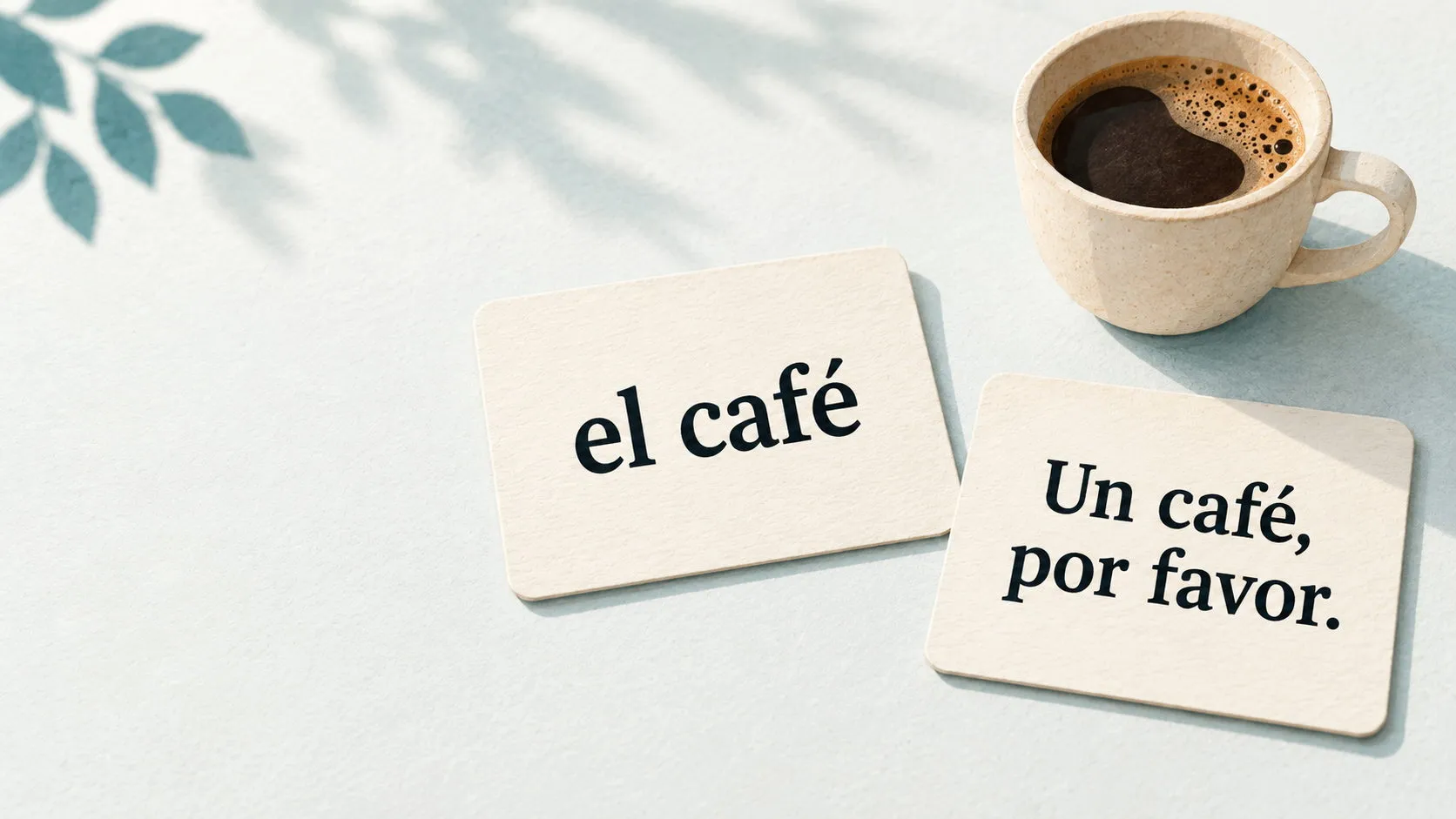
You know that pan means “bread.” But can you tell someone at a shop what you want to buy? When you learn Spanish vocabulary, that is a useful connection to make: from knowing a word to expressing something you actually want to do.
You do not need a huge list to get started. Choose a situation, gather the words it calls for, and practice short expressions you can adapt. Here, you will begin with three everyday tasks: ordering coffee, buying bread, and looking for a train station.
Choose vocabulary for a specific task
“I want to build my basic Spanish vocabulary” is a good goal, but it does not tell you which words to choose. Ask a more practical question: What do I want to do in Spanish next?
- Order at a café: learn the drink and a short way to ask for it.
- Shop for something: learn the product, a useful verb, and a price question.
- Find your way around: learn the place you need and a way to ask where it is.
Start with one situation. Each word then has a job in a small practice task. You can add more topics later rather than trying to learn everything at once.
A small Spanish vocabulary set for beginners
This is a practice selection, not a ranking of the most common Spanish words. Nouns include their articles so you can learn grammatical gender along with meaning.
| Spanish | Meaning in this context | What you can do with it |
|---|---|---|
| el café | coffee | order a drink |
| el pan | bread | name a product |
| la tienda | shop, store | name a shopping destination |
| la estación | station | look for a place |
| la calle | street | talk about your surroundings |
| comprar | to buy | say what you want to buy |
| buscar | to look for | say what you are looking for |
| costar | to cost | ask about a price |
| por favor | please | make a request |
Unlike English “the,” Spanish articles carry grammatical gender: el pan is masculine and la tienda is feminine. Write down la tienda, not just tienda. The article is part of what you need to learn.
Context also matters. La estación can mean a station, but it can also mean a season. La estación de tren makes “train station” explicit. A vocabulary card should make clear which meaning you are practicing.
Three situations: Put the words to work
1. Order at a café
Un café, por favor. — A coffee, please.
A simple order does not require a long sentence. Combine the drink with a polite expression. Read it, say it aloud, and then try it without looking.
For a small variation, say Un café con leche, por favor. — A coffee with milk, please. Café con leche is a familiar combination listed in the dictionary entry for café. Practice it as a useful expression instead of assembling three separate words each time.
2. Buy bread at a shop
Quiero comprar pan. — I want to buy bread.
You are learning more than pan: Quiero comprar … is a pattern you can use with another product. To ask the price of something you are pointing to, try:
¿Cuánto cuesta esto? — How much does this cost?
The question gives costar a concrete purpose. When writing it, remember the opening question mark and the accent in cuánto.
3. Look for a train station
Busco la estación de tren. — I am looking for the train station.
This tells someone what you are looking for. To ask directly where it is, use:
¿Dónde está la estación de tren? — Where is the train station?
Now change only the place: Busco la tienda. — I am looking for the shop. That lets you check whether you can use the pattern rather than simply repeat one memorized sentence.
Change one part at a time
You do not need complicated variations at the beginning. Keep a pattern and swap one part:
- Busco la estación de tren. → Busco la tienda.
- Quiero comprar pan. → Quiero comprar café.
- Un café, por favor. → Un café con leche, por favor.
Check that the new sentence fits the situation. Buying coffee at a store and ordering coffee at a café are different tasks, even though both use café.
For longer expressions, first get comfortable with the part that carries your message. You do not have to memorize an entire conversation straight away. Add the next question when you can produce the first expression yourself.
Recall the answer, then revisit it later
Understanding a phrase as you read it is a start. To use it yourself, try producing it before you can see the answer. The Learning Scientists explain retrieval practice as bringing learned information to mind and recommend checking your answer afterward.
For this vocabulary set, try the following:
- Read an expression and make sure you understand it.
- Cover the Spanish. Leave only the situation or English prompt visible.
- Say or write your answer before checking.
- Compare the words, articles, verb forms, and spelling with the example.
- Try again later, mixing the expression with ones you have already practiced.
Spread those attempts across separate study opportunities. Spaced practice means distributing study over time rather than doing it all in one sitting. Choose a manageable amount based on your time and how well you can recall earlier material.
A short exercise: Answer before looking
Cover the answers and complete these four tasks:
- Order a coffee and include “please.”
- Say that you want to buy bread.
- Ask the price of an item you are pointing to.
- Say you are looking for the train station. Then change the station to the shop.
Possible answers:
- Un café, por favor. A short order combines the drink with a polite request.
- Quiero comprar pan. Here, quiero is followed by the infinitive comprar.
- ¿Cuánto cuesta esto? Esto refers to the “this” you are indicating.
- Busco la estación de tren. → Busco la tienda. The verb stays the same; the place changes.
Other answers may also work. Focus on whether your sentence expresses the intended task and its words fit together correctly. If one part is missing, practice that part again rather than rereading the whole set.
Continue with prepared phrases in Lingo
In Lingo Phrase Cards, choose an available source-to-target language pair and preview its sets. One offered example is German → Spain Spanish; choose the actual pair you need rather than relying on this article’s language. Prepared content presents words in phrases, with IPA pronunciation notation and Amazon Polly Neural audio for the target-language phrases. The audio is synthetic speech you can use as a listening model.
Look for a topic that matches your next task, for example within the everyday-life or travel categories. Categories include level guidance. A 100-card set is a learning package for several sessions, not a daily quota. Certain categorized sets require a license, but you can still preview them.
Open an unlocked set in the regular learning mode. Attempt the answer before flipping the card, compare it, and then mark whether you knew it. Due cards take priority over new ones, and you can adjust the daily limit for new cards. Listen to the audio and deliberately repeat an expression instead of leaving it playing in the background.
Pool, box, and error-card practice offer additional review. These free-practice views do not change card progress; later assessment happens in regular learning.
Start with an everyday task you genuinely want to express. Visit the Lingo page to explore the available language pairs and sets.