Por vs. para: choose the right Spanish preposition by meaning
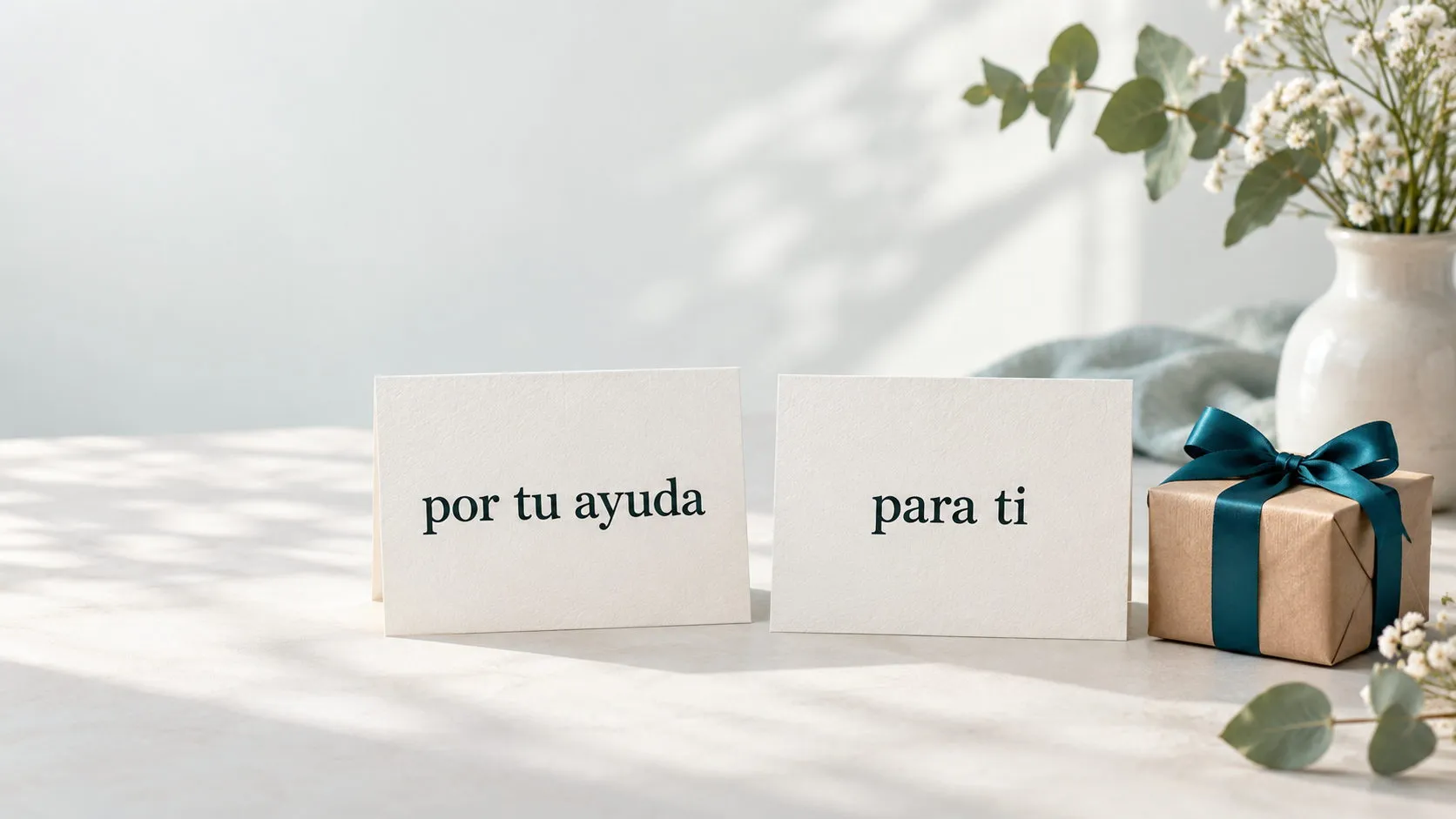
You hand someone a gift and say, Gracias por tu ayuda. Este regalo es para ti. — Thank you for your help. This gift is for you. English uses “for” twice, but Spanish makes two different connections: por explains why you are thanking someone; para identifies the person the gift is intended for.
That is the starting point for choosing between por and para. Rather than translating one English word, ask what relationship your sentence expresses. A few everyday situations can make the main uses easier to distinguish, then you can practice making the choice yourself.
A quick guide: reason or intended outcome?
As a starting point, por often introduces a reason, a route or an exchange; para often introduces a purpose, a recipient or an intended destination. This is a useful guide, not an explanation of every fixed expression. SpanishDictionary.com’s overview separates these common uses.
| What are you expressing? | Preposition | Example |
|---|---|---|
| The reason for doing something | por | Lo hago por ti. — I’m doing it because of you / for your sake. |
| The purpose of an action | para | Estudio para aprender. — I study in order to learn. |
| Who something is intended for | para | Este regalo es para ti. — This gift is for you. |
| The price paid for something | por | Pago diez euros por el libro. — I pay ten euros for the book. |
| The route you take | por | Paso por el parque. — I go through the park. |
| The destination you set off for | para | Salgo para Madrid. — I’m leaving for Madrid. |
| When something needs to be ready | para | Necesito el informe para el lunes. — I need the report by Monday. |
Find the meaning in the left-hand column first. Not every Spanish use of por or para translates as “for.”
Use por for a reason and para for a purpose
A reason explains what motivates an action. A purpose tells us what the action is intended to achieve.
- Estudio español por mi trabajo. — I study Spanish because of my job. The job is the reason.
- Estudio español para hablar con mis clientes. — I study Spanish in order to speak with my clients. Speaking with them is the intended result.
Both could be true of the same person. The preposition changes the focus, not necessarily the situation. Ask “What motivates me?” or “What am I trying to accomplish?”
Para + infinitive often expresses a purpose: Leo para aprender — I read in order to learn. An infinitive is the basic verb form, here aprender. But an infinitive does not automatically require para. Gracias por ayudarme means “Thank you for helping me.” You are thanking someone for an action, so por fits. Lingolia’s comparison includes both purpose constructions and dar las gracias por followed by an infinitive.
Price and recipient: the same book, two connections
Imagine buying a book and giving it to someone:
- Pago diez euros por el libro. — I pay ten euros for the book.
- El libro es para Ana. — The book is for Ana.
The first sentence connects a price to a purchase: por. The second identifies the intended recipient: para. The fact that both English sentences use “for” does not make the Spanish prepositions interchangeable.
A person’s name after the preposition does not automatically mean para either. In Lo hago por Ana, Ana is the motivation: “I’m doing it for Ana’s sake.” In Este libro es para Ana, she is the recipient. Choose the relationship, not a rule such as “person = para.”
Route and destination: through the park or off to Madrid?
Por can describe the area or route you pass through: Paso por el parque — I go through the park. The park is on your route; it need not be your final destination.
Para can indicate the destination when you set off: Salgo para Madrid — I’m leaving for Madrid. Madrid is the destination. Spanish has other ways to express destinations too, such as Voy a Madrid. Do not replace every directional preposition with para.
For this particular contrast, picture a line passing through an area for por and an arrow pointing toward an intended destination for para. That image helps with routes and destinations, but it is not a rule for all the other uses.
Learn communication methods and deadlines as separate patterns
Two useful everyday expressions are worth learning in full:
- Hablamos por teléfono. — We talk on the phone. Por introduces the means of communication.
- Necesito el informe para el lunes. — I need the report by Monday. In this deadline context, para marks when it needs to be ready.
A time word alone does not determine the preposition. Por la mañana means “in the morning,” while para el lunes can express a deadline. Learn the complete pattern rather than assigning every time expression to one preposition.
Three fixed expressions and one common mistake
You do not need to reconstruct every expression from a general rule. Learn common phrases as units:
- por favor — please;
- por ejemplo — for example;
- para siempre — forever.
The common mistake is thinking “Both mean for, so either will do.” Sometimes both prepositions can fit a sentence, but the meaning changes. Lo hago por ti emphasizes your motivation; a gift para ti is intended for you. Decide what you mean before choosing the Spanish wording.
Quick practice: choose and explain
Fill in por or para. The hints specify the intended meaning:
- Gracias ___ tu ayuda. — You are thanking someone for their help.
- Este regalo es ___ ti. — You are naming the recipient.
- Estudio español ___ hablar con mis clientes. — You are stating a purpose.
- Pago diez euros ___ el libro. — You are stating a price.
- Paso ___ el parque. — The park is on your route.
- Necesito el informe ___ el lunes. — The report needs to be ready by Monday.
Answers and explanations:
- por: The help is the reason for your thanks.
- para: The gift is intended for that person.
- para: Hablar describes the intended result of studying.
- por: You connect the price to what you buy.
- por: You describe a route through a place, not a destination.
- para: You specify a deadline for having something ready.
Now write two sentences of your own: one reason with por, one purpose with para. Using the same action makes the difference especially clear: Leo por mi trabajo — I read because of my job; Leo para aprender — I read in order to learn.
Keep practicing with complete phrases
When you review, cover the whole answer and try to say the complete sentence from a situation prompt. Check it, then explain your choice with a label: reason, purpose, price, recipient, route or deadline. You are practicing a message rather than a single translated word.
In Lingo Phrase Cards, you can choose an available language direction—for example, German → Spanish (Spain)—and preview prepared sets. Words appear in phrases; target-language phrases include IPA pronunciation notation and audio generated with Amazon Polly Neural, providing a synthetic listening model. Some categorized sets require a license.
With an unlocked set in the regular study mode, try the answer before flipping the card, compare it, then mark whether you knew it. The Leitner review system uses that assessment for later reviews. For the original practice sentences in this article, paper and a covered answer work too.
Start with a sentence you genuinely want to use and identify its purpose. The Lingo page is your starting point for exploring available language directions and sets.