Less vs fewer: the difference and ten exercises with answers
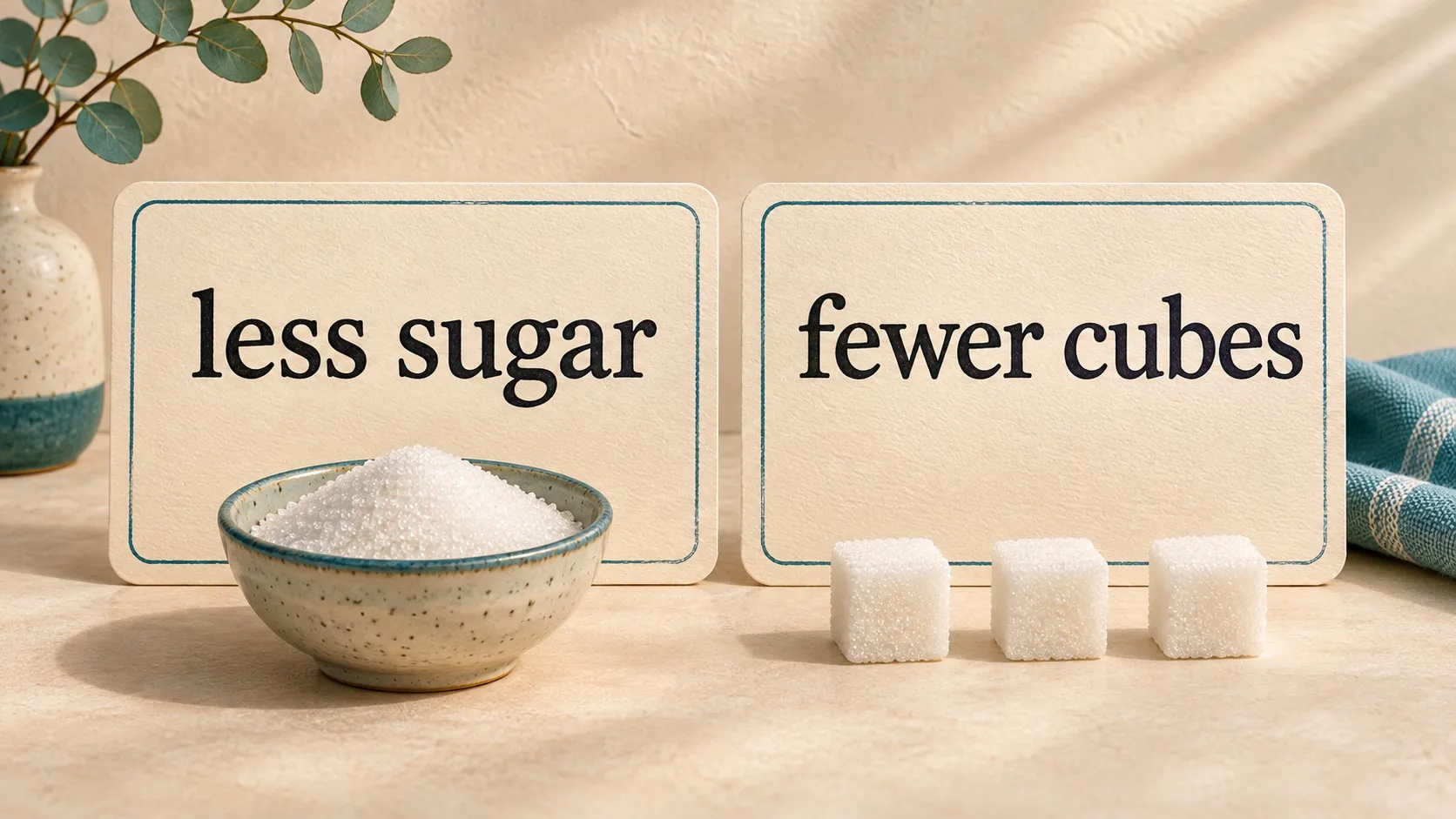
We need less sugar. We need fewer sugar cubes. Both sentences describe a smaller quantity, but they package it differently. Less goes with an uncountable amount; fewer goes with a smaller number of countable things.
Use the examples below to make that choice, then try ten exercises with explained answers. These are original learning examples. The key is the English noun, not just its final letter: people is plural, while money describes an amount.
The quick check: an amount or a number?
Less is the comparative form of little; fewer is the comparative form of few. Cambridge’s grammar guide explains the distinction between uncountable nouns and countable plurals.
| What is being reduced? | Choose | Original example |
|---|---|---|
| An amount of sugar | less sugar | This recipe needs less sugar. |
| The number of sugar cubes | fewer sugar cubes | I put fewer sugar cubes in my tea now. |
| Available time | less time | We have less time today. |
| The number of tasks | fewer tasks | We have fewer tasks today. |
| The number of people | fewer people | There are fewer people here today. |
Underline the noun first. Can you count individual items in that meaning, as in one task, two tasks? Fewer is the standard choice when comparing a smaller number of them. If the noun describes an amount, such as time or sugar, choose less.
For questions about how large a quantity is, see much and many. Here, you are comparing a quantity with an earlier one or with another situation.
Change the unit and you change the noun
You can weigh sugar or count cubes. The substance is similar, but the wording changes:
- Use less sugar. Compare an amount.
- Use fewer spoonfuls of sugar. Count spoonfuls.
- We bought less milk. Compare the amount of milk.
- We bought fewer bottles of milk. Count bottles.
In bottles of milk, bottles is the noun whose number you compare. Adding of milk does not make the bottles uncountable. Being able to measure something is different from treating the noun as countable.
The same distinction gives you less work, but fewer tasks. Let the word group you actually use guide the choice.
Less of and fewer of: when do you need of?
Use of before a specified group introduced by the, a possessive such as my, or a pronoun such as them:
- We use less of the sugar in this jar. Part of a specified amount.
- Fewer of my friends drive to work now. A smaller number from a particular group.
- I invited ten people, but fewer of them came. A smaller number of those people.
Compare fewer people with fewer of the people. The first describes a smaller number generally; the second selects a smaller number from a known group. Write fewer of the people, not fewer the people.
With a plain noun, there is no extra of: less sugar, not less of sugar. Cambridge also explains the uses of less and less of.
Three useful checks
1. People is already plural. For a smaller number of people, standard English uses fewer people, even though the noun does not end in -s.
2. Less can describe a degree. In This bag is less expensive, you compare how expensive the bag is, not the number of bags. Use less before the adjective. I sleep less now is also possible: it describes an activity rather than a count of nouns.
3. You may hear less with plural nouns. Cambridge notes that forms such as less cars occur in informal speech. For the straightforward noun comparisons in these exercises and in careful standard writing, use fewer cars. This is a practical writing guide, not an account of every informal usage or special construction involving numbers.
Ten exercises: choose before checking
Complete 1–8 with less or fewer. In 9–10, supply the missing connection or correct the sentence. Use the standard patterns above and keep the other words unchanged.
- This recipe needs ___ sugar than the old one.
- I put ___ sugar cubes in my tea now.
- We have ___ time this morning.
- There are ___ people on the bus today.
- We bought ___ bottles of milk this week.
- I have ___ work to do today.
- ___ of my friends live nearby now.
- This bag is ___ expensive than that one.
- Add the missing word: We use less ___ the sugar in this jar.
- Correct for standard writing: We have fewer money this month.
Answers and explanations
- Less: sugar is an uncountable amount. This recipe needs less sugar than the old one.
- Fewer: sugar cubes are separate, countable items.
- Less: time describes the amount available here.
- Fewer: people is a countable plural without the regular -s ending.
- Fewer: you count bottles, not milk.
- Less: work is uncountable here; a different noun gives you fewer tasks.
- Fewer: a smaller number of your friends. Fewer of my friends live nearby now.
- Less: expensive is an adjective; you compare a degree.
- Of: We use less of the sugar in this jar. This pattern needs of before the sugar.
- We have less money this month. Money names an amount, not individual coins. With coins, use fewer coins.
Turn an answer into your own sentence
Describe two changes in your routine, such as I use less sugar now and I buy fewer snacks now. Then change a unit: less milk becomes fewer bottles of milk. Say the complete phrase from memory and explain which noun decides your choice.
The guide to learning vocabulary in context with phrase flashcards offers a broader practice routine. A useful contrast gives you more to work with than an isolated definition.
In Lingo Phrase Cards, you can explore the offered language directions and preview sets. Prepared phrases include IPA and Amazon Polly Neural audio on the target-language side. In an unlocked set, try recalling the phrase before turning the card, then assess your answer in the regular study mode; this updates Leitner progress and due dates. Categorized sets may require a license. Your own comparison sentences can complement this phrase practice.
Explore the available language directions and sets in Lingo Phrase Cards.