Much or many? Talk about quantities with confidence
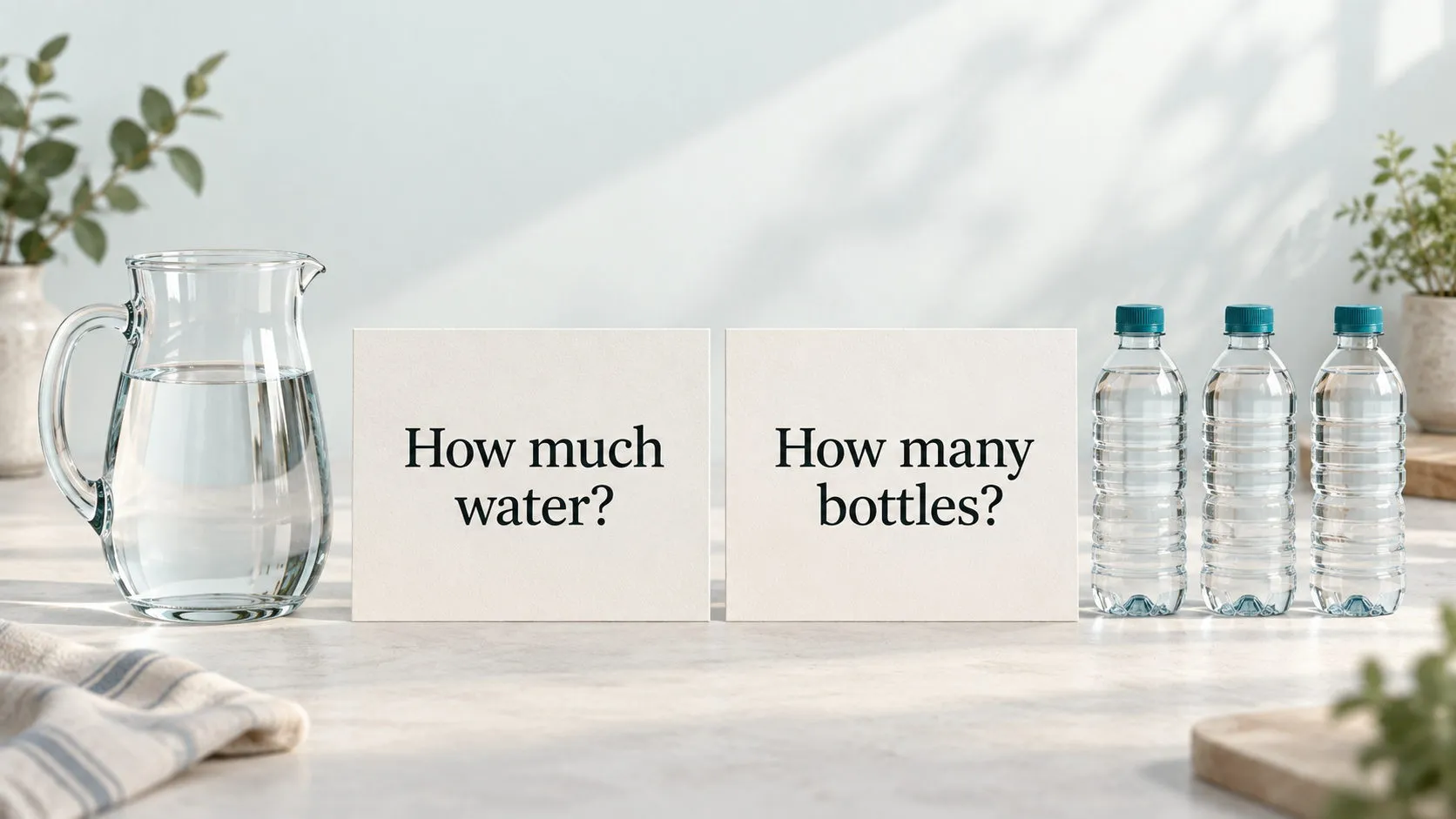
How much water do we need? How many bottles do we need? Both questions could be part of the same shopping trip. Yet one uses much and the other many. The difference isn’t how large the quantity is: water describes an amount, while bottles names separate items.
Start with the English noun to choose between much and many. Then consider the sentence: in an everyday positive statement, a lot of may sound more natural. This guide takes you through both decisions, with practical contrasts and seven exercises.
The basic rule: amounts versus countable items
Use much with uncountable nouns and many with plural countable nouns. “Uncountable” doesn’t mean impossible to measure. It means we don’t normally count the noun itself as separate units in that meaning.
| Noun | What you’re describing | Quantity question |
|---|---|---|
| water | an amount of water | How much water? |
| bottles | separate bottles | How many bottles? |
| money | an amount of money | How much money? |
| coins | individual coins | How many coins? |
| time | available time | How much time? |
| minutes | units of time | How many minutes? |
You can say one bottle, two bottles, but not normally one water, two waters when describing water as a substance. Measuring it in liters doesn’t make water a countable noun. Cambridge’s grammar guide explains the distinction between much and many in these terms.
Adding a unit changes the noun that matters
Compare How much water is left? with How many bottles of water are left? In the second question, you count bottles, not water. That’s why many is correct, even though of water follows it.
The same pattern works with much milk / many glasses of milk and much time / many hours. Underline the noun you’re asking about. This is more reliable than “liquids take much”: a liquid can also be described in countable containers or servings.
Don’t assume a noun behaves exactly as it does in your first language. Information, advice and luggage are uncountable in their usual English meanings: not much information, not much advice, not much luggage. Avoid many informations. The British Council’s guide to countable and uncountable nouns lists these examples. If you want to count individual bags, ask How many bags do you have?
Build a complete how much or how many question
Use how much to ask about an amount and how many to ask about a number:
- How much water is left?
- How many bottles are left?
- How much time do we have?
- How many minutes do we have?
Notice water is but bottles are in the first pair. In the second pair, do we have stays the same. Choosing a quantity word doesn’t replace the rest of the question structure.
The answer doesn’t have to be a large number. Two is a perfectly good answer to How many bottles do we need? How many asks for the number; it doesn’t mean there must be lots of something.
When is a lot of more natural?
Much and many are common in questions and negative statements:
- We don’t have much water.
- We don’t have many bottles.
In everyday positive statements, a lot of is often a natural choice with either noun type: We have a lot of water and We have a lot of bottles. Keep of before the noun: not a lot water.
This is guidance about usage, not a ban on many in positive statements. Many people work here is correct. Plain I have much time, however, sounds unusual in an ordinary conversation; I have a lot of time is more natural. You can also use a lot of in questions and negatives: Do we have a lot of water? Cambridge distinguishes style and context rather than declaring every positive use incorrect.
Too much and too many: more than you need
Adding too means the amount or number is excessive. The noun rule stays the same:
- There is too much water in the glass.
- There are too many bottles in the bag.
A lot of describes a large quantity, not necessarily a problem. Too much / too many says it goes beyond a suitable limit. Use so much / so many to emphasize a large quantity: We have so much work or There are so many people. These combinations also work in positive sentences.
Seven exercises with explained answers
Choose much or many. First underline the noun that determines your choice. For number 7, rewrite the statement so it sounds natural in an ordinary conversation.
- How ___ water is left in the jug?
- How ___ bottles of water should we buy?
- We don’t have ___ time before the train leaves.
- There aren’t ___ people in the shop.
- I don’t have ___ information about the trip.
- There are too ___ bags in the car.
- Rewrite: We have much food for the picnic.
Answers:
- Much: water is uncountable here. How much water is left in the jug?
- Many: you’re counting bottles, not water. How many bottles of water should we buy?
- Much: time describes an amount of available time.
- Many: people is a countable plural here, even without a regular plural -s.
- Much: information is uncountable in English, regardless of how its translation works in another language.
- Many: bags are countable; too many means an excessive number.
- We have a lot of food for the picnic. That’s the natural everyday choice; much in this kind of positive statement is more formal.
Put the contrast into a short conversation
Imagine you’re planning a picnic. Say How much water do we need? How many bottles should we buy? We don’t have much space in the bag. Then answer for yourself: We need three bottles. On your next attempt, swap water/bottles for time/minutes. Practice the choice in a situation, rather than learning the two words in isolation.
If you want to ask whether anything is available at all, rather than how large the quantity is, see the guide to some and any. That’s a different decision from choosing much or many.
In Lingo Phrase Cards, you can choose an offered language direction with English as the target language and preview suitable sets. Prepared content combines words in phrases with IPA and audio for the target-language phrases. Certain categorized sets require a license. In an unlocked set’s regular study mode, try to answer before turning the card over, then assess your answer. Your own shopping conversation can complement those reviews.
Keep the contrast in mind: much water, many bottles. Find the entry point to language directions and sets on the Lingo page.