Let, make, or allow? When to use the infinitive with to
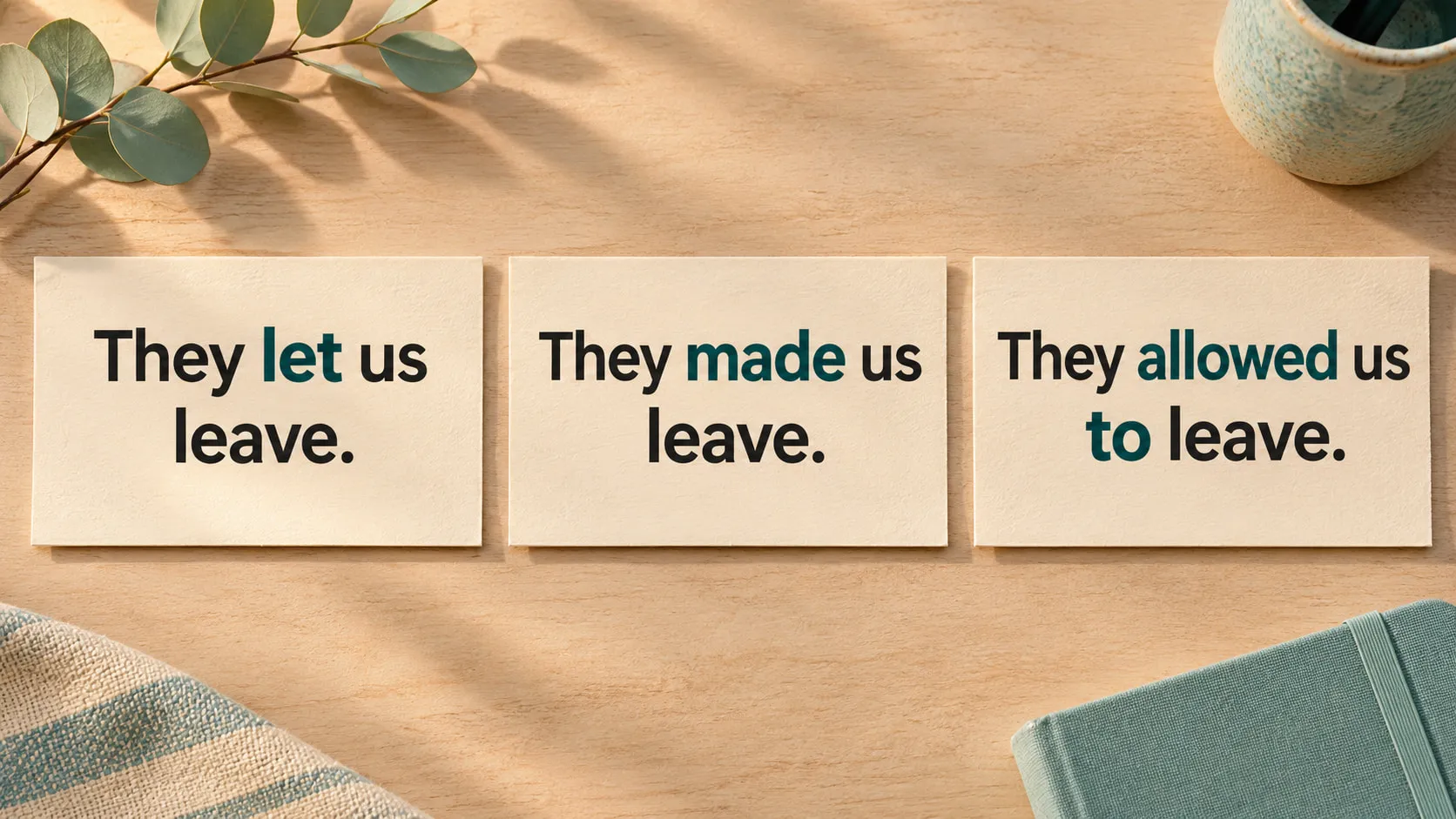
If they let you leave, you had permission. If they made you leave, you had to go. Allow is closer in meaning to let, but it takes a different pattern: let you leave, allow you to leave. The same little word, to, also turns up when make is used in the passive.
Choose the meaning, then build the sentence
| What you mean | Pattern | Example |
|---|---|---|
| Give someone permission | let + object + base verb | Let me try. |
| Give permission or make something possible | allow + object + to + base verb | The ticket allows you to return the next day. |
| Cause or compel someone to do something | make + object + base verb | That song makes me smile. |
Let is natural in conversation. Allow often sounds more formal, particularly when you’re explaining a rule. Make doesn’t always imply force: a song can cause a smile without anyone being told what to do. The person after the first verb takes the object form: me, him, her, us, or them.
Compare three cards about leaving
The first side gives an English meaning clue. The second shows the target sentence with US English pronunciation. Notice that the action stays the same while the choice to leave changes.
say someone can go
They said we could go.
let
They let us leave.
IPA of the complete target sentence: /ðeɪ lɛt əs liv/
require someone to leave
They required us to go.
made
They made us leave.
IPA of the complete target sentence: /ðeɪ meɪd əs liv/
give permission
They gave us permission to go.
allowed
They allowed us to leave.
IPA of the complete target sentence: /ðeɪ əˈlaʊd əs tə liv/
Learn this way in Lingo Phrase cards with example sentences, IPA and target-language audio you can listen to. Explore more content in the app.
Explore card sets in LingoIn the passive: allowed to or made to?
Use We were allowed to leave when the focus is on the people receiving permission. We were let to leave isn’t the usual way to express that meaning.
When you turn The guard made him wait into a passive sentence, add to: He was made to wait. The person who waited becomes the subject. See the guide to the passive voice for more examples of this change in focus.
Six practice questions
Fill in the blanks or rewrite the sentence as instructed.
- Please ___ me finish. (An everyday request for permission.)
- The rules ___ visitors to bring water. (Give permission.)
- That photo ___ her laugh yesterday. (Caused her to laugh.)
- They let us to sit by the window. (Correct the verb pattern.)
- The coach made them run another lap. (Start with They were …)
- We weren’t ___ to take photos. (Photography was prohibited.)
Answers
- let — An everyday request; finish comes without to.
- allow — The pattern is allow visitors to bring.
- made — The photo caused the reaction, and the event took place yesterday.
- They let us sit by the window. — Use the base verb after let us.
- They were made to run another lap. — In this passive pattern, made takes to run.
- allowed — Weren’t allowed to means they didn’t have permission.
To keep practicing, pick one everyday action. Say it first as something you were free to do, then as something a person or situation caused you to do. Say the whole phrase, including the object and the infinitive.