English passive voice: forms, focus and practice
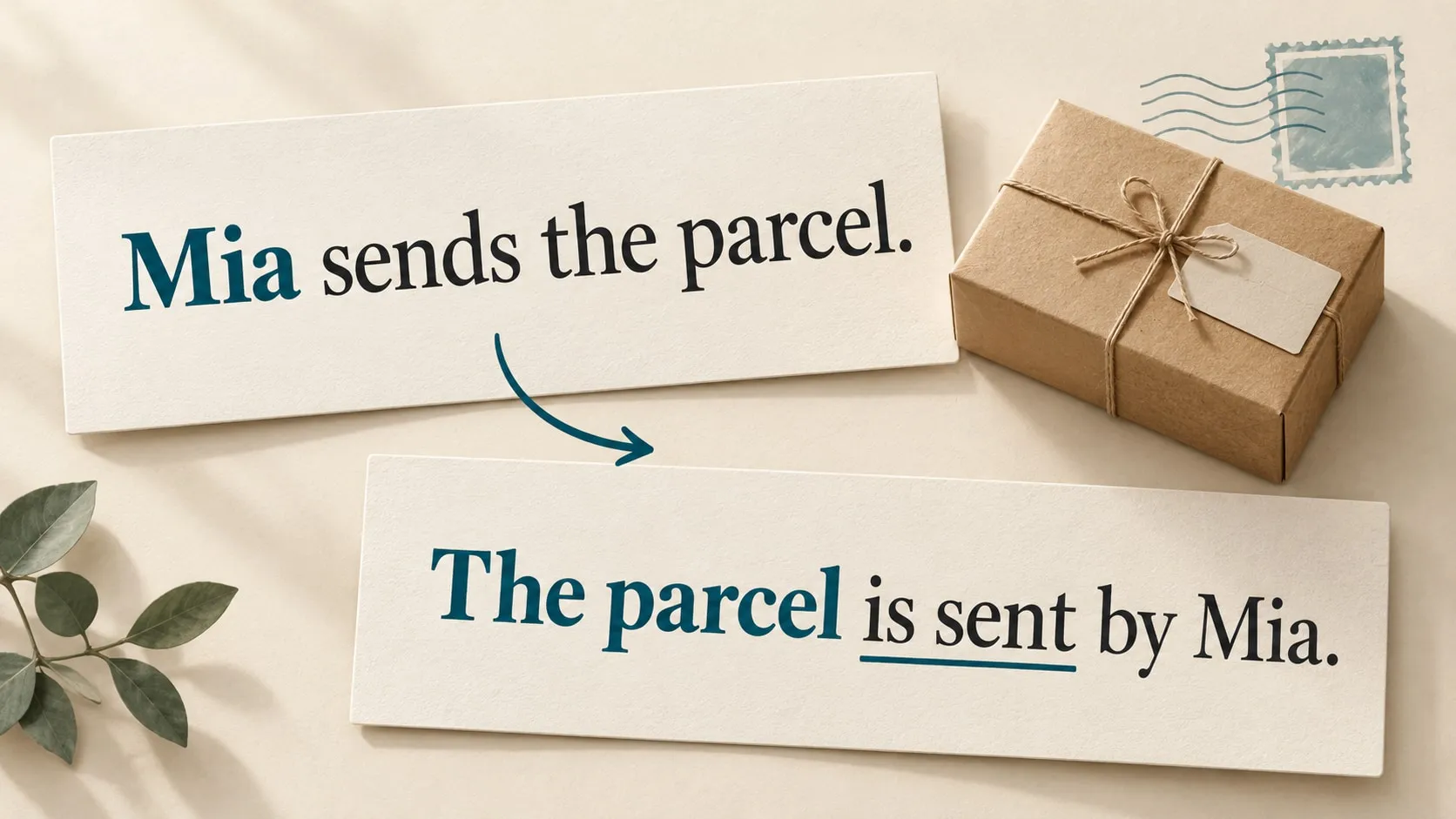
“Mia sends the parcel” and “The parcel is sent by Mia” describe the same event. The difference is where you direct the reader’s attention: to Mia or to the parcel. That change of focus is the point of the passive voice. Its basic pattern is be + past participle.
Active or passive: choose your focus
| Voice | Example | Starting point |
|---|---|---|
| Active | Mia sends the parcel. | the person doing the action |
| Passive | The parcel is sent by Mia. | the thing the action affects |
In the active sentence, Mia is the subject and the parcel is the object. In the passive, the parcel becomes the subject. You can mention the person with by Mia, or leave the person out when that information is unnecessary: The parcel is sent every Monday.
Passive voice is not a tense. You can use it for present, past or future situations. Choose it when the action or the affected person or thing matters more than who performs the action.
How to build a passive sentence
For a straightforward sentence with a direct object, use four steps:
- Find the object: The team repairs the bridge. What does the team repair? The bridge.
- Make it the subject: The bridge …
- Choose the correct form of be: present simple, singular → is.
- Add the past participle: The bridge is repaired by the team.
The past participle is often called the third verb form. Regular verbs usually end in -ed: repair → repaired. Learn irregular forms separately: send → sent, write → written, take → taken. A past-simple form is not always a past participle: the passive is was written, not was wrote.
Do not add will simply because the sentence is passive. The parcel is sent every Monday describes a routine; The parcel will be sent tomorrow refers to the future.
Keep the original tense
Changing from active to passive changes the focus, not the time reference. The auxiliary verb group carries tense and aspect; the main verb’s participle stays the same.
| Form | Passive pattern | Example |
|---|---|---|
| Present simple | am/is/are + participle | The rooms are cleaned every day. |
| Past simple | was/were + participle | The rooms were cleaned yesterday. |
| Present perfect | have/has been + participle | The rooms have been cleaned. |
| Present continuous | am/is/are being + participle | The rooms are being cleaned now. |
| Future with will | will be + participle | The rooms will be cleaned tomorrow. |
| Modal verb | can/must … + be + participle | The rooms must be cleaned. |
Compare The team repaired the bridge with The bridge was repaired by the team. Writing is repaired instead would change the tense.
Is being cleaned describes an action in progress. Has been cleaned says the cleaning has already taken place. Practise the whole verb group, rather than remembering cleaned on its own.
When should you include by?
Include the agent—the person or thing doing the action—when it adds useful information:
- The mural was painted by my sister. — Her identity is the interesting point.
- My bike was stolen last night. — You do not know who stole it; by someone adds little.
- The tickets are checked at the entrance. — The procedure matters more than the individual staff members.
You do not have to carry every active subject into a by-phrase. Equally, do not remove information the reader needs. If the discussion is about who painted the mural, keep by my sister.
Questions and negatives
For a question, put the first auxiliary before the subject:
- Is the parcel sent every Monday?
- Were the tickets checked?
- Has the bridge been repaired?
For a negative, put not after the first auxiliary: The parcel is not sent on Sundays. You can use a contraction: The tickets weren’t checked. These passive sentences do not need an extra do/does/did: Was the parcel sent?, not Did the parcel be sent?
Three common mistakes
- Missing be: The letter was written yesterday, not The letter written yesterday as a complete sentence.
- Wrong agreement: The letters are sent, but The letter is sent.
- Trying to make every verb passive: The train arrived late has no object to become a passive subject. The train was arrived late is incorrect.
Not every combination of be and a participle-like word clearly describes an action. The door is closed can describe the door’s state. Start with clear action sentences and time expressions, such as The door was closed at six.
Practice: transform and complete
Keep the tense given in each task. These are original practice examples for this article.
- Present simple: The staff check the tickets. → The tickets ___ by the staff.
- Past simple: Someone stole my bike last night. → My bike ___ last night.
- Present perfect: The team has repaired the bridge. → The bridge ___ by the team.
- With will: They will send the documents tomorrow. → The documents ___ tomorrow.
- Make a past-simple question: the parcel / send / yesterday?
- Choose the correct sentence: The train arrived late or The train was arrived late?
Answers and explanations
- are checked — plural subject, present simple; participle checked.
- was stolen — singular subject, past simple; participle stolen. The unknown agent can be omitted.
- has been repaired — keep the present perfect; the new subject the bridge is singular.
- will be sent — will + be + participle, not will sent.
- Was the parcel sent yesterday? — auxiliary was before the subject; participle sent.
- The train arrived late. — arrive has no object here and cannot form this kind of passive.
Continue with complete phrases
On paper, write three active sentences about daily tasks: someone checking tickets, sending a message or repairing a bike. Make them passive. Underline the entire verb group and ask: Have I kept the time reference? Does the agent matter? Cover your answer and say the sentence again aloud.
For your wider language routine, Lingo Phrase Cards provides vocabulary in phrases with IPA and audio on the target-language side. Choose an offered language direction and an available set. Attempt an answer before turning the card over, then rate it in regular learning mode; that rating updates its Leitner box and next review date.
To review tense choices, see past simple or present perfect. For a regular card routine, read the Leitner and spaced-repetition guide.
Sources and further reading
Explore the available language directions and sets in Lingo Phrase Cards.