Lingo Phrase Cards vs. Babbel: phrase practice or a language course?
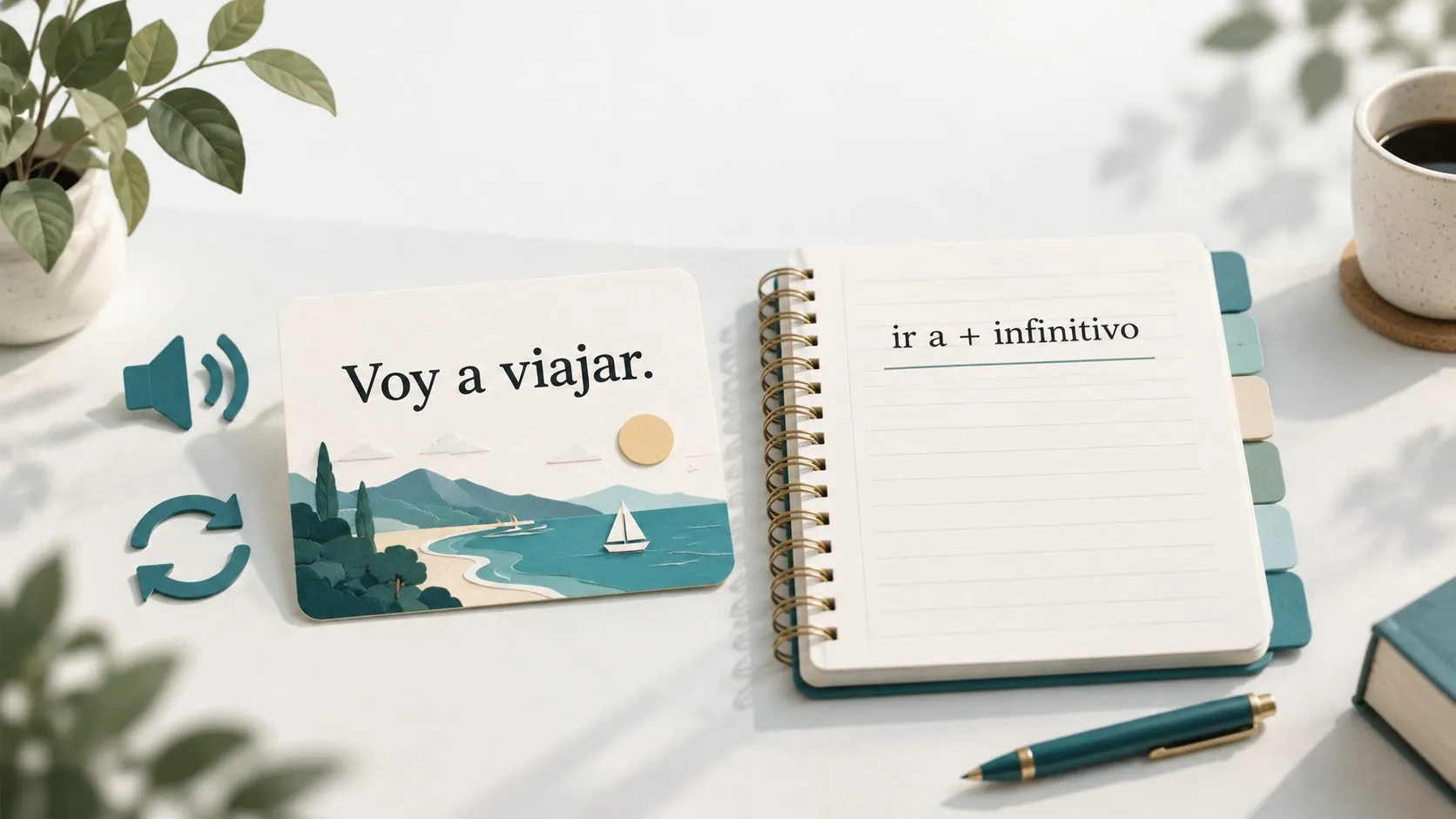
You want useful phrases you can listen to, pronounce, recall, and review. Perhaps selecting pictures, typing frequently, or waiting for microphone feedback interrupts your concentration. In a Lingo Phrase Cards vs. Babbel comparison, the study workflow deserves as much attention as the feature list.
Both offer prepared content and scheduled reviews. Lingo focuses on phrase flashcards with consistent IPA notation and audio across six shared categories. Babbel offers a structured language course with varied exercises and additional vocabulary review. The choice depends on how you prefer to work each day.
Lingo Phrase Cards is a DokuBasis product, and this comparison appears on the DokuBasis website. It draws on documented features and official Babbel sources, rather than a head-to-head hands-on test. Research date: October 7, 2026.
The main differences at a glance
| Criterion | Lingo Phrase Cards | Babbel |
|---|---|---|
| Prepared content | Six categories per offered language pair, each with four 100-card phrase sets | Expert-developed courses with thematic units, lessons, and reviews |
| Study workflow | Attempt an answer, flip the card, rate it yourself; use audio and IPA | Listening, speaking, writing, grammar, and dialogue exercises; a separate flashcard review mode |
| Pronunciation | Target-language phrases consistently include IPA and Amazon Polly Neural audio; built-in sound chart | Course recordings by native speakers, according to Babbel; speech-recognition feedback in speaking exercises |
| Reviews | Five-box Leitner system with adjustable intervals and daily new-card limit | Automatic spaced-repetition scheduling for vocabulary from completed lessons |
| Custom material | The workflow described here uses supplied sets | Custom collections of learned course vocabulary, without freely adding your own review words |
| Grammar and AI | Look up available topics and take a tutor prompt to your own AI app | Course grammar and a separate guide for selected languages; integrated conversation scenarios in Babbel Speak |
Ready-made content: two structured approaches
In Lingo, choose an offered language pair, preview a set, and study with an unlocked set. Preparation covers phrase context, level guidance, and pronunciation support together.
All offered pairs use six categories:
| Category | Level guidance |
|---|---|
| Building on the basics | A1–A2 |
| Everyday life and social situations | A2–B1 |
| Travel | A1–B1 |
| Work and study | B1–B2 |
| Natural speech and idioms | B1–C1 |
| Advanced communication | B2–C1 |
Each category has four sets of 100 cards: 24 categorized sets and 2,400 cards per language pair. This is a defined content framework in which you choose relevant topics. Levels guide selection, rather than guaranteeing C1 proficiency from flashcards alone. A 100-card set is a package for several sessions, not a daily target.
Babbel also handles content preparation. Its official course description describes expert-designed thematic units and lessons lasting roughly 10–15 minutes. Everyday life, travel, and work are among the topics. You can switch courses and lessons.
The comparison is between prepared learning concepts: phrase sets and their reviews in Lingo, lessons with different tasks in Babbel. Neither requires you to start by assembling your own learning material.
When you prefer recall to frequent typing
Lingo’s regular workflow is straightforward: think of an answer, flip the card, then decide whether you knew it. Answer mentally or aloud; you do not need to type it or submit it for microphone assessment. Listen to the audio and consult IPA when checking the phrase.
That steady rhythm may suit you if picture-selection or changing input tasks break your focus. Honest self-assessment matters: recognizing an answer after seeing it is different from producing it yourself.
Babbel’s varied exercises serve different purposes. Writing can help you work on spelling; listening and speaking tasks provide other kinds of practice. If you enjoy that variety, it is a reason to consider Babbel.
However, Babbel vocabulary review does not always require typing. Its review documentation includes flashcards that you recall and turn over. Compare the lesson workflow and the additional review mode separately.
Audio and IPA without speech-recognition grading
Lingo’s target-language phrases consistently include IPA and audio across all six categories and offered language pairs. IPA, the International Phonetic Alphabet, represents speech sounds in writing. A built-in sound chart is also available during sessions.
The supplied recordings are generated with Amazon Polly Neural: natural-sounding neural speech synthesis, not human recordings. AWS explains the improvement over its standard voices; this does not establish an audio-quality advantage over Babbel.
The practical value is the combination: a phrase provides context, audio gives you a pronunciation model, and IPA lets you examine the sounds. These are concrete card-quality features alongside a shared structure and level guidance, rather than simply a large card count.
Babbel describes its prepared course content as recorded by native speakers. Speech recognition adds a different function: speak into the microphone and receive feedback. Recording quality and recognition accuracy are separate questions.
If unrecognized answers frustrate you, Lingo’s workflow without automatic pronunciation grading may feel more comfortable. Babbel identifies factors such as noise, microphone quality, and departures from the target phrase, and lets you disable recognition. Lingo does not automatically assess your pronunciation: you listen, read, and compare for yourself.
Reviews, progress, and milestones
Lingo uses five Leitner boxes in regular study. Correct answers move cards upward to box 5; new cards and incorrect answers go into box 1. Default intervals are 1, 3, 7, 14, and 30 days, and you can adjust them. Due cards come before new cards, with an adjustable daily new-card limit.
Pool, box, and error-card practice let you revisit material freely. These views do not update card progress like rated reviews. Statistics and milestones display recorded study progress, rather than certify a language level.
Babbel adds words and phrases to review after you complete lessons. Its documentation describes increasing intervals of one, four, seven, fourteen, and sixty days, then six months, with continued correct answers. Review offers flashcards, writing, speaking, and listening. Course progress, statistics, and a streak are also part of the offering.
Both organize reviews. Lingo centers on directly selected phrase sets and understandable boxes; Babbel builds your review vocabulary from lessons.
Custom cards: collecting is different from creating
Babbel’s custom collections let you gather vocabulary you have already learned. The official documentation explicitly says you cannot freely enter your own words or phrases into review or a collection.
The Lingo workflow described here also starts with prepared sets. If you need your exact textbook vocabulary or specialist work terms, a custom-card editor is a separate requirement. The Anki comparison explores that different tool concept.
Prepared content is useful when it fits your goals, but it does not automatically replace an editor for your personal material.
Look up grammar and continue in your own AI app
Lingo lets you open available grammar topics from an overview, read explanations, and mark topics as read. This section is available for language directions with supplied grammar material. One documented example is the near future with ir a + infinitive in German → Spanish (Spain).
That reference workflow suits a specific question: pick a topic, reread its explanation, and return to the examples without first completing a whole lesson session.
Lingo prepares a tutor prompt for the topic. Share it through a suitable device feature or copy it into your own AI app. For example, add:
Give me three short everyday situations about this topic. Let me answer each one first, then explain the appropriate form. Follow up with a question about my mistake.
This is a suggested exercise, not an automatically guaranteed response. Lingo can also prepare a set-related prompt for error cards. You choose the AI app you prefer and explore your particular question. The external provider determines its models, features, and costs; the conversation happens outside Lingo.
Babbel also provides a grammar reference section. Its English-language Grammar Guide page lists A1/A2 material for German, European and Mexican Spanish, and French. Find it under Practice in the app or Explore on the website. This is separate from grammar within the courses themselves.
Babbel Speak adds AI-supported conversations in everyday scenarios. The German documentation describes a mobile/tablet beta for selected learning languages, rather than desktop access; availability can vary with your language combination.
The distinction is topic lookup plus an open prompt for your own AI app in Lingo versus Babbel’s grammar resources and integrated conversation scenarios. Usefulness depends on your question, not an unverified ranking of AI models.
Daily use: access, devices, and short sessions
Lingo is an installable browser-based web app. Progress is stored locally; manual JSON backups save settings and progress. Some categorized sets require a license, while previews remain accessible. Automatic device synchronization and fully preloaded offline content are not part of this workflow.
Babbel offers a website and iOS/Android apps. Progress synchronizes across devices using the same account. You can download lessons in the mobile app for offline use. These are practical advantages when switching devices or traveling without a reliable connection. Check the relevant subscription and features for your language combination.
Try the workflow with your own goal
Allow about ten minutes per offering:
- Preview relevant material beyond the basics, such as everyday or work topics.
- Listen to several phrases and try Lingo’s IPA chart. Separate the recording’s sound from microphone feedback.
- Attempt answers before seeing solutions. Try a Babbel lesson and its flashcard review mode.
- Look up a grammar question and try sharing Lingo’s tutor prompt.
- Decide whether you prefer steady card recall or changing exercises, and how much you need synchronization and downloaded lessons.
Which approach fits you?
Lingo Phrase Cards is especially suitable for directly recalling prepared phrases: six shared categories, manageable 100-card sets, consistent IPA and neural audio, Leitner reviews, and available grammar topics you can develop further in your own AI app. Card answers require neither typing nor automatic microphone grading.
Babbel is especially suitable for a guided language course with varied exercises, plus vocabulary review, native-speaker course recordings, device sync, and downloadable lessons. Its flashcard mode and optional speech recognition deserve a place in a fair decision too.
If a focused phrase and pronunciation trainer appeals to you, explore available language pairs and set previews through the Lingo page. Choose the workflow you want to return to regularly.