Learn English vocabulary: Turn single words into everyday sentences
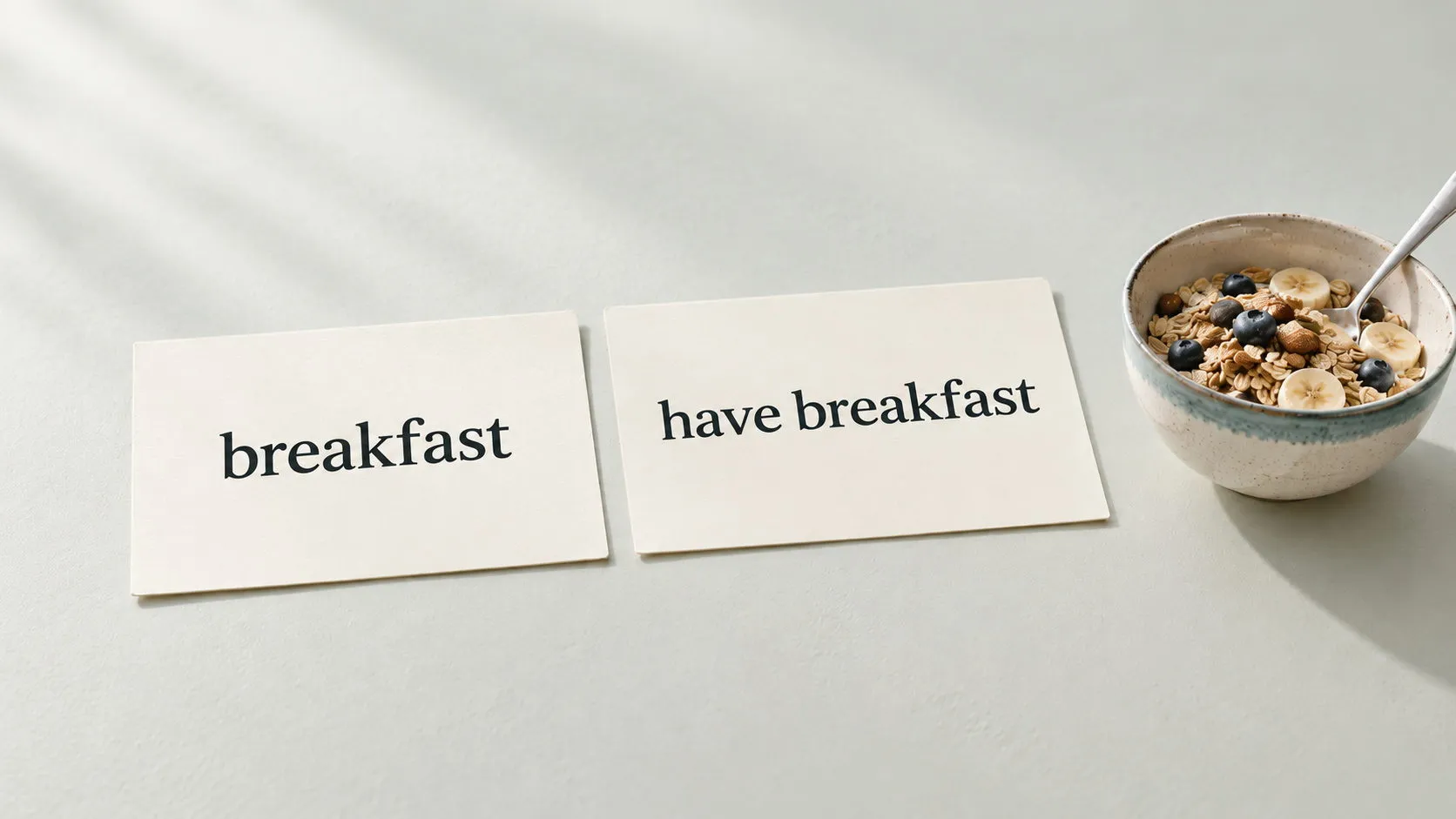
You know breakfast, bus, and home, but you still pause when you try to describe your day. Often, the missing piece is a word combination: have breakfast, catch the bus, or get home. Those combinations let you say what you actually do.
If you are learning English as an additional language, start with one small task: describe your usual day in three sentences of your own. This guide gives you six useful expressions, explains how they work, and helps you practice recalling them without looking at the answer.
Choose a situation, not an endless word list
Think about what you want to tell someone. What time do you get up? How do you travel to work or class? What happens later? These questions give your vocabulary a purpose. You do not need every word connected with daily life before you can start speaking.
For this practice activity, use six combinations:
| English expression | Meaning in this situation | Example sentence |
|---|---|---|
| get up | leave your bed and start your day | I get up at seven. |
| have breakfast | eat your first meal of the morning | I have breakfast at home. |
| catch the bus | travel on the bus or reach it in time | I catch the bus at eight. |
| have lunch | eat your midday meal | I have lunch at twelve. |
| have a break | stop an activity for a short rest | I have a break in the afternoon. |
| get home | arrive where you live | I get home at six. |
The times are examples. Replace them with details from your own day. These six expressions are a manageable practice set, not a complete list of basic English vocabulary.
Keep the useful words together
Get up: Do not lose the second word
In I get up at seven, get up means leaving your bed. If you learn only get, you lose the part that identifies the action. Include up when you practice. Cambridge Dictionary lists this meaning of the expression.
Now compare get home. Here, get works with home to mean “arrive home.” I go home at six means that you leave for home at six; I get home at six gives your arrival time. These may be different times. In these expressions, use home without to: get home, go home.
Have breakfast: Have is not only about owning things
You can use have for meals: have breakfast and have lunch. In I have breakfast, you are describing eating, not owning a breakfast. Eat breakfast is also possible; this activity deliberately practices a group of expressions with have.
Notice the small word in have a break. Keep the whole combination: have breakfast, but have a break. The Cambridge guide to have explains its use for meals and activities.
Catch the bus: Context gives you the meaning
Catch can describe taking hold of something, but it also appears with transport. In I catch the bus at eight, you mean taking the bus or reaching it in time. You are not physically catching a bus with your hands.
For a first practice set, focus on this meaning. You can explore other meanings later. To extend the same transport pattern, try catch the train.
Build three sentences, then change one detail
Start with a short routine:
I get up at seven. I have breakfast at home. I catch the bus at eight.
These are regular actions, so we use the simple present. Now make the routine your own:
- Change the time: I get up at six.
- Change the transport: I catch the train at eight.
- Change the meal: I have lunch at home.
Change one part at a time. This helps you see which pattern stays the same and which information changes. Then add a fourth sentence: I get home at six.
When you talk about another person, the verb forms change:
She gets up at seven. She has breakfast at home. She catches the bus at eight.
Notice gets, has, and catches. The Cambridge simple-present guide explains these forms. You are still talking about the same actions; you adapt the sentence to its subject.
Connect spelling, sound, and meaning
The spelling of breakfast may tempt you to pronounce it as two separate words. Cambridge gives /ˈbrek.fəst/. The dot marks the syllable boundary, and the stress mark comes before the first syllable. Listen to the dictionary pronunciation, then say the whole expression have breakfast.
Try this sequence:
- Read the expression and check its meaning.
- Listen carefully to the pronunciation.
- Repeat it aloud.
- Hide the model and use it in a sentence of your own.
Repeating a recording and recalling a sentence are different tasks. If you can say it only while reading, give yourself another attempt with the answer hidden.
Review with a real question
Instead of rereading the table, give yourself a specific prompt: “Say that you leave your bed at seven.” Produce I get up at seven before checking the model. Look at the whole expression, including up and the time, rather than accepting get alone.
The Learning Scientists recommend recalling information without the material in front of you, then checking your answer for feedback. Spread later attempts across separate study sessions, and bring older expressions back into practice. The goal is to build the sentence again later, not simply finish a longer list today.
Practice: Describe your day without the model
Cover the table. Write your answers before reading the explanations.
- Say that you leave your bed at seven.
- Complete: I ___ breakfast at home.
- Say that you take the bus at eight. Use catch.
- Change I have breakfast at home to talk about she.
- You arrive home at six. Correct: I get to home at six.
Answers and explanations:
- I get up at seven. Keep up as part of the expression.
- I have breakfast at home. Have breakfast means eating breakfast. Eat would also work in English; here you are practicing the expression with have.
- I catch the bus at eight. Catch has a transport meaning in this context.
- She has breakfast at home. The form with she is has.
- I get home at six. Do not add to in this use of home.
Finish by answering What time do you get up? aloud with your own time. To build more questions, see the guide to do, does, and did.
Add Lingo to your vocabulary routine
Lingo Phrase Cards offers learning directions into English from German, French, Latin American Spanish, and Brazilian Portuguese. Choose an available direction that matches a language you know; reading this website in English does not mean you need an English-to-English course.
The prepared content presents words in phrases. Target-language phrases include IPA and audio generated with Amazon Polly Neural. Categories cover areas such as foundations and everyday social situations, helping you choose material without first assembling topics and pronunciation support from different collections.
Open a set preview, then choose an unlocked set. In regular learning, answer before turning the card and indicate whether you knew the answer afterward. Due cards are considered before new ones. Pool, box, and mistake-card practice provide extra ways to go through material; those free-practice views do not change card progress. Some categorized sets require a license.
After reviewing, describe three actions from your own day. Your next useful step may be using a familiar word in the right combination, rather than adding another isolated word.
Explore the available language directions and sets in Lingo Phrase Cards.