Por vs. para in Brazilian Portuguese: understand the difference with everyday examples
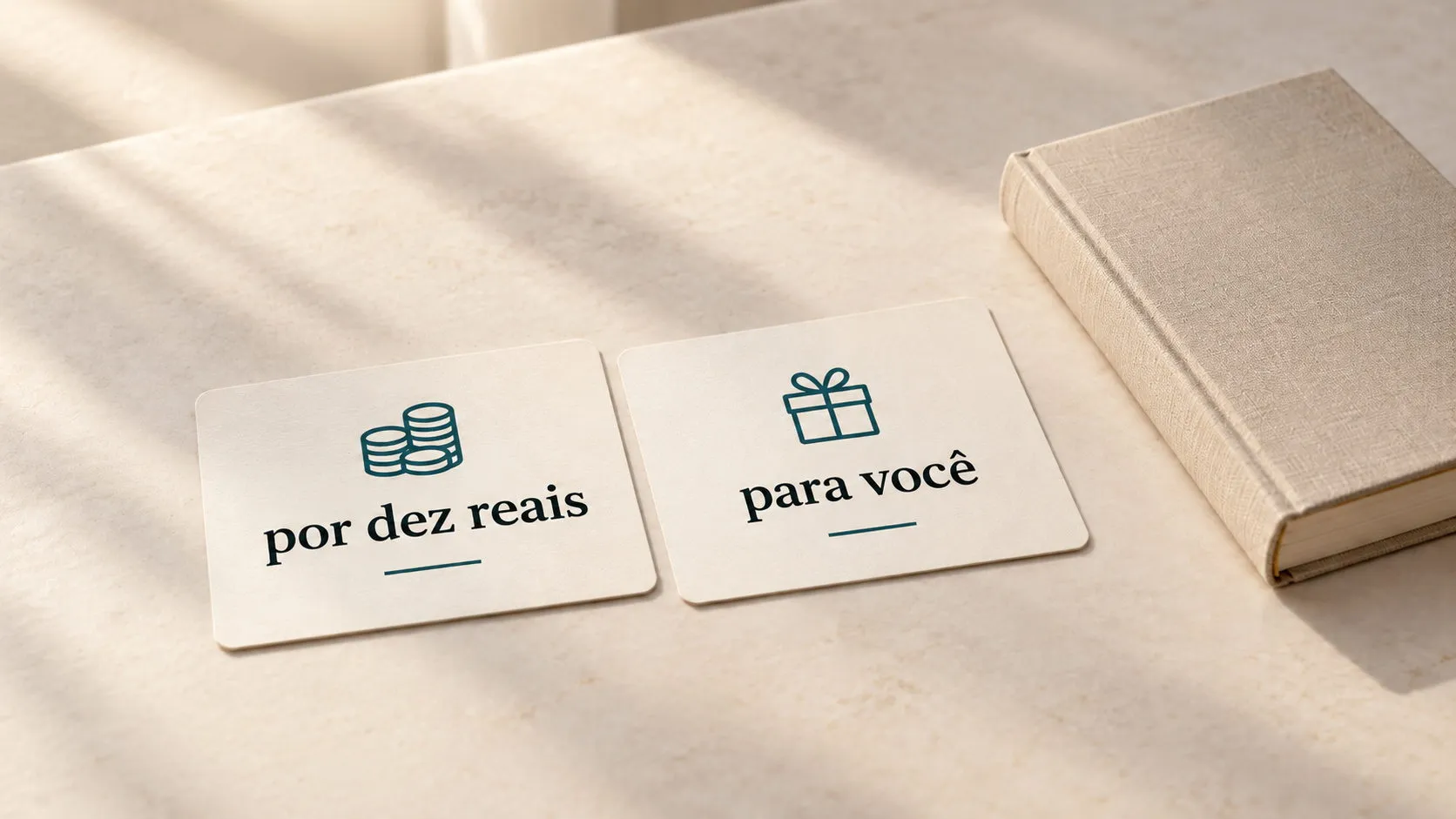
You buy a book por dez reais and set it aside para você: bought for ten reais, intended for you. English uses “for” in both phrases. Portuguese makes two different connections: por links the purchase to its price; para identifies the recipient.
When choosing between por and para in Brazilian Portuguese, start with your message rather than a word-for-word translation. What relationship does this part of the sentence express? The examples below separate the main meanings, then give you a chance to practice them.
A quick guide to the relationship you mean
Para often points to a purpose, destination or recipient. Por can express a reason, route, price or duration, among other meanings. The Brazilian language school Rio & Learn explains these basic uses.
| What you mean | Form | Example and meaning |
|---|---|---|
| The purpose of an action | para | Estudo para aprender. — I study in order to learn. |
| Who something is intended for | para | O livro é para você. — The book is for you. |
| Where you are going | para | Vou para a escola. — I’m going to school. |
| The reason for an action | por | Faço isso por medo. — I do this out of fear. |
| The price paid | por | Comprei o livro por dez reais. — I bought the book for ten reais. |
| The route you take | por, here pelo | Passo pelo parque. — I go through the park. |
| How long something lasts | por | Vou ficar por duas semanas. — I’m going to stay for two weeks. |
This is a starting point, not a list of every expression. In particular, pelo is not a third competing preposition: it already contains por.
Reason and purpose: what motivates you, and what do you want to achieve?
Compare two sentences about the same activity:
- Estudo português por interesse. — I study Portuguese out of interest. Interest is my motivation.
- Estudo português para conversar com meus colegas. — I study Portuguese in order to talk with my colleagues. Talking with them is my goal.
Both can be true. Por presents the motivation here; para presents the intended result. “Why?” can ask about either, so separate “What makes me do it?” from “What am I trying to achieve?”.
Para + infinitive is a useful purpose pattern: Leio para aprender — I read in order to learn. An infinitive is the basic verb form, here aprender. Learn the whole pattern with its meaning rather than deciding from the next word alone.
Price and recipient: one book, two connections
Imagine bringing someone a book:
Comprei o livro por dez reais. O livro é para você.
The first sentence answers the price question: ten reais. The second says who will receive the book. The noun livro stays the same, but the relationship changes.
A person after the preposition is not automatically a recipient. Faço isso por você can mean doing something for someone’s sake or in their place; context decides. O livro é para você clearly identifies the book’s intended recipient. Practice Portuguese’s explanation also distinguishes these relationships.
Route and destination: pelo parque, para a escola
You can go through the park on your way to school:
- Passo pelo parque. — I go through the park. The park is part of the route.
- Vou para a escola. — I’m going to school. The school is the destination.
In pelo parque, por combines with the definite article o. Portuguese contracts these words. The Brazilian school Caminhos shows the four forms:
| Original words | Contracted form |
|---|---|
| por + o | pelo |
| por + a | pela |
| por + os | pelos |
| por + as | pelas |
This also explains pela cidade — through the city — and Obrigado pela ajuda — Thank you for the help, said by a male speaker. A female speaker says Obrigada pela ajuda. Pela stays the same: it agrees with a ajuda, not the person saying thanks.
Duration or a scheduled time?
Time expressions also depend on meaning:
- Vou ficar por duas semanas. — I’m going to stay for two weeks. Por expresses duration.
- O relatório é para amanhã. — The report is intended or needed for tomorrow. Para identifies the scheduled time.
The first sentence refers to the future but still uses por. A memory aid such as “por looks back, para looks ahead” can illustrate reason versus purpose; it is not a rule for past and future tenses. Ask whether you mean a length of time or a scheduled point. A future verb form or the word amanhã does not settle the choice by itself.
Recognize pra and pro without losing the full forms
Informal Brazilian Portuguese often uses pra and pro. Vou para a escola becomes Vou pra escola in everyday speech; para o museu can become pro museu. Caminhos describes these common shortened forms.
For your first written practice sentences, spell out para, para a and para o so that you can see the structure. When listening, recognize that pra and pro do not change the destination in these examples. Do not confuse pro with pelo: pro museu names the destination; pelo museu can describe a route through the museum.
Learn some expressions as complete units:
- por favor — please;
- por exemplo — for example;
- para sempre — forever.
One memory trick cannot explain every fixed expression.
Quick practice: choose the form and explain it
Fill in por, para, pelo or pela. The hints specify the intended meaning:
- Comprei o caderno ___ quinze reais. — State the purchase price.
- Este caderno é ___ você. — Name the recipient.
- Estudo português ___ falar com meus vizinhos. — State the purpose.
- Passo ___ parque antes de chegar à escola. — Your route goes through the park; o parque has a definite article.
- Vou ficar aqui ___ três dias. — State the duration.
- Obrigada ___ ajuda. — A woman thanks someone for the help; the noun phrase is a ajuda.
Answers with explanations:
- por: Connect the price to the purchase.
- para: The notebook is intended for the person addressed.
- para: Talking to the neighbors is the intended result.
- pelo: A route through the park requires por + o here.
- por: Three days is a duration, even if the stay has not started yet.
- pela: Thanks for a ajuda, so por + a. Obrigada identifies the speaker as female.
Next, write your own price sentence and recipient sentence. Keep the same object so that you have to express the difference in relationship.
Practice whole phrases and continue with Lingo
When reviewing, cover the whole Portuguese sentence, not just the preposition. Leave a situation visible: “The notebook costs fifteen reais” or “The notebook is for you.” Say your answer, compare it and briefly explain the choice. You are practicing a message rather than an isolated translation.
In Lingo Phrase Cards, you can choose an available direction such as German → Brazilian Portuguese and preview prepared sets. Words appear in phrases; target-language phrases include IPA pronunciation notation and audio generated with Amazon Polly Neural. The audio is a synthetic listening model. Some categorized sets require a license.
With an unlocked set in regular study mode, answer before flipping the card, compare the solution and then mark whether you knew it. The Leitner system uses that assessment for later reviews. Paper and a covered answer work for the practice sentences in this article too.
Start with a situation you want to express: price, recipient, route or destination? The Lingo page is your starting point for exploring available language directions and sets.