Savoir or connaître? Two ways to say “know” in French
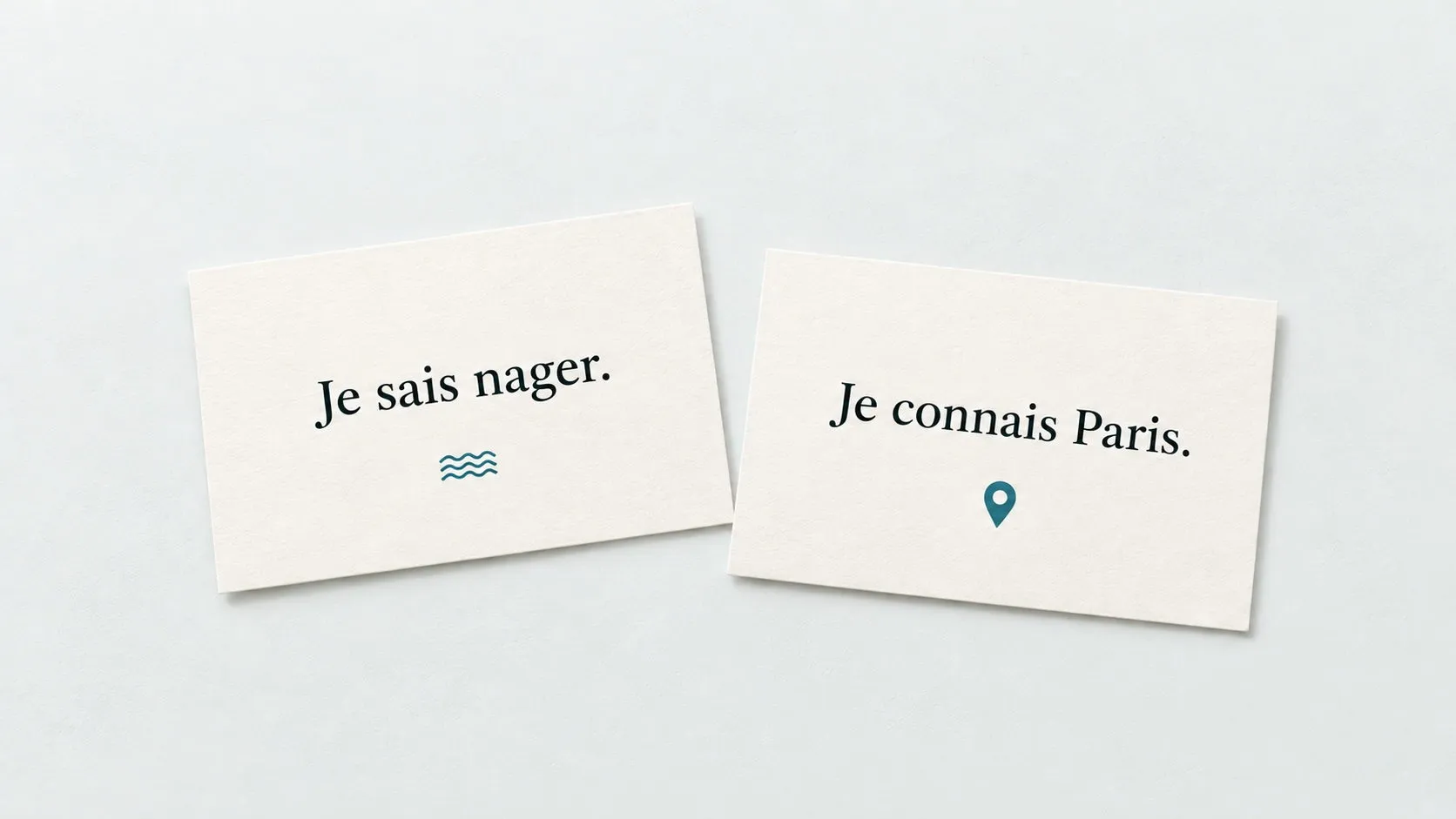
You know Paris, know where the station is, and know how to swim. English uses know in all three cases. French divides the work: Je connais Paris, Je sais où est la gare, and Je sais nager. Choosing between savoir and connaître means looking at both the meaning and the words that follow.
Start with one question: Are you stating a fact, describing a learned skill, or expressing familiarity with someone or something? The examples below help you decide, and a short practice section lets you try the patterns yourself.
A quick guide to the choice
| What you mean | Usual pattern | Example |
|---|---|---|
| You know that something is true. | savoir + que + clause | Je sais que Léa habite à Lyon. |
| You know where, whether, or when. | savoir + indirect question | Je sais où est la gare. |
| You have learned how to do something. | savoir + infinitive | Je sais nager. |
| You are familiar with a person, place, or thing. | connaître + direct object | Je connais Paris. |
These are useful everyday patterns, not a complete list of meanings. The University of Texas at Austin’s French grammar makes the same basic distinction between facts and abilities on one side and familiarity with people and places on the other.
Savoir: knowing information or knowing how
Facts and indirect questions
Use savoir to say what information you have. It often introduces a clause beginning with que, où, si, quand, or comment:
- Je sais que Léa habite à Lyon. — I know that Léa lives in Lyon.
- Je sais où est la gare. — I know where the station is.
- Tu sais si le café est ouvert ? — Do you know whether the café is open?
Look at the whole expression after the verb. In où est la gare, you have a small clause with its own verb. You are not saying that you are familiar with the station; you are saying that you know where it is.
You can also answer simply Je sais: “I know.” The conversation supplies the missing information. To say that you do not know, use Je ne sais pas.
Learned skills
Before an infinitive, savoir means knowing how to do something:
- Je sais nager. — I know how to swim / I can swim.
- Elle sait cuisiner. — She knows how to cook.
- Nous savons parler français. — We know how to speak French.
Learn the short pattern savoir + activity: savoir nager, savoir cuisiner, savoir parler. You do not need to translate the English word “how” separately in these skill statements. The meaning is a learned ability, not every possible use of the English word “can.”
Connaître: being familiar with someone or something
Use connaître when you are talking about a person, place, or thing you know:
- Je connais Léa. — I know Léa.
- Nous connaissons ce quartier. — We know this neighborhood.
- Vous connaissez ce restaurant ? — Do you know this restaurant?
Here, Léa, ce quartier, and ce restaurant are direct objects. There is no preposition before the person’s name: Je connais Léa, not Je connais à Léa.
Compare two ways of talking about the same subject:
| Familiarity | Information |
|---|---|
| Je connais Léa. — I know Léa. | Je sais que Léa habite à Lyon. — I know that Léa lives in Lyon. |
| Je connais Paris. — I am familiar with Paris. | Je sais où est Paris. — I know where Paris is. |
Knowing where a city is does not mean being familiar with it. The topic alone does not determine the verb; what you say about it matters.
Why “savoir never comes before a noun” is too simple
“Verb or clause → savoir; noun → connaître” can help with early examples. It is not an absolute rule. With some pieces of information, both verbs are possible: Je sais la réponse and Je connais la réponse can both mean “I know the answer.” Lawless French also describes overlap when talking about information and things learned by heart.
Begin with clear patterns such as savoir nager, savoir où…, and connaître une personne. If you later see a noun after savoir, do not automatically treat it as a mistake.
Present-tense forms side by side
Both verbs are irregular. These forms will let you build your own short sentences:
| Subject | savoir | connaître |
|---|---|---|
| je | sais | connais |
| tu | sais | connais |
| il / elle / on | sait | connaît |
| nous | savons | connaissons |
| vous | savez | connaissez |
| ils / elles | savent | connaissent |
Practice a form with its complement rather than on its own: nous savons nager, nous connaissons Paris. That way you choose both the meaning and the right ending.
Practice: which verb fits?
Fill each gap with the correct present-tense form of savoir or connaître. First identify the pattern, then check the subject.
- Je ___ nager.
- Tu ___ Léa ?
- Nous ___ que Léa habite à Lyon.
- Ils ___ ce quartier.
- Vous ___ si le café est ouvert ?
- Elle ___ cuisiner.
Answers explained
- sais: nager is an infinitive describing a learned skill.
- connais: Léa is the person you know.
- savons: the que clause states information; nous takes savons.
- connaissent: ce quartier is a place they are familiar with; the subject is plural.
- savez: si le café est ouvert means “whether the café is open.”
- sait: cuisiner is a learned activity; elle takes sait.
Now write three sentences of your own: one skill, one familiar place, and one fact about that place. Cover them and try to produce the complete sentences again. This is a suggestion for practicing your own examples, not an extra grammar test built into the app.
Keep learning with phrases
If you study French from English or German, you can choose that language pair in Lingo Phrase Cards and open a set preview. The prepared phrases include French IPA transcriptions and audio. Choose an unlocked set, try to answer before turning the card over, and then rate your answer in the regular Leitner study mode. Some category sets require a license.
For your next practice round, ask: Do I know a fact, know how to do something, or know someone or something? Visit the Lingo product page to explore the available language pairs and sets, and try the study flow with suitable phrases.