How does a rainbow form—and why is there sometimes a second one?
How do rainbows form? Understand refraction, color order and the Sun's position, plus why a double rainbow has a fainter bow with reversed colors.
A shower moves away, sunlight breaks through, and a colored arc appears on the opposite side of the sky. A rainbow forms when sunlight is refracted as it enters water droplets, reflected inside them, and refracted again as it leaves. Different colors are bent by different amounts. Seeing the bow therefore depends on your viewpoint as well as the rain.
The most useful rule is simple: keep the Sun behind you and look toward sunlit droplets ahead. It also explains why you cannot walk to the end of a rainbow.
What happens to light inside a raindrop?
Sunlight contains a continuous spectrum of visible colors. Light changes speed as it passes from air into water. When it crosses the surface at an angle, its direction changes too: this is refraction. Because the bending depends on wavelength, the light spreads into colors, a process called dispersion.
For the ordinary primary rainbow, some of the light takes this route:
- It enters a drop and is refracted.
- It reflects once off the inside of the drop’s far surface.
- It leaves the drop and is refracted again.
Many droplets send light toward your eyes in this way. They do not all contribute the same color in your viewing direction. What matters is the geometry linking sunlight, drops, and your eye (Met Office).
Which rainbow color is on the outside?
The primary rainbow is red on the outside and violet on the inside. Orange, yellow, green, and blue blend between them. The familiar seven-color description is a memory aid: the actual spectrum has smooth transitions rather than seven sharply separated stripes.
The outer red edge is about 42 degrees from the antisolar point, while the inner violet edge is about 40 degrees away. The antisolar point is the direction exactly opposite the Sun from your viewpoint. These figures describe an angular radius around that point, not a distance to the rain or a fixed height above the horizon (German Weather Service, DWD).
Why is a rainbow curved?
Directions at the same angular distance from the antisolar point trace a circle. Where suitable sunlit drops occupy those directions, parts of that circle can become visible. From the ground, we usually see only the section above the horizon. Terrain and gaps in the rain can hide or interrupt the rest.
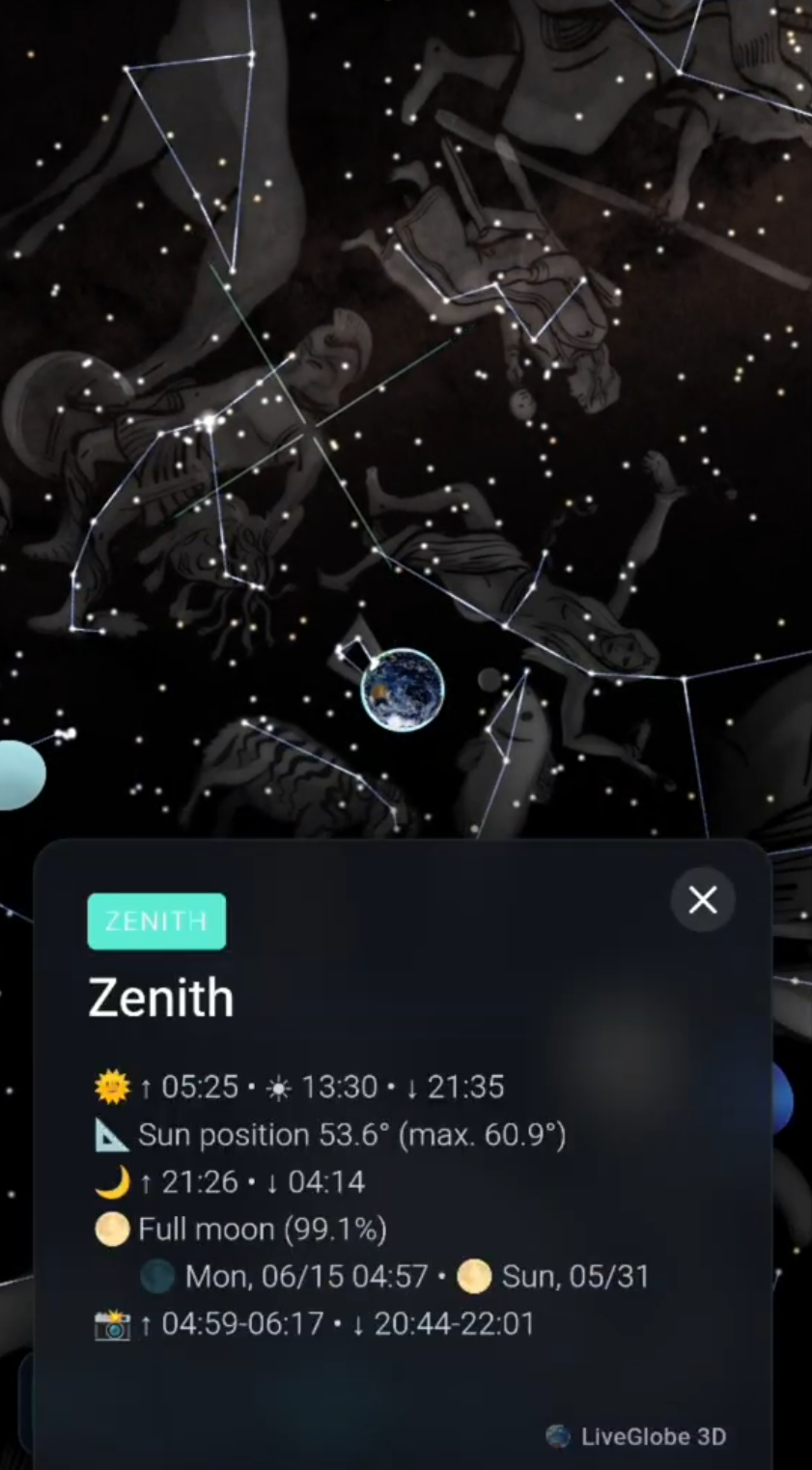
As the Sun rises higher, its opposite point moves farther below the horizon and the bow sits lower. With an unobstructed, level horizon, a useful approximation for the top of the red outer edge is:
Rainbow height ≈ 42° minus the Sun’s elevation.
A Sun 10° above the horizon gives a rainbow top around 32° high; with a Sun at 35°, only about 7° remains. This is a geometric guide, not a promise that a rainbow will appear. From an aircraft or an elevated viewpoint, suitable droplets below you can sometimes reveal a complete circle.
The circle belongs to your viewpoint. An apparent “end” resting on a field is therefore not a fixed destination. Moving toward it changes the geometry along with you.
What causes a double rainbow?
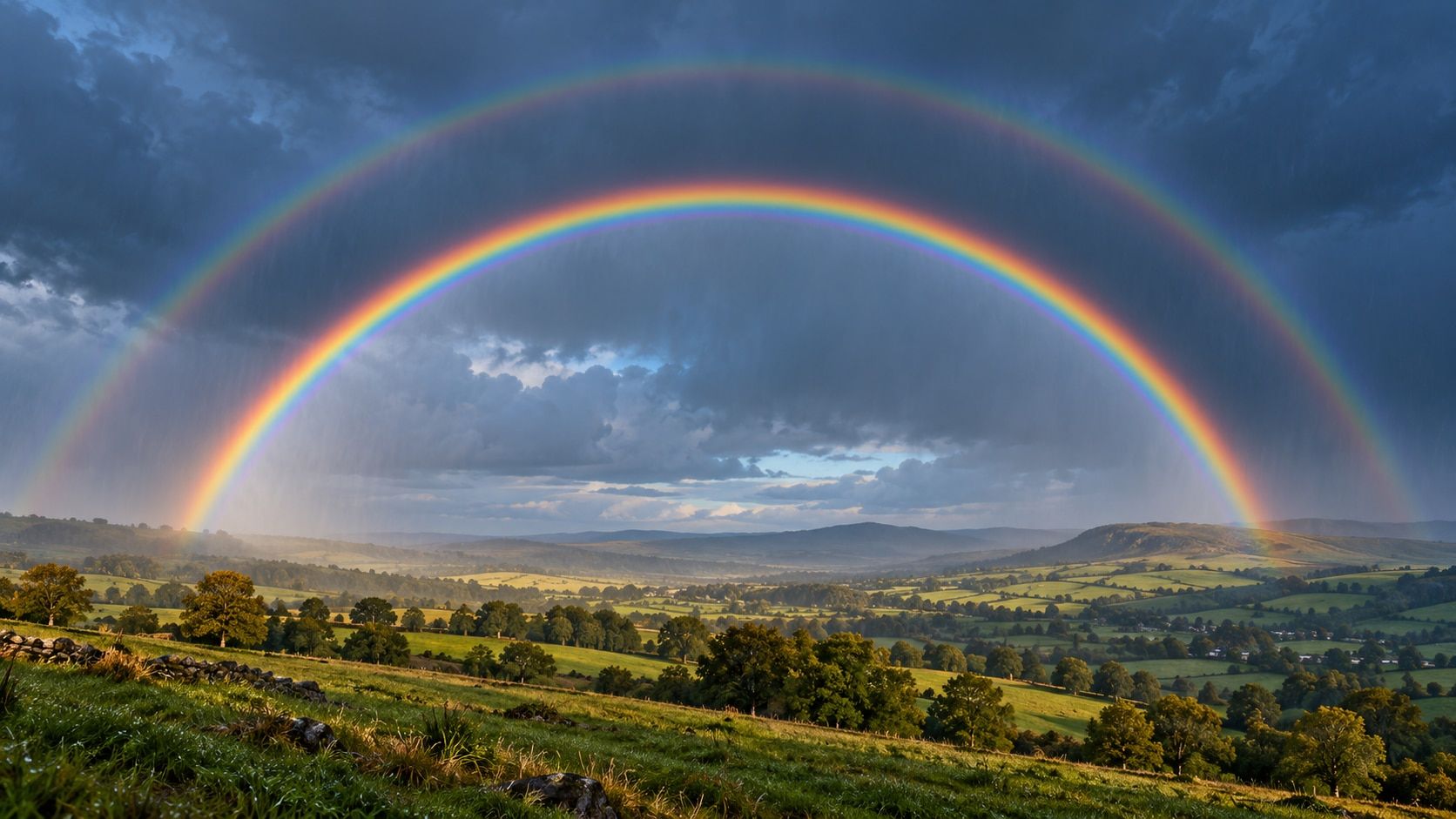
Sometimes a larger, fainter arc appears outside the bright primary bow. Light contributing to this secondary rainbow reflects twice inside a droplet. The secondary bow has a larger angular radius and reversed colors: red on its inside and violet on its outside. It is not a mirror image projected onto another cloud (Met Office).
The sky between the bows often looks darker because less rainbow light from these two ray paths reaches us there. This region is called Alexander’s dark band. It is not completely dark; the sky inside the primary bow often looks somewhat brighter by comparison.
| Feature | Primary bow | Secondary bow |
|---|---|---|
| Internal reflections | One | Two |
| Position | Smaller arc | Outside the primary |
| Color order | Red outside | Red inside |
| Appearance | Usually brighter | Usually fainter |
A simple observation routine
When sunlight illuminates a passing shower, compare three things:
- With your back to the Sun, look toward the curtain of rain. It need not be raining where you stand.
- Follow the primary bow’s red outer edge, then look beyond it for a fainter bow with reversed colors.
- Note the time, viewing direction, and height of the bow’s top. On another occasion, compare how a lower Sun allows a higher bow.
A photograph records one viewpoint. Sun and rain alone do not guarantee a visible rainbow if the drops are not in the right direction for you.
Put the location in context
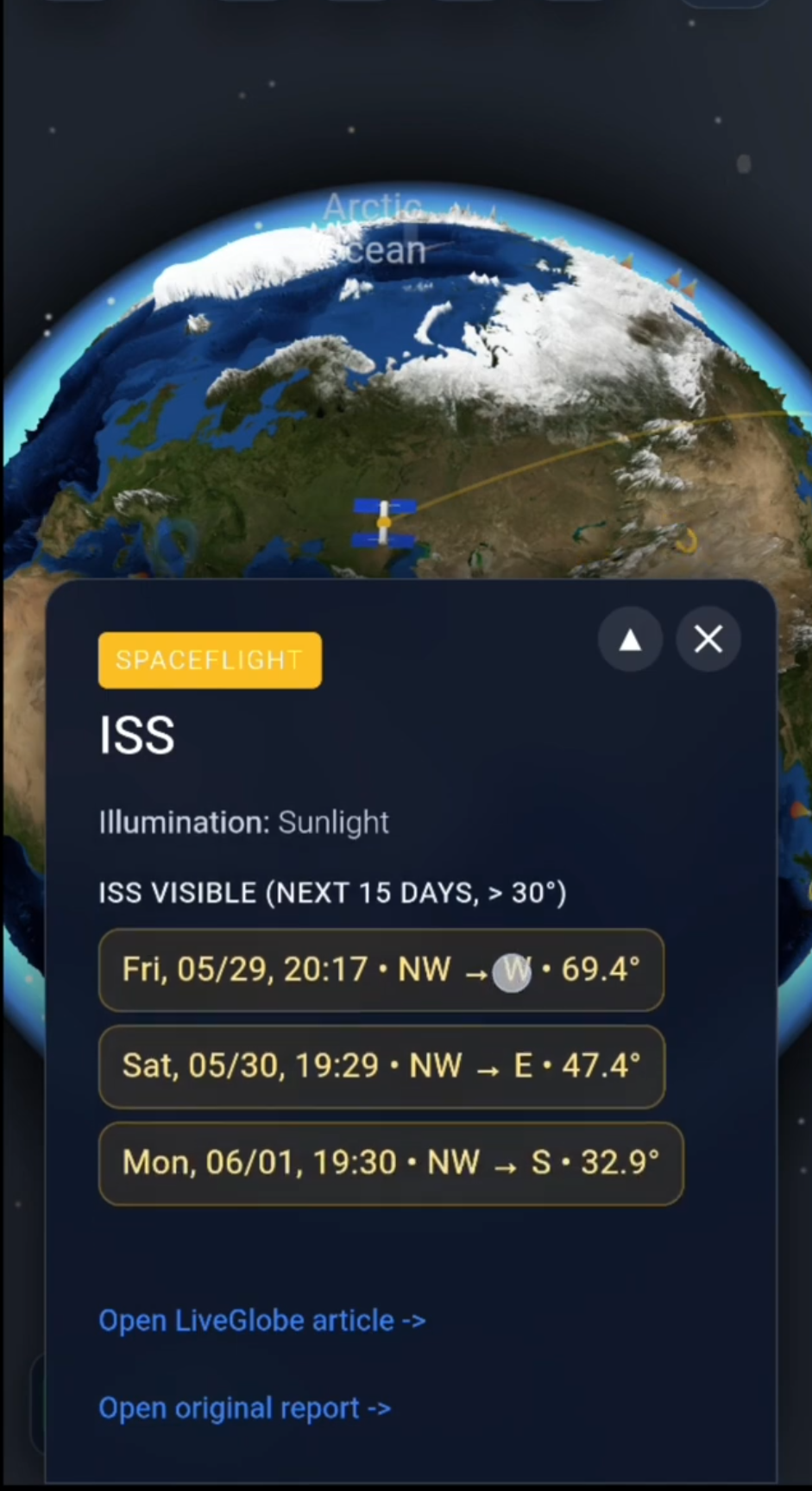
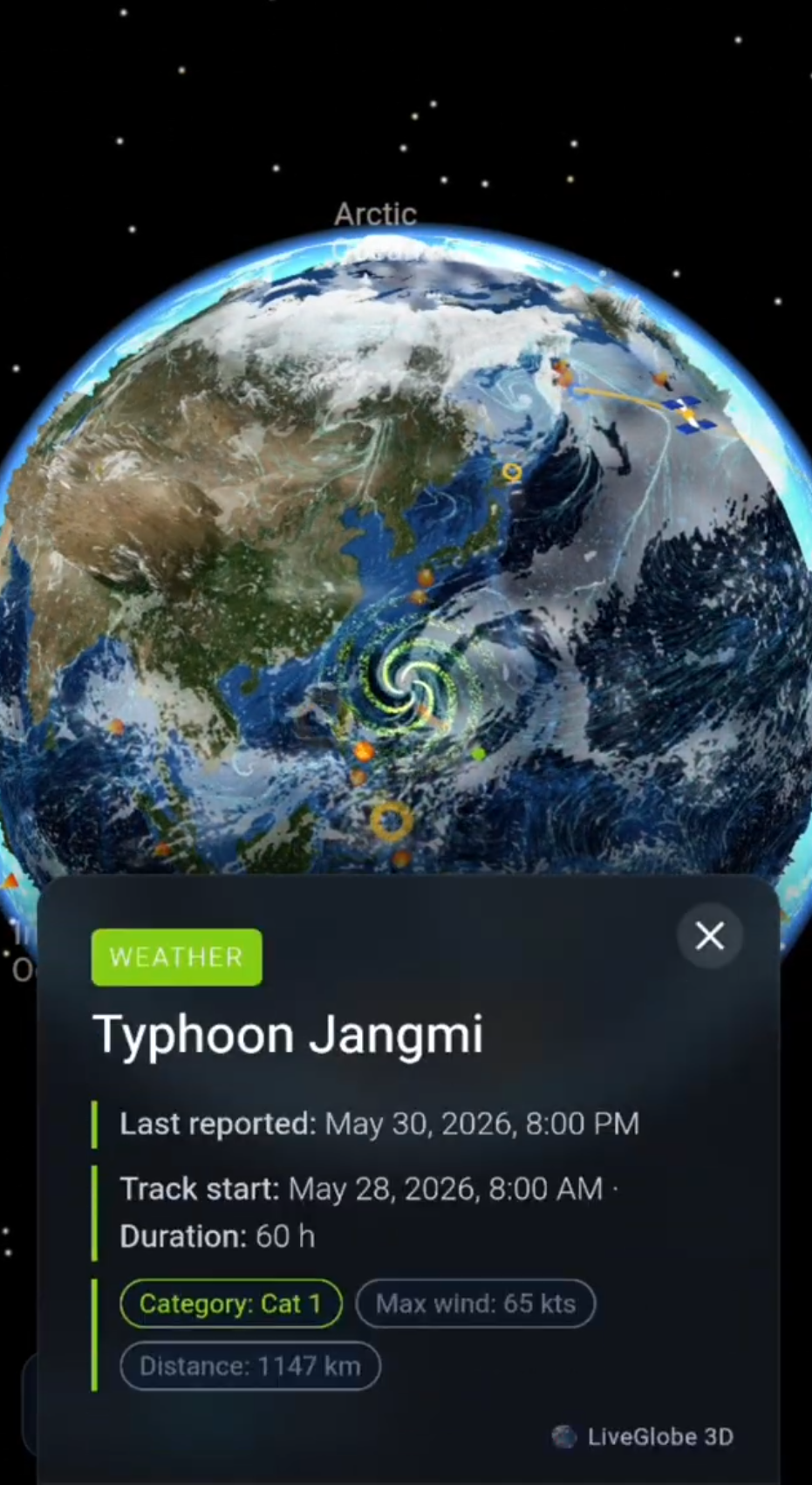
In LiveGlobe 3D, you can rotate and zoom the globe and use the magnifying-glass search with at least two characters to find a place. Search requires a network connection and external services. Use the globe to place your observation site in its surrounding landscape; observe the actual Sun direction and rain curtain locally.
For another kind of atmospheric color, read why the sky is blue and sunsets are often red. Next time a rainbow appears, start with one revealing detail: is red on the outside or the inside of the bow you are looking at?
Short clips
The app in motion: short, genuine glimpses straight from use.
At a glance
How the app feels on your phone.