Solar eclipses: what makes them total, annular or partial?
What causes a solar eclipse? Compare total, annular and partial eclipses, understand the Moon's shadow and learn why your location changes the view.
The Moon is much smaller than the Sun, yet it can hide the Sun’s entire bright disk. They look roughly the same size in our sky because the Moon is so much closer. Whether the whole disk disappears, a bright ring remains or only a section is covered depends on their apparent sizes and where you stand.
That is why people watching the same eclipse can have very different experiences. A map of the shadow’s path often tells you more than the label “total eclipse.”
The order is Sun – Moon – Earth
During a solar eclipse, the Moon passes between the Sun and Earth and casts its shadow on part of Earth’s surface. This can happen only at new moon, when the Moon lies in the Sun’s direction as seen from Earth and its sunlit half faces mostly away from us.
But most new moons bring no eclipse. The Moon’s orbit is tilted by about five degrees relative to Earth’s orbital plane. Usually it passes above or below the Sun in our sky, and its shadow misses Earth. An eclipse becomes possible near a node, where the two orbital planes intersect. NASA’s explanation of eclipse geometry sets out this three-dimensional alignment.
A lunar eclipse reverses the middle two bodies: Sun – Earth – Moon. Earth’s shadow then falls on the full Moon.
How can a small Moon cover a huge Sun?
The Sun is roughly 400 times the Moon’s diameter and roughly 400 times farther away. Both therefore occupy a similar angle in our sky. What matters is their apparent size, rather than their physical size in space.
That apparent size varies. The Moon follows an elliptical orbit, so it looks larger when nearer and smaller when farther away. Earth’s distance from the Sun varies a little too. If the Moon’s disk is large enough and lines up correctly, it can hide the entire bright solar disk. If it is too small, sunlight remains visible around the edge.
You can model this with a coin held near your eye in front of a distant round indoor lamp. Move the coin closer or farther away: it can cover the lamp or leave a rim showing. Use an indoor lamp for this experiment, never the Sun.
Three appearances to tell apart
| Eclipse at your location | What the Moon covers | What remains visible |
|---|---|---|
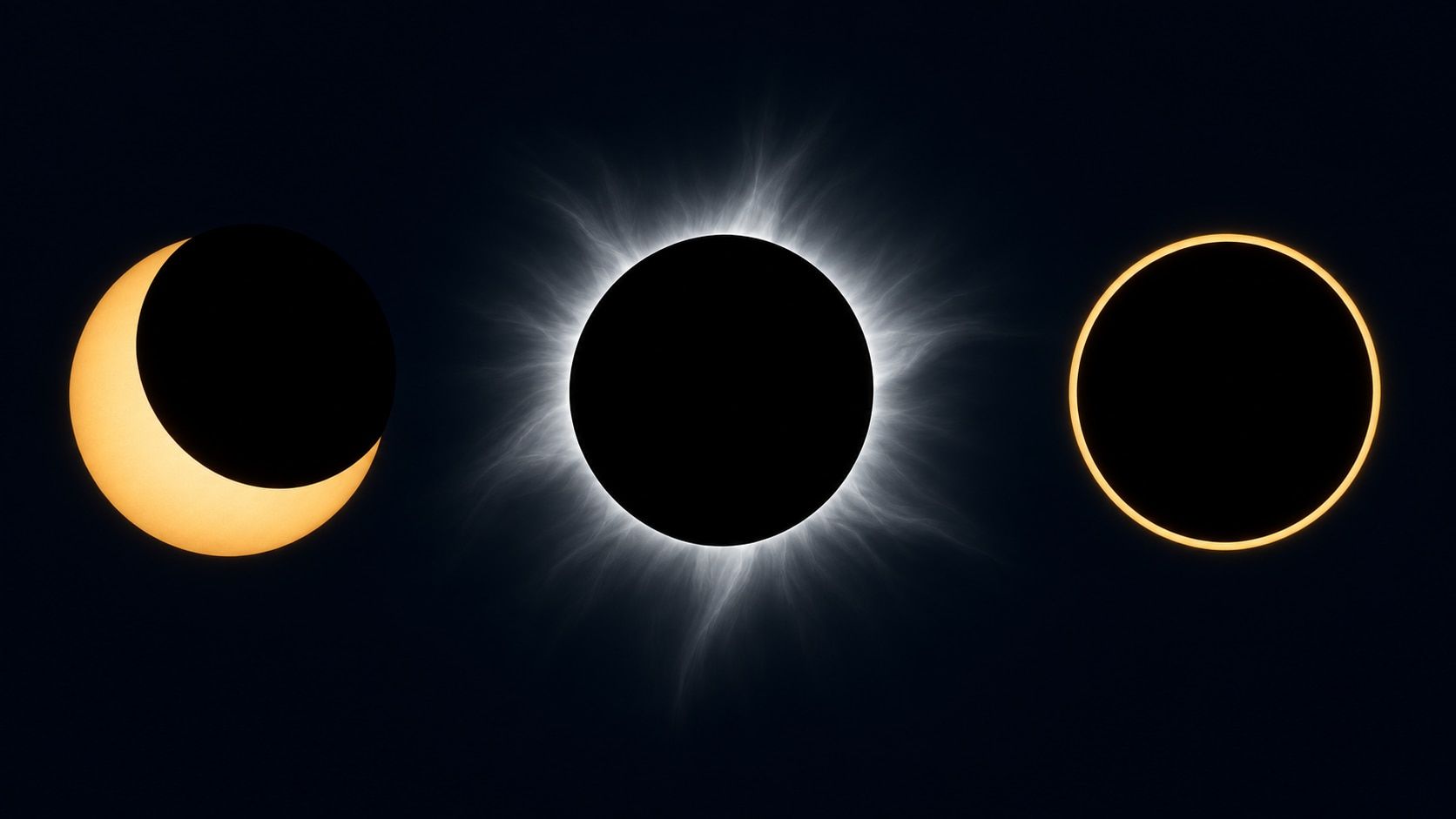
| Total | The entire bright solar disk | The faint outer solar atmosphere, the corona, can become visible during totality |
| Annular | The middle, with the Moon appearing too small to cover everything | A bright ring of the solar disk |
| Partial | Only part of the solar disk | A bitten or crescent-shaped Sun |
The bright ring in an annular eclipse is not the corona. It is uncovered bright solar surface, so an annular eclipse has no totality. NASA’s guide to eclipse types also describes hybrid eclipses: Earth’s curvature can make the same event total along some sections of its central path and annular along others.
Your location determines your view
The Sun is an extended light source, so the Moon’s shadow has distinct regions:
- Umbra: the entire bright solar disk is hidden. Totality is possible where this shadow reaches Earth’s surface.
- Penumbra: only part of the Sun is hidden. Observers here see a partial eclipse.
- Antumbra: beyond the tip of the umbra, the Moon appears smaller than the Sun. Central alignment produces an annular view.
The central path is narrow compared with the much wider region of partial visibility. As the Moon moves and Earth rotates, the shadow travels across the surface. Outside the whole shadow region, there is no solar eclipse to see.
On an eclipse map, find your precise location first, then check the local eclipse type and times. An event described as total need not be total in your country or city. Check the Sun’s altitude and the time zone used, too; clouds also affect what you can actually see.
Try a shadow model indoors
A broad lamp, a small ball and a larger ball help explain the geometry. Make the lamp your Sun, put the small “Moon” between it and the larger “Earth,” and catch the shadow on the larger ball or a white surface.
- Move the small ball sideways: its shadow reaches different places or misses the surface.
- Change its distance from the surface and watch the dark central area and softer edge.
- Compare two places on the surface: they do not receive the same amount of light from the lamp.
This is not a scale model, and a small light source may produce a very subtle penumbra. It explains differences between locations, not eclipse timings.
Watch the real Sun safely
Direct solar viewing requires suitable, undamaged eclipse glasses or handheld solar viewers complying with ISO 12312-2. Ordinary sunglasses are not enough. During partial and annular eclipses, protection is needed throughout. The sole exception for unaided direct viewing is the brief interval of complete totality during a total eclipse; protection is required before it and as soon as the bright solar disk reappears. Follow NASA’s solar-viewing safety guidance.
An indirect alternative is pinhole projection. With your back to the Sun, let sunlight pass through a small hole in a card onto a white sheet behind it and look at the projected image. Do not look through the hole at the Sun.
Eclipse glasses do not make it safe to look through binoculars, a telescope or a camera. Optical equipment needs appropriate special-purpose solar filters secured over the front of the optics and expert guidance.
Explore Earth and Moon in space
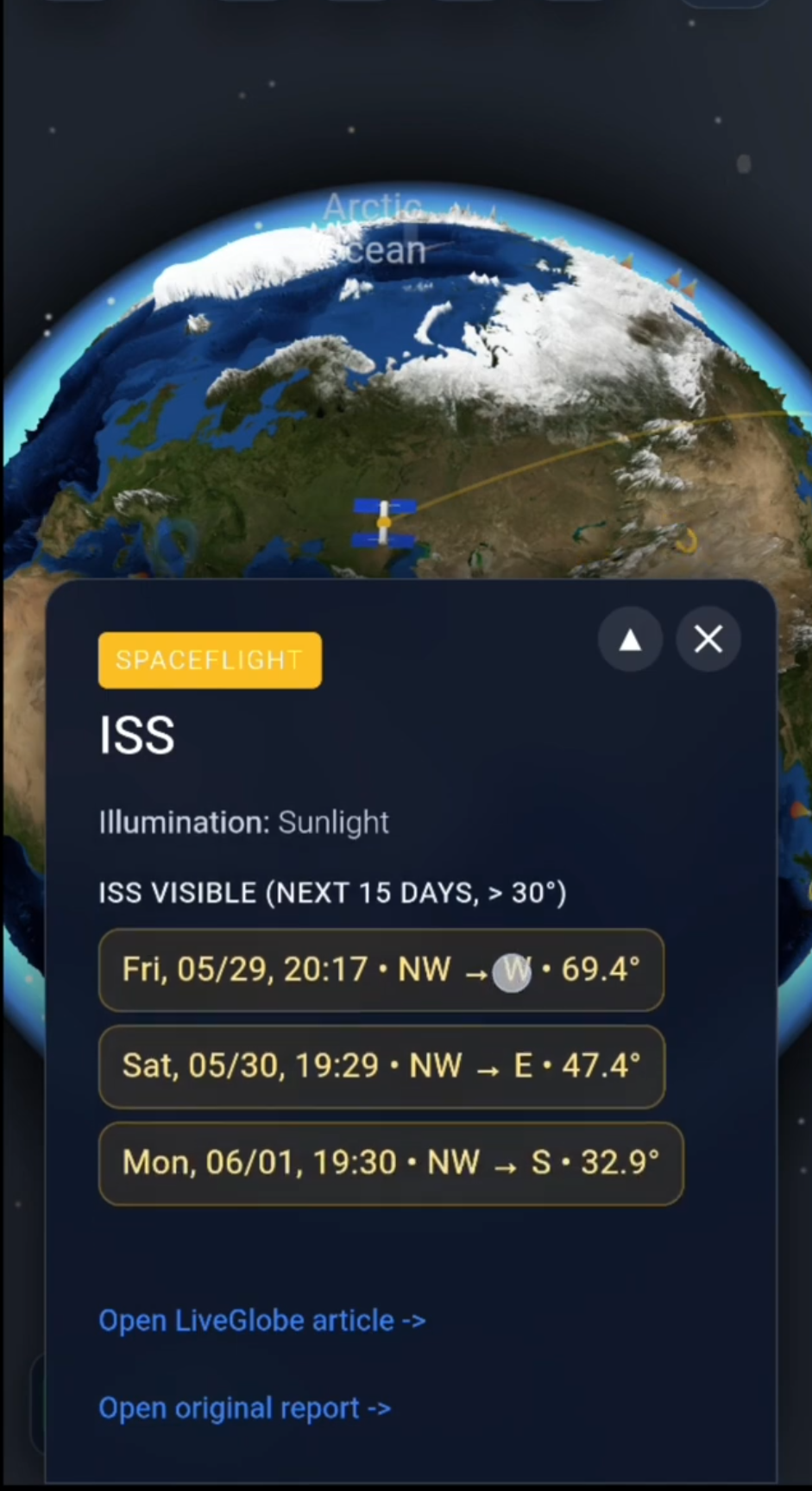
In LiveGlobe 3D, you can rotate and zoom the globe, switch between Earth and sky, and enable the Moon through the space menu. The web app is configured to require sign-in. Use these views for spatial orientation, and an astronomical calendar for the precise local eclipse type and times.
The useful question is not just “Is it total?” but “Where does the shadow pass, and where am I?” Explore LiveGlobe 3D and its available views and connect the geometry overhead with a place on Earth.
Short clips
The app in motion: short, genuine glimpses straight from use.
At a glance
How the app feels on your phone.