What causes the seasons? Earth's tilt, not its distance from the Sun
Discover what causes the seasons: Earth's tilt changes sunlight angles and day length, giving the Northern and Southern Hemispheres opposite seasons.
It can be winter in Germany while southern Australia is enjoying summer. Both places are on the same Earth and, at the same moment, are effectively the same distance from the Sun. The main cause of the seasons is Earth’s tilted axis: as Earth travels around the Sun, the tilt changes the Sun’s height in the sky and the length of daylight in each hemisphere.
“Summer happens when Earth is closer to the Sun” sounds reasonable. But it does not explain a Northern Hemisphere summer. To see why, separate three things: Earth’s daily rotation, its yearly orbit, and the direction of its axis.
A tilted axis with a nearly constant direction
Earth’s axis is an imaginary line through the North and South Poles. Earth rotates around it, producing day and night. At the same time, Earth orbits the Sun.
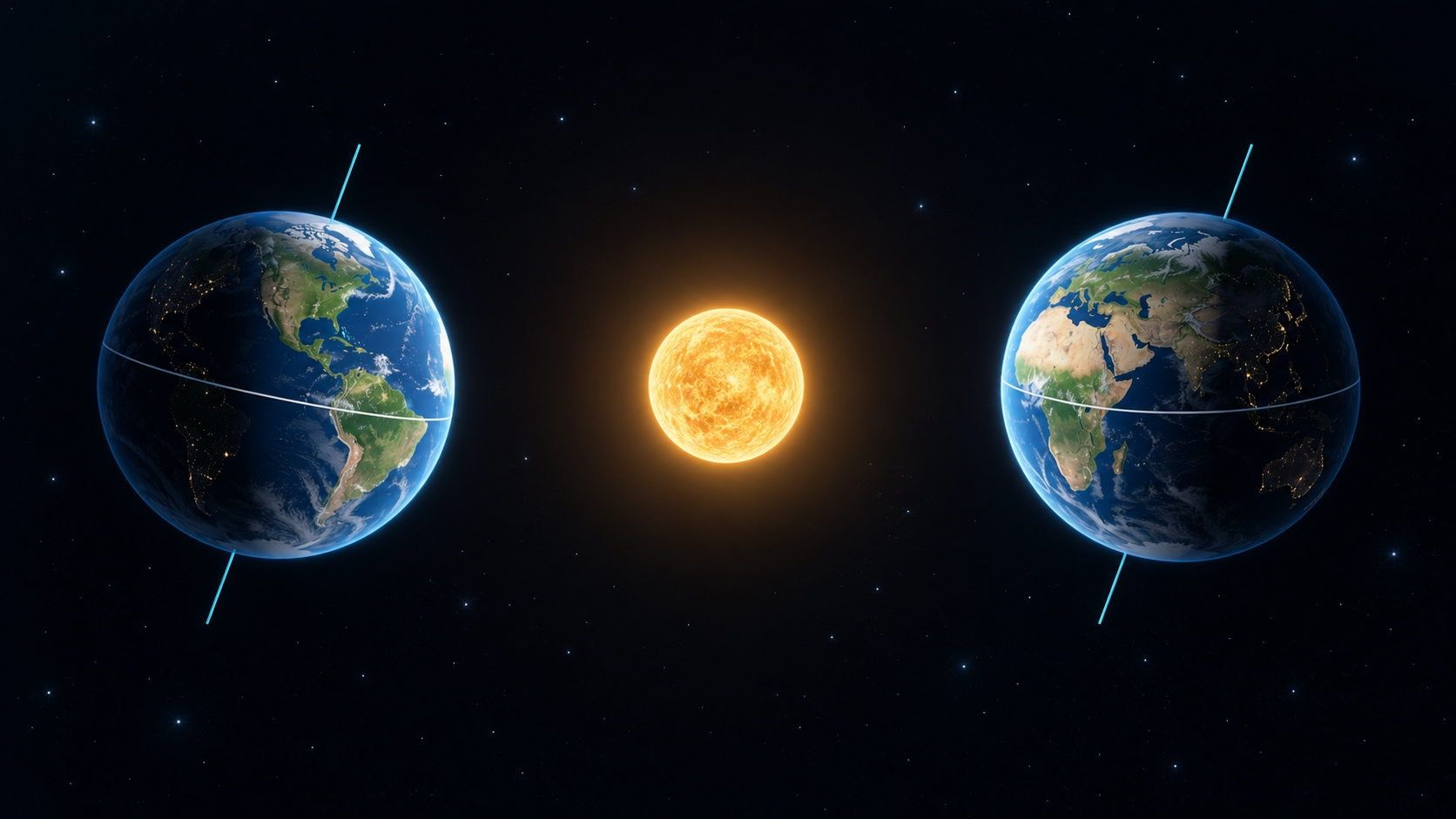
The axis does not stand perpendicular to the plane of that orbit. It leans away from the perpendicular. In a simple model of one year, it keeps pointing in approximately the same direction in space. Earth does not tip over afresh each summer and straighten up each winter.
Imagine carrying a tilted ball around a lamp, with its upper end always pointing toward the same wall. At one position the upper end leans toward the lamp; at the opposite position it leans away. This changing orientation relative to the Sun is what matters (NASA: what causes the seasons).
Two effects give summer more sunlight
When a hemisphere leans toward the Sun, both the angle of sunlight and the time available for it change.
1. A higher Sun concentrates light on a smaller area
Shine a flashlight straight onto a sheet of paper and you get a compact spot. Tilt the paper and the same light spreads across a larger patch. There is less light per unit of surface area.
Sunlight behaves similarly. When the Sun is higher in the sky, its rays reach the ground more directly. A low Sun spreads incoming radiation across a larger area. The National Weather Service’s explanation uses this paper-and-flashlight model.
2. Longer days allow more time for sunlight
At middle latitudes in the hemisphere tilted toward the Sun, a place spends more of each rotation on Earth’s illuminated side. The Sun stays above the horizon longer.
More direct sunlight and longer daylight work together. They explain the seasonal increase in solar energy, rather than the temperature of every individual day. Clouds, air movements, and other weather conditions also affect local temperatures.
Earth keeps rotating in winter too. A short winter day does not mean the planet spins faster. That location simply spends less of the same rotation in sunlight.
Why the hemispheres have opposite seasons
The Northern and Southern Hemispheres lie on opposite sides of the equator. When the north leans more toward the Sun, the south leans away. Six months later, the situation is reversed.
| Time of year | Northern Hemisphere, such as Germany | Southern Hemisphere, such as southern Australia |
|---|---|---|
| Around June | Summer: higher Sun and longer days | Winter: lower Sun and shorter days |
| Around December | Winter: lower Sun and shorter days | Summer: higher Sun and longer days |
| Around March | Transition into spring | Transition into fall |
| Around September | Transition into fall | Transition into spring |
This is a seasonal pattern, not a weather forecast. It explains why Christmas falls during summer in southern Australia and winter in Germany. It does not promise a particular temperature on that date.
At the March and September equinoxes, neither hemisphere is tilted more toward the Sun. That still does not give every location exactly twelve hours between sunrise and sunset. See why day and night are not exactly equal on the equinox for the distinction.
What Earth–Sun distance does and does not explain
Earth follows an elliptical orbit rather than a perfect circle, so its distance from the Sun changes. Earth is normally closest in January and farthest away in July (NASA Space Place).
That is a useful check on the common misconception: Northern Hemisphere winter occurs around the time of closest approach. The hemisphere comparison is even clearer. A change in distance affects the planet as a whole; it cannot explain summer in one hemisphere and winter in the other at the same time.
Distance is not completely irrelevant to the amount of solar radiation reaching Earth. But axial tilt explains the opposing seasonal cycle considered here. “Summer means closer to the Sun” is the wrong rule.
Try a simple ball-and-light model
Picture a ball, a light source, and a mark for the North Pole:
- Keep the light in one place. It represents the Sun.
- Hold the ball’s axis at a tilt. Its upper end must point in the same direction throughout the exercise.
- Compare opposite positions. Keep the ball equally far from the light on both sides. At one position the North Pole leans toward it; at the other it leans away.
- Add the daily rotation. Follow a point at middle northern latitudes. How much of its path is illuminated, and how directly does the light meet it?
- Compare a southern point. Its seasonal change runs the other way.
Moving the ball closer to the lamp is not the key. A fixed axis direction combined with a changing orbital position produces the contrast. A nearby lamp is a teaching model, not a scale replica of the Earth–Sun system.
Locate the hemispheres on a globe
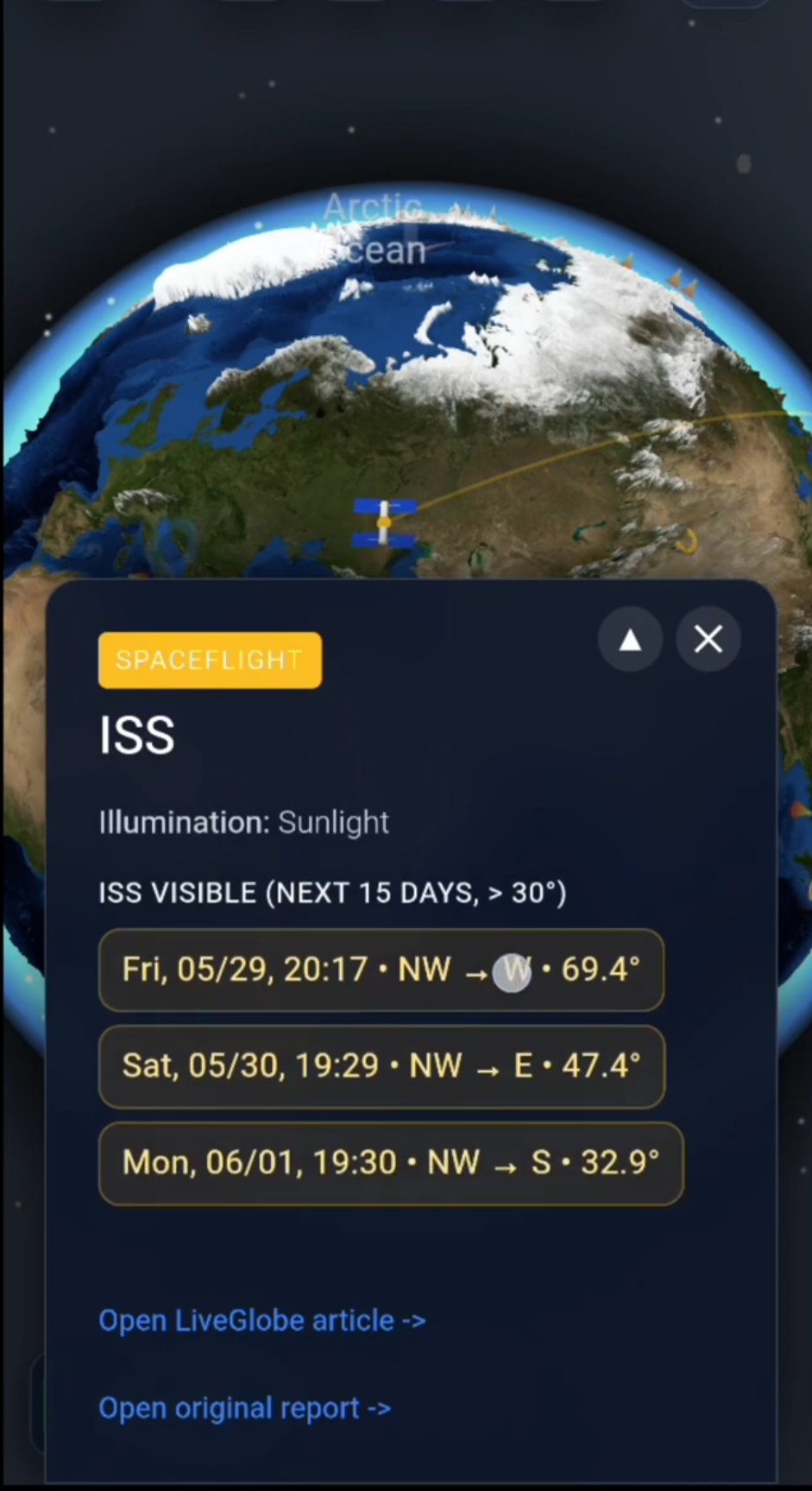
In LiveGlobe 3D, you can rotate and zoom the globe and enable the equator, tropics, and polar circles in the settings. Look at Europe, then Australia. The equator makes their positions in different hemispheres easy to locate. The web app is configured for sign-in.
Use the globe for geographical orientation and the ball-and-light model for the cause. Rotating the on-screen globe changes your viewpoint, not the physical cause of the seasons. For exact local solar times, use an astronomical table.
Explore the available globe views and ask as you move between north and south: Which hemisphere is tilted more toward the Sun at this time of year?
Common questions
Are day and night seasons too?
No. Day and night result from Earth’s rotation. The annual cycle of seasons results from its orbit around the Sun combined with its tilted axis.
Does Earth tilt toward the Sun each summer?
Not by changing its axis direction in this simple yearly model. The axis keeps approximately the same direction; a new position in the orbit changes which hemisphere leans toward the Sun.
Why is it not summer everywhere at once?
The hemispheres face opposite ways. When the north leans more toward the Sun, the south leans away; six months later, the relationship is reversed.
Short clips
The app in motion: short, genuine glimpses straight from use.
At a glance
How the app feels on your phone.