Why does ice float—and why do lakes freeze from the top?
Understand why ice floats and freshwater lakes freeze from the top: density, the special role of 4 °C, winter layering and a simple observation in a glass.
An ice cube stays at the top of a glass. A winter lake can have a solid lid while water beneath it remains liquid. Both observations involve density: ordinary ice is less dense than liquid water. Fresh water also reaches its greatest liquid density at about 4 °C, rather than at its freezing point. Together, these properties explain why a lake normally starts freezing at the surface.
Less dense does not mean every piece weighs less
A large block of ice can weigh much more than a small glass of water. Floating is not a contest between the total masses of two arbitrary objects. What matters is mass per unit volume, or density.
Compare equal volumes of ordinary ice and liquid water near freezing: the ice contains less mass. As it floats, it displaces water whose weight equals its own. It reaches that balance before the whole block is submerged, leaving a small portion above the waterline.
The USGS explanation of water density links this to the arrangement of water molecules. Freezing produces a more open crystal structure. The same amount of water takes up more room as ice. It is not floating because water vanished or because air was pumped into it.
Why 4 °C matters before freezing begins
Many liquids become denser as they cool. Fresh water initially follows that pattern: cooling it from 10 to 4 °C increases its density. Below about 4 °C, the trend reverses. Further cooling towards freezing makes the liquid slightly less dense again.
This unusual behaviour is separate from the additional expansion when water turns solid. The German educational resource LEIFIphysik describes both changes.
| State in a simplified freshwater model | Density comparison |
|---|---|
| Liquid water at 10 °C | Less dense than at 4 °C |
| Liquid water at about 4 °C | Greatest density |
| Liquid water near 0 °C | Slightly less dense again than at 4 °C |
| Ordinary ice near 0 °C | Substantially less dense than the liquid |
These are physical relationships, not measurements from a particular lake. For reference, 4 °C is about 39 °F; 0 °C is 32 °F.
A lake cooling down, step by step
Picture a reasonably deep freshwater lake losing heat to colder surroundings in autumn. The sequence becomes clearer in three stages:
- Cooling above 4 °C: Surface water becomes denser as it cools and can sink. Water from below takes its place, and wind can help mix the lake.
- Cooling below 4 °C: The colder surface water is now less dense than water at roughly 4 °C beneath it. It tends to stay on top, allowing winter layering to develop.
- Freezing at the surface: Once the top layer has lost enough heat, ice forms there. Its lower density keeps it at the surface as a floating lid.
Liquid water can remain underneath. The ice separates it from the cold air and slows further heat loss; it does not generate warmth. More heat still has to leave for more water to freeze.
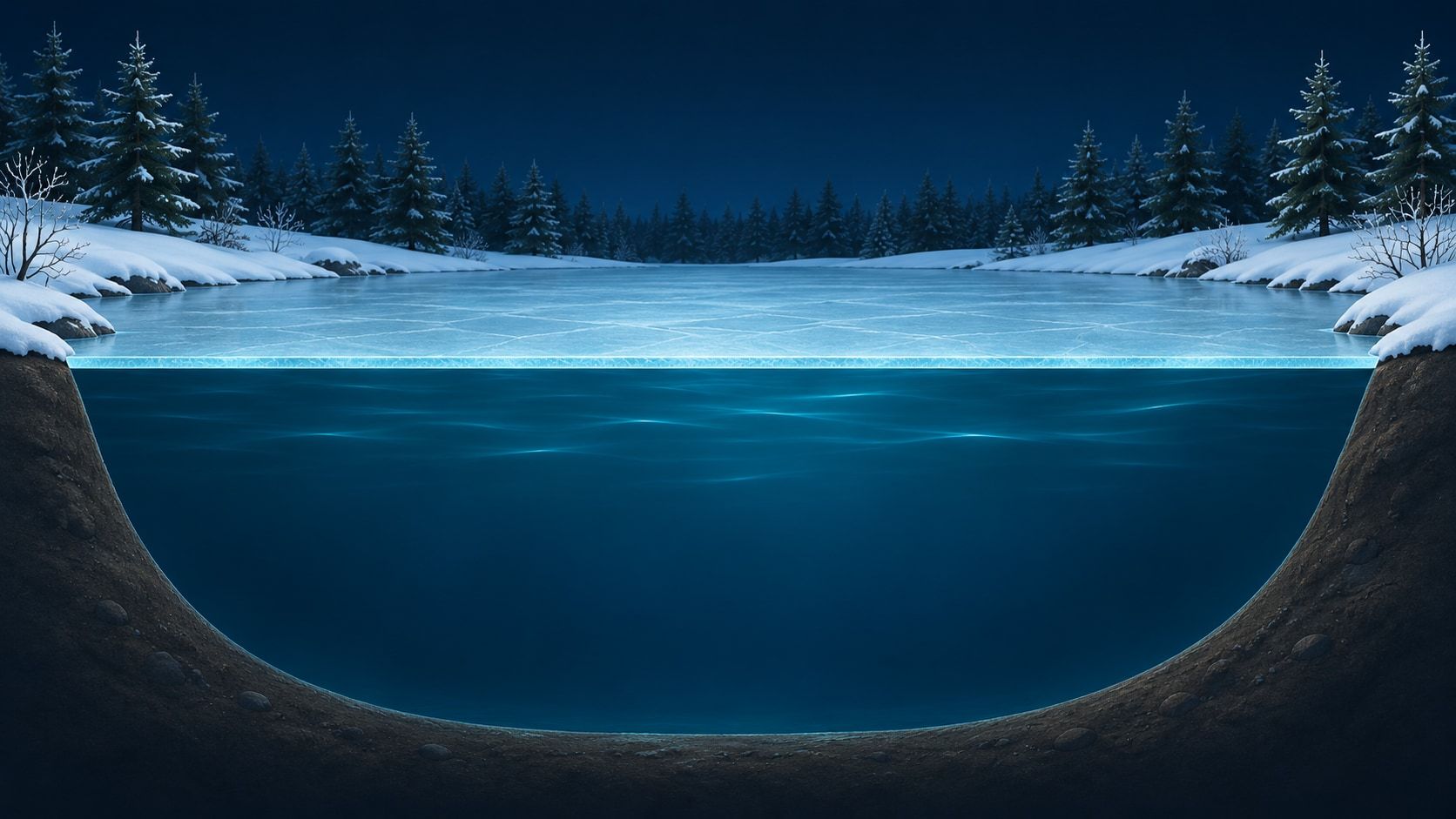
The cover is an editorial cutaway illustration of this principle: a thin ice lid above liquid water. Colours and layer thicknesses are schematic.
Is the bottom of every lake exactly 4 °C?
No. The familiar diagram showing ice above and 4 °C water below is a useful model, not a universal temperature map. A real lake’s depth, mixing, inflows, outflows and history of cold weather all matter. Shallow water bodies can freeze all the way through during prolonged cold.
This explanation concerns fresh water under ordinary conditions. Dissolved salts change density and freezing behaviour, so the 4 °C model cannot simply be applied to the sea. For that setting, read the guide to ocean currents and density.
Try an observation in a glass
Place an ordinary ice cube in a clear glass of tap water. Look from the side: most of it sits underwater, with a small portion sticking out. Push it under with a spoon and release it; it rises again. That demonstrates the buoyancy of ice, but it does not by itself demonstrate water’s maximum density at 4 °C.
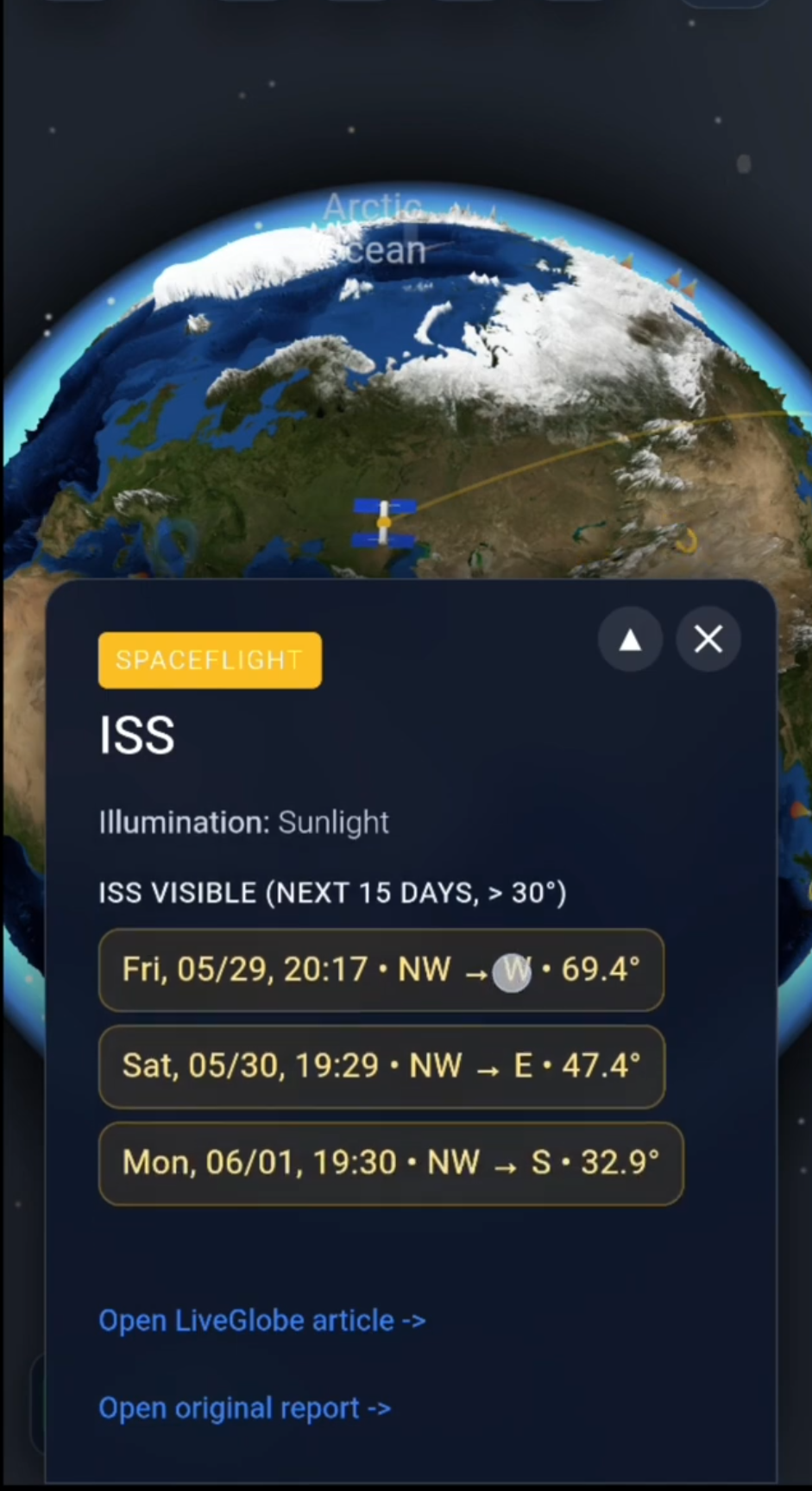
To add a geographical perspective, search for Lake Constance in LiveGlobe 3D, then rotate the globe and zoom into the surroundings. You can place a lake in its wider landscape. The web app has a sign-in flow, and place search relies on external data. This is geographical exploration rather than an ice-cover measurement.
Remember the two ideas: water near 4 °C can sit below colder fresh water, and ice stays above both because it is less dense. The glass and the winter lake follow the same underlying physics.
Short clips
The app in motion: short, genuine glimpses straight from use.
At a glance
How the app feels on your phone.