Must or have to? Tell obligations, prohibitions and choices apart
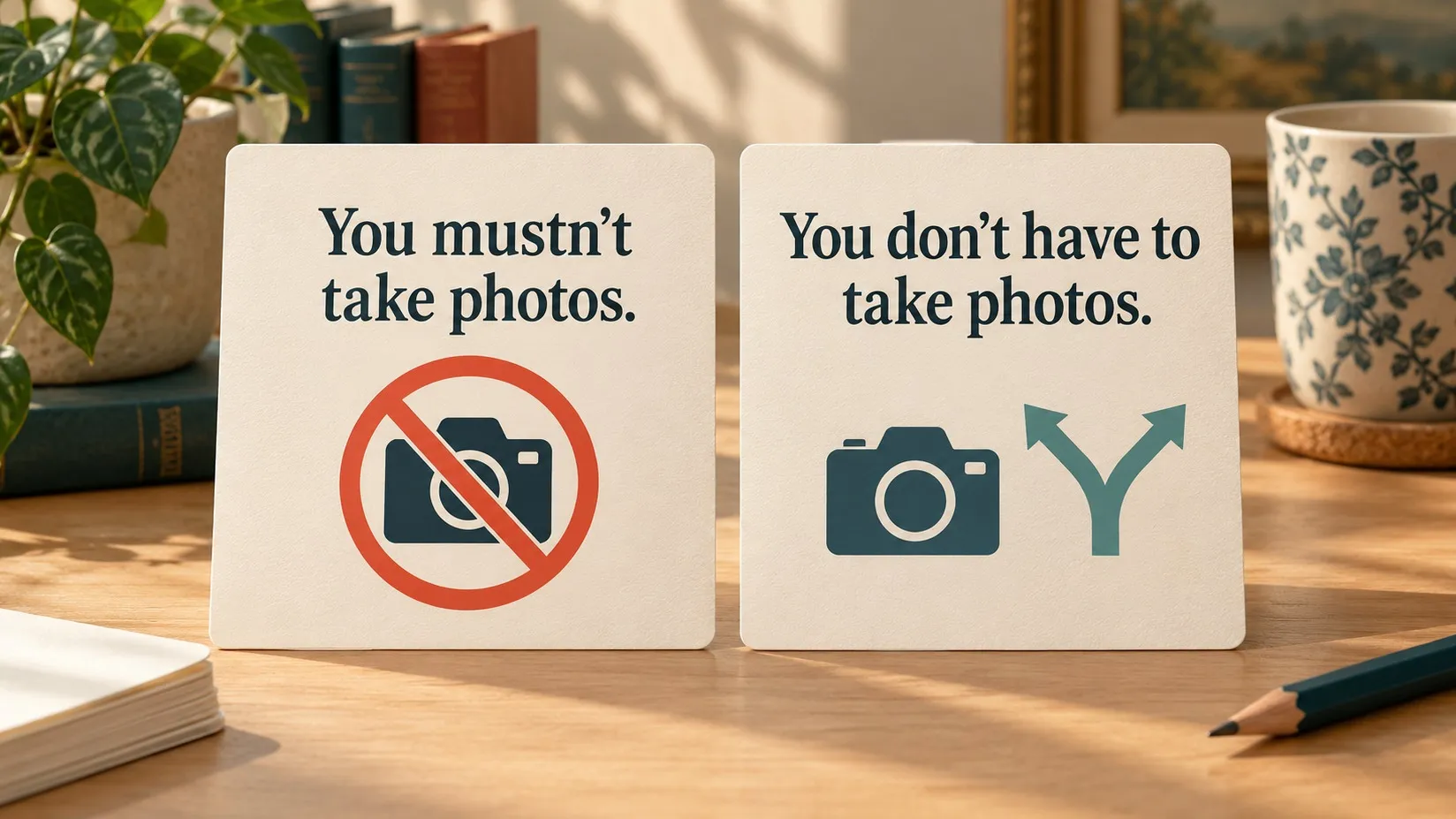
You mustn’t take photos. Photography is forbidden. You don’t have to take photos. Photography isn’t necessary. These sentences look similar, but they give very different instructions. That’s why learning must and have to means more than treating them as two ways to express an obligation.
Start with three meanings: necessary, forbidden or not necessary. Then check the verb form, especially with he/she/it, questions and past events. The six exercises below let you put both decisions into practice.
The essential difference at a glance
| Your meaning | English pattern | What it tells someone |
|---|---|---|
| Something is necessary. | You must book a ticket. / You have to book a ticket. | Booking is required. |
| Something is forbidden. | You mustn’t take photos. | Don’t take photos. |
| Something is not necessary. | You don’t have to take photos. | There is no requirement to take photos. |
Mustn’t is the short form of must not. To remove an obligation, use don’t have to, or doesn’t have to with he/she/it. Don’t need to and needn’t can also express a lack of necessity: You needn’t print the ticket. Printing it isn’t required.
Cambridge’s guide to must explicitly distinguishes prohibition from lack of obligation. Before choosing a form, ask: Am I saying “don’t do it” or “it isn’t necessary”?
Positive must and have to: consider the speaker’s perspective
Both forms can express strong necessity. Must often emphasizes what the speaker considers important or insists on:
- I must remember my ticket. I’m reminding myself that this matters.
- You must keep the exit clear. I’m giving a firm instruction.
Have to often presents a requirement arising from rules or circumstances:
- We have to book online. The museum doesn’t sell tickets at the entrance. The booking arrangement makes this necessary.
- Maya has to show her ticket at the door. That’s part of the admission procedure.
“Must is internal; have to is external” is a useful starting point, not an absolute rule. Public notices also use must: Visitors must show their tickets. That is still an external rule. Context and emphasis matter more than dividing every obligation into two fixed categories.
Mustn’t and don’t have to in one museum visit
Imagine these three instructions:
- You mustn’t take photos in this room. Taking photos would break a rule.
- You don’t have to print your ticket. You can show it on your phone. Printing is unnecessary.
- You have to leave your large bag at the cloakroom. Leaving the bag is required.
The negative forms make the biggest difference. Don’t have to does not itself mean “forbidden”: it removes a requirement. Any other restrictions depend on the wider situation.
If you want to reassure someone that waiting is unnecessary, say You don’t have to wait. You mustn’t wait would instead tell them firmly not to wait. Think about the message before adding not to a verb.
Statements and questions: check the whole verb phrase
Must has the same form with every subject. Follow it with the base verb without to: she must leave, not she musts leave or she must to leave. For a question, put must before the subject, without do: Must we leave now?
Have to changes form:
| Subject/time | Obligation | No obligation | Question |
|---|---|---|---|
| I/you/we/they, present | We have to book. | We don’t have to book. | Do we have to book? |
| he/she/it, present | She has to book. | She doesn’t have to book. | Does she have to book? |
| Past | They had to book. | They didn’t have to book. | Did they have to book? |
After does/doesn’t or did/didn’t, use have, not has or had. Cambridge’s explanation of have to covers these forms. For the broader question pattern, see our guide to do, does and did.
Past and future obligations
Use had to for a past obligation:
- Yesterday we had to wait outside. Waiting was necessary then.
- We didn’t have to pay. Payment wasn’t necessary.
The second sentence doesn’t by itself tell you whether someone paid anyway. To express a past prohibition, you can say We weren’t allowed to take photos.
For a future necessity, will have to is useful: Next time we’ll have to book earlier. But must can also refer to the future: I must call the museum tomorrow. Don’t turn “must has no past obligation form” into “must can never refer to a future event”.
One related-looking structure has a different job: must have + past participle expresses a deduction. She must have forgotten her ticket means you conclude that she forgot it, not that she was required to forget it.
Six exercises with explained answers
Choose the meaning first, then build the form.
- The museum bans photography. You ___ take photos here. Choose mustn’t or don’t have to.
- A digital ticket is enough; printing is optional. You ___ print your ticket. Choose mustn’t or don’t have to.
- Complete with have or has: Maya ___ to show her ticket.
- Complete the question: Does Maya ___ to book online?
- Change this obligation to the past, starting with Yesterday: We have to wait outside.
- Correct this sentence to express no obligation: He doesn’t has to come.
Answers:
- Mustn’t: You mustn’t take photos here. It is a prohibition.
- Don’t have to: You don’t have to print your ticket. Printing isn’t required, but it isn’t banned.
- Has: Maya has to show her ticket. Maya takes the she form.
- Have: Does Maya have to book online? Does already marks the third-person singular.
- Yesterday we had to wait outside. Had to expresses the past obligation.
- He doesn’t have to come. Use have after doesn’t; the sentence removes the obligation.
Turn a gap-fill into something you can say
Choose a place you know and write three sentences: one requirement, one prohibition and one optional action. For example: I have to show my ticket. I mustn’t take photos. I don’t have to print anything. Then cover the verb phrases and produce each sentence again from its meaning.
With Lingo Phrase Cards, you can explore the offered language directions and preview sets that suit your goals. The prepared content presents words in phrases, with IPA and audio for target-language phrases. Some categorized sets require a license. In an unlocked set’s regular learning mode, try your answer before turning the card over, then rate it. Free practice views are available for extra review; they don’t change card progress. Your own three-sentence scene adds a separate opportunity to use the patterns.
Remember the key contrast: mustn’t means forbidden; don’t have to means not required. Explore available language directions and sets through the Lingo page.