Already, yet or still? Meaning, word order and eight exercises
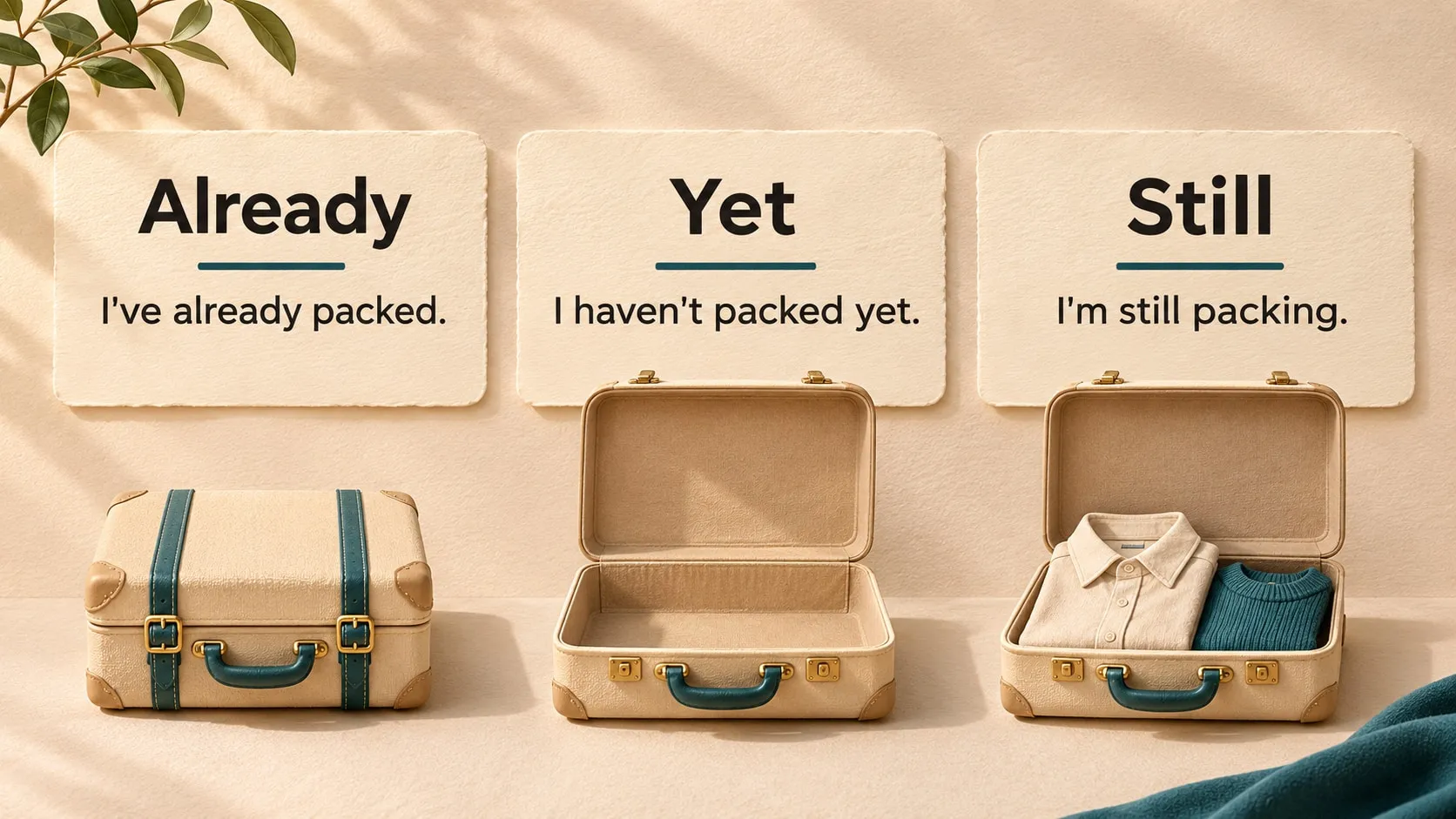
I’ve already packed. I haven’t packed yet. I’m still packing. The topic stays the same, but the situation changes: packing is done, it hasn’t been done up to now, or it’s continuing. Choose already, yet and still by the meaning you want, rather than treating them as automatic tense signals.
This guide covers their common time-related uses, with eight original exercises and explained answers.
The quick decision: done, not done or continuing?
| Your message | Example | Main idea |
|---|---|---|
| Something has happened | I’ve already packed. | It is done before now. |
| Something hasn’t happened up to now | I haven’t packed yet. | It remains to be done. |
| An activity continues | I’m still packing. | It hasn’t stopped. |
Cambridge Grammar explains these different perspectives. The same real-world situation can allow more than one word if you change the emphasis or sentence structure.
Already: something is the case before now
Use already for something that has happened before the relevant moment. It often suggests “sooner than expected”, but it doesn’t always express surprise.
- I’ve already sent the tickets. Sending them is done.
- We already know the address. We don’t need to find it out.
- The taxi is already here. It has arrived, perhaps earlier than expected.
The usual middle position is before a simple main verb, after the first auxiliary, or after main-verb be: already know, have already sent, is already here. Don’t put it between a verb and its direct object: I’ve already packed my bag, not I’ve packed already my bag.
End position is possible too: You’ve finished already? This can give extra emphasis or express surprise, especially in conversation. See Cambridge’s guide to already.
Yet: has the expected change happened?
In this time-related use, yet is particularly common in questions and negative sentences, usually at the end:
- Have you packed yet? You’re asking about an expected task.
- The taxi hasn’t arrived yet. Its arrival hasn’t happened up to now.
- Is your room ready yet? You’re checking whether the expected state has been reached.
Not … yet leaves room for something to happen later. You can also answer briefly: Have you booked the hotel? — Not yet.
Questions don’t always require yet. Have you already packed? is correct and can suggest surprise that packing might be finished so soon. Compare:
- Is the taxi here yet? You’re checking for an expected arrival.
- Is the taxi here already? You’re surprised it could be here so early.
Still: the situation continues
Still marks continuation, whether it is an activity or a state:
- I’m still packing. The activity continues.
- We still live near the station. Our home hasn’t changed.
- The shop is still open. It hasn’t closed.
Common positions are before the main verb (still live), after be (is still open), and after the first auxiliary in a positive verb phrase (are still waiting).
For negatives, learn this useful pattern: I still haven’t packed. Here, still goes before haven’t. It stresses that an expected change continues not to happen, often with impatience or surprise. I haven’t packed yet focuses more simply on the task remaining undone up to now. The facts may be the same; the emphasis differs.
These words don’t select a tense for you
Already and yet often appear with the present perfect, but I already know and Is it ready yet? use other forms. In American English, you’ll also hear I already packed. Think about meaning and the time frame, not just one signal word. For the tense decision itself, read past simple versus present perfect.
Eight exercises: choose, order and interpret
In 1–5, add already, yet or still. Use the situation and the given gap position. Then complete the transformations.
- You’ve been packing for an hour and continue: I’m ___ packing.
- You’re waiting for a message; none has come: Maya hasn’t replied ___.
- There is no booking left to make: I’ve ___ booked the hotel.
- You’re checking expected readiness without particular surprise: Is your room ready ___?
- Emphasise impatiently that the reply continues not to arrive: She ___ hasn’t replied.
- Put the words in order, using already in middle position: have / I / already / checked / the address.
- Add still to show this remains true: We live near the station.
- You’re surprised the bus is here so early. Choose: Is the bus here yet? or Is the bus here already?
Answers and explanations
- I’m still packing. The activity continues.
- Maya hasn’t replied yet. The expected reply hasn’t arrived up to now; yet goes at the end.
- I’ve already booked the hotel. It is done; already follows the auxiliary.
- Is your room ready yet? You’re checking whether an expected change has happened.
- She still hasn’t replied. Still before hasn’t emphasises the continuing absence of a reply.
- I have already checked the address. Not I have checked already the address: keep the verb and direct object together.
- We still live near the station. Put still before the main verb live.
- Is the bus here already? Already matches the stated surprise. The question with yet is grammatical too, but has a different focus.
Make three statements about your own day
Choose one completed task, one unfinished task and one continuing state: I’ve already had lunch. I haven’t called Sam yet. I’m still at work. Cover the sentences and say them from the situations, rather than reciting three isolated word meanings.
For broader phrase practice, Lingo Phrase Cards lets you choose an offered learning direction and preview its sets. Prepared target-language phrases combine context with IPA and audio generated using Amazon Polly Neural. In an unlocked set, try recalling the phrase before turning the card over, then assess your answer in regular study; this updates its Leitner box and due date. Some categorised sets require a licence.
Explore the available learning directions and sets in Lingo Phrase Cards.