Past simple or present perfect? Choose by context
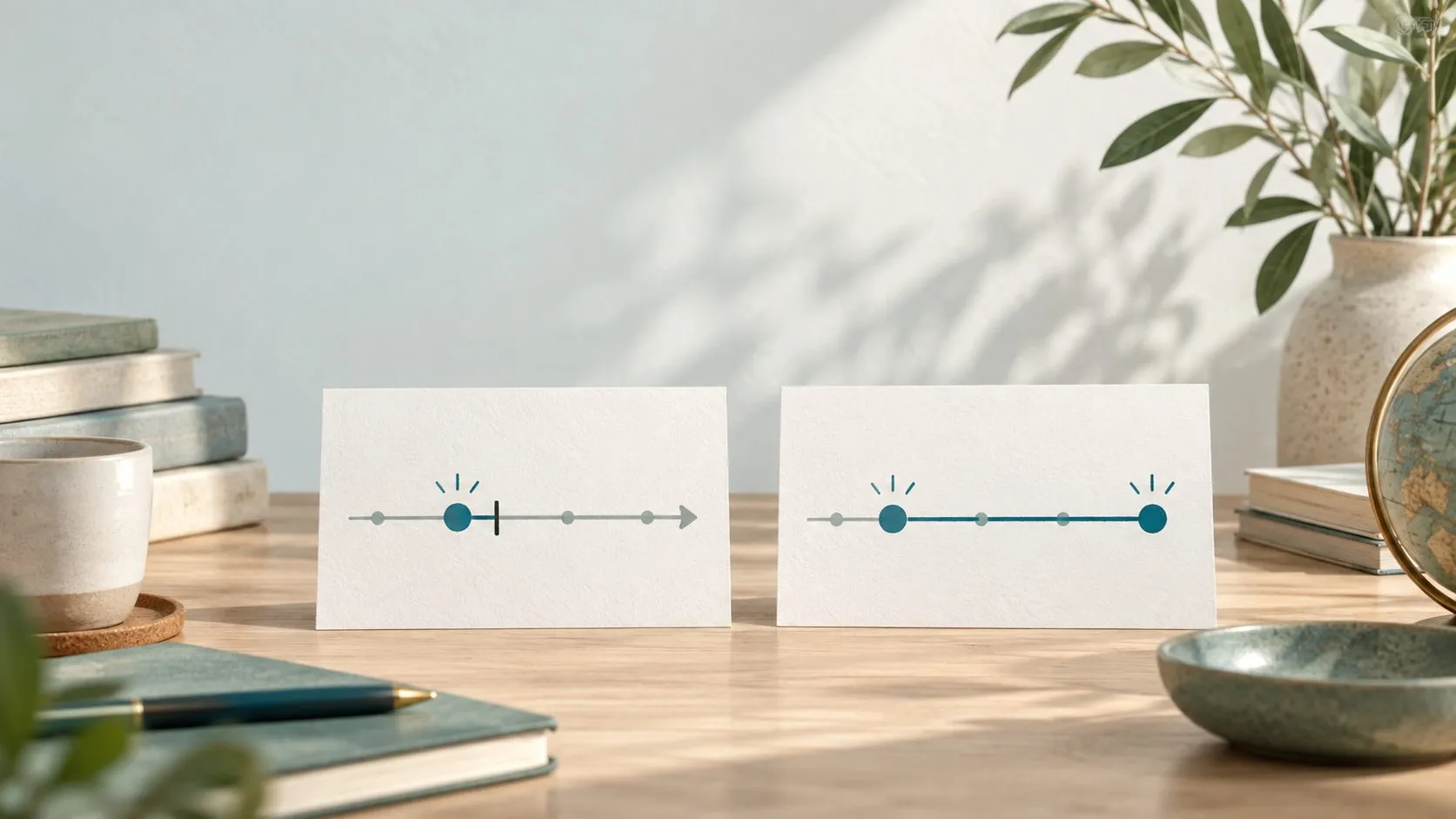
I visited my cousin last Saturday. I have visited my cousin twice this month. Both visits happened in the past. The first belongs to a finished time; the second counts visits up to now, within a month that is still under way. This is the distinction to look for when you choose between the past simple and the present perfect.
Instead of hunting for one “signal word”, ask: Is the speaker placing the event in a finished past period, or looking back from the present?
A two-question decision guide
Is the time finished and specified? Use the past simple for We watched the film on Saturday. It also works when you recount a sequence of completed events: I opened the door, walked in and sat down.
Does the time reach the present, or does the outcome matter now? The present perfect fits We have watched the film twice so far (a count up to now), I have broken my glasses, so I can’t read the sign (a present result), and She has lived here since 2020 (a situation continuing now). A completed action can have a present result: the glasses broke earlier, but their condition matters now.
The Cambridge comparison distinguishes a definite past time from time up to now. It doesn’t mean every event without an explicit date must be in the present perfect: the wider conversation may already establish a finished time.
Compare three pairs of situations
Last week or this week?
- I wrote three emails last week. Last week has ended: past simple.
- I have written three emails this week. This week is still open: present perfect for the running total.
Even today isn’t an automatic cue. I had lunch at noon today locates lunch at a specific earlier time; I haven’t had lunch today considers the day up to this moment. The meaning of the whole sentence matters.
Life experience or a particular trip?
- Have you ever visited Edinburgh? asks about an experience at any point up to now.
- Did you visit Edinburgh on your trip last summer? refers to a finished trip.
One conversation can use both: I have visited Edinburgh. I went there in 2022. The first sentence introduces the experience; the second supplies a specific past detail. Cambridge’s present perfect guide explains this shift.
Still true or over?
- Maya has worked in this café since 2022. She still works there.
- Maya worked in this café from 2022 to 2024. That period is over.
With a continuing situation, since gives the starting point; for gives a duration. A duration such as for four years needs to match the day on which you actually say it.
Check the verb form, then the time clue
Regular past-simple verbs take -ed (worked); irregular ones use their past form (wrote, went). The present perfect uses have/has + past participle: I have written, she has gone. With an irregular verb, I wrote and I have written make the difference easy to see.
Yesterday and last year often suggest a finished time; so far, ever and since commonly invite a view from the present. They are clues, not a substitute for context. There is also regional variation: Cambridge Grammar notes that American English often uses the past simple with already and yet where British English would use the present perfect.
Try four short questions
Fill in the verb and explain your time reference before reading the answers.
- Last night, we ___ (watch) a documentary.
- I ___ (not finish) my report yet; I’m still working on it. Use the British-English choice practised here.
- Have you ever ___ (try) this recipe? Supply the missing verb form.
- We ___ (meet) at the station. What extra context would make met or have met appropriate? Give two versions.
Answers:
- We watched a documentary. Last night is over.
- I haven’t finished my report yet. The report remains unfinished now. American English can also use a past-simple construction with yet; this exercise targets the British-English use.
- Have you ever tried this recipe? After have, use the past participle; the question concerns experience up to now.
- Both work with a suitable context: We met at the station yesterday specifies a finished occasion. We have met at the station several times so far counts occasions up to now. The original sentence alone doesn’t settle the choice.
Make your own contrasting pair
Choose one activity. First give a running total (I have read two chapters so far); then describe an event at a finished time (I read the first chapter yesterday). Say out loud which time frame you mean. That explanation is more useful than memorising a word list.
Lingo Phrase Cards offers grammar topics where they are available in a chosen course; check which topics and sets are actually offered for your language pair rather than assuming a particular lesson is there. For an optional exercise in an external AI app, the existing guide on practising English grammar with an AI app explains the separate workflow. You can also explore the available language pairs and sets in Lingo.