Been or gone? The difference and eight exercises with answers
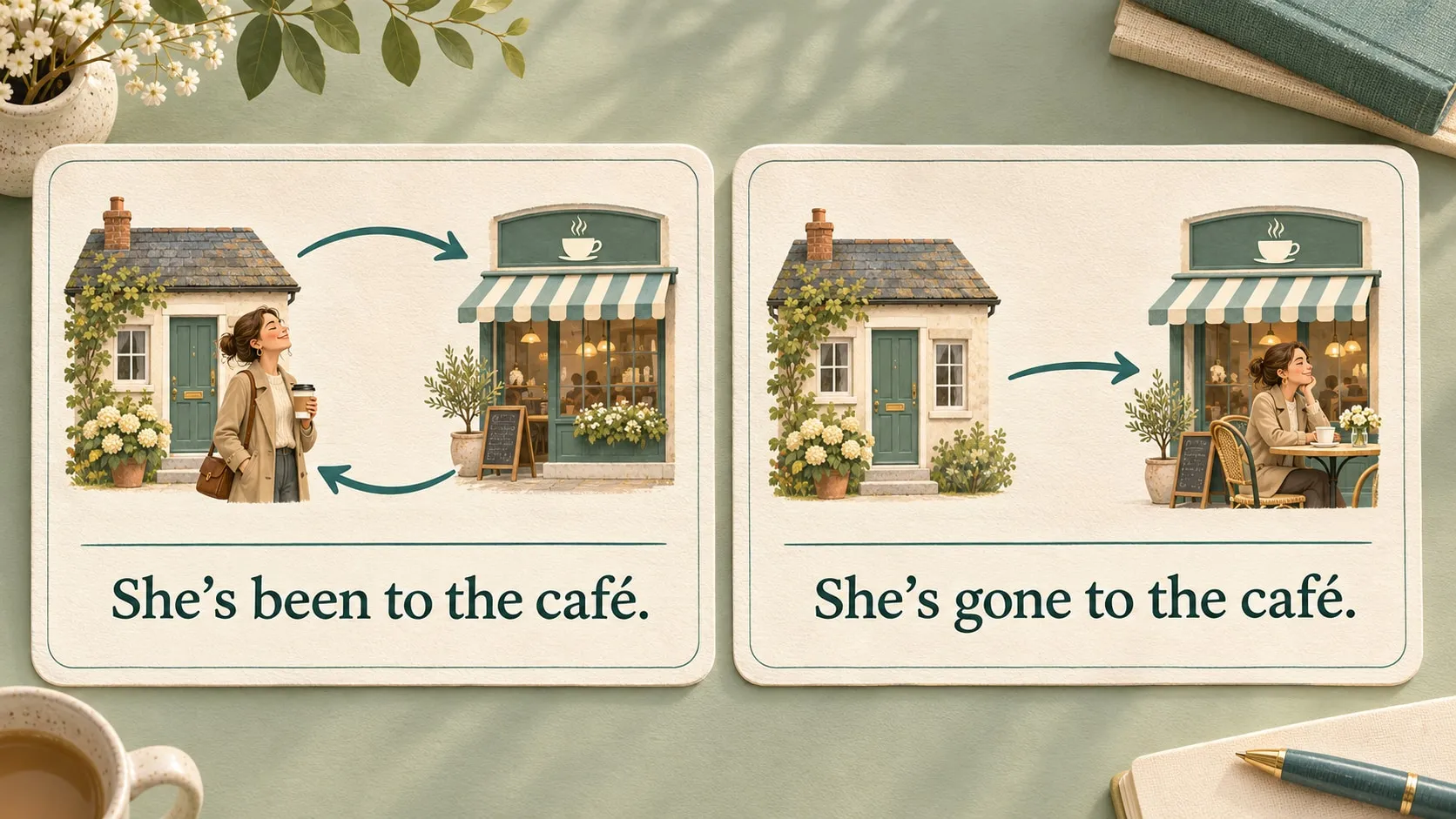
She’s been to the café. She’s gone to the café. Both sentences describe a café visit, but they tell you different things about the situation now. In the first, the visit is over. In the second, she’s still away.
This guide focuses on have/has been to and have/has gone to for visits, plus been in for a stay continuing up to now. Start with one question: Is the visit complete, or is the person still away?
A quick comparison
| Situation | Example | Meaning |
|---|---|---|
| Completed visit | She’s been to the café. | She visited and came back. |
| Still away | She’s gone to the café. | She’s on her way there or still there. |
| Continuing stay | She’s been in Rome for a week. | Her stay in Rome started a week ago and continues. |
Cambridge’s grammar guide explains the main contrast as completed versus incomplete visits. Gone to does not necessarily mean the person has already arrived.
Been to: a completed visit or past experience
Use have/has been to to talk about a completed visit or somewhere a person has visited before:
- I’ve been to Lisbon twice. Two previous visits.
- Sam has been to the bakery. He’s back with some bread. His trip is over.
- Have you ever been to Canada? A question about experience.
- I’ve never been to Canada. No previous visit.
For the ordinary question about whether someone has visited a place, learn Have you ever been to …? as a whole expression. You’re asking about their experience, rather than explaining their current absence.
Gone to: away and not back yet
Use have/has gone to when someone has left for a place and hasn’t returned:
- Maya has gone to the library. She’ll be back at six. She’s away now.
- The children have gone to the park. They’re still there. Their visit continues.
Compare two replies to Where’s Sam?:
- He’s gone to the bakery. You may need to wait to speak to him.
- He’s been to the bakery. He’s in the kitchen now. The visit is complete; he’s back.
The distinction concerns the situation at the time of speaking. Gone doesn’t mean the person will never return.
Building statements, questions and negatives
The present perfect uses have/has + past participle: I have been, she has gone. Use have with I, you, we, they and has with he, she, it.
- Statement: She has gone to the café. Short form: She’s gone to the café.
- Question: Has she gone to the café?
- Negative: She hasn’t gone to the café.
Don’t put went after have/has: say She has gone, not she has went. For the wider choice between a finished past event and a situation connected to now, see past simple versus present perfect.
Been in: a stay continuing up to now
Been doesn’t always imply a return. With have/has been in + place + for/since, you’re typically describing a stay that continues:
- I’ve been to Rome. I’ve visited Rome before.
- I’ve been in Rome for a week. I arrived a week ago and am still there.
Lingolia’s comparison also separates these patterns. Apply the “went and returned” memory aid to been to for visits, not to every use of been. For starting points and durations, practise for and since.
Eight exercises: let the situation decide
In 1–5, choose been or gone. In 6, supply the preposition. Then complete the two sentence tasks.
- Lea is home again: Lea has ___ to the café. She’s back now.
- Omar is still on his way to the bank: Omar has ___ to the bank. He hasn’t arrived yet.
- Ask about travel experience: Have you ever ___ to Ireland?
- Nina is out of the office: Nina has ___ to the station. She’ll be back later.
- You haven’t visited the place: I’ve never ___ to Oslo.
- Your stay continues: We’ve been ___ Berlin for three days.
- Correct this sentence about someone still away: He has went to the supermarket.
- Turn She has been to Canada into a question about experience, using ever.
Answers explained
- been — The visit is over; Lea has returned.
- gone — Omar is still away. The journey there is part of the incomplete trip.
- been — Have you ever been to Ireland? asks about a previous visit.
- gone — Nina is absent now.
- been — never been to means no previous visit.
- in — We’ve been in Berlin for three days. describes the continuing stay.
- He has gone to the supermarket. Use the participle gone after has.
- Has she ever been to Canada? Put the auxiliary before the subject.
Make three situations of your own
Imagine someone back from shopping, someone still at the library, and someone staying in a city for two days so far. Say a full English sentence for each situation. Cover the examples and try again, choosing been to, gone to or been in from the meaning.
For further phrase practice, Lingo Phrase Cards offers prepared sets in its available language directions. Preview a set to explore target-language phrases with IPA and audio generated using Amazon Polly Neural. In an unlocked set, answer before turning the card over, then rate your recall in the regular learning mode to update its Leitner box and due date. Some categorized sets require a license.
Explore the available language directions and sets in Lingo Phrase Cards.