Bon or bien? Practise everyday French with ten exercises and answers
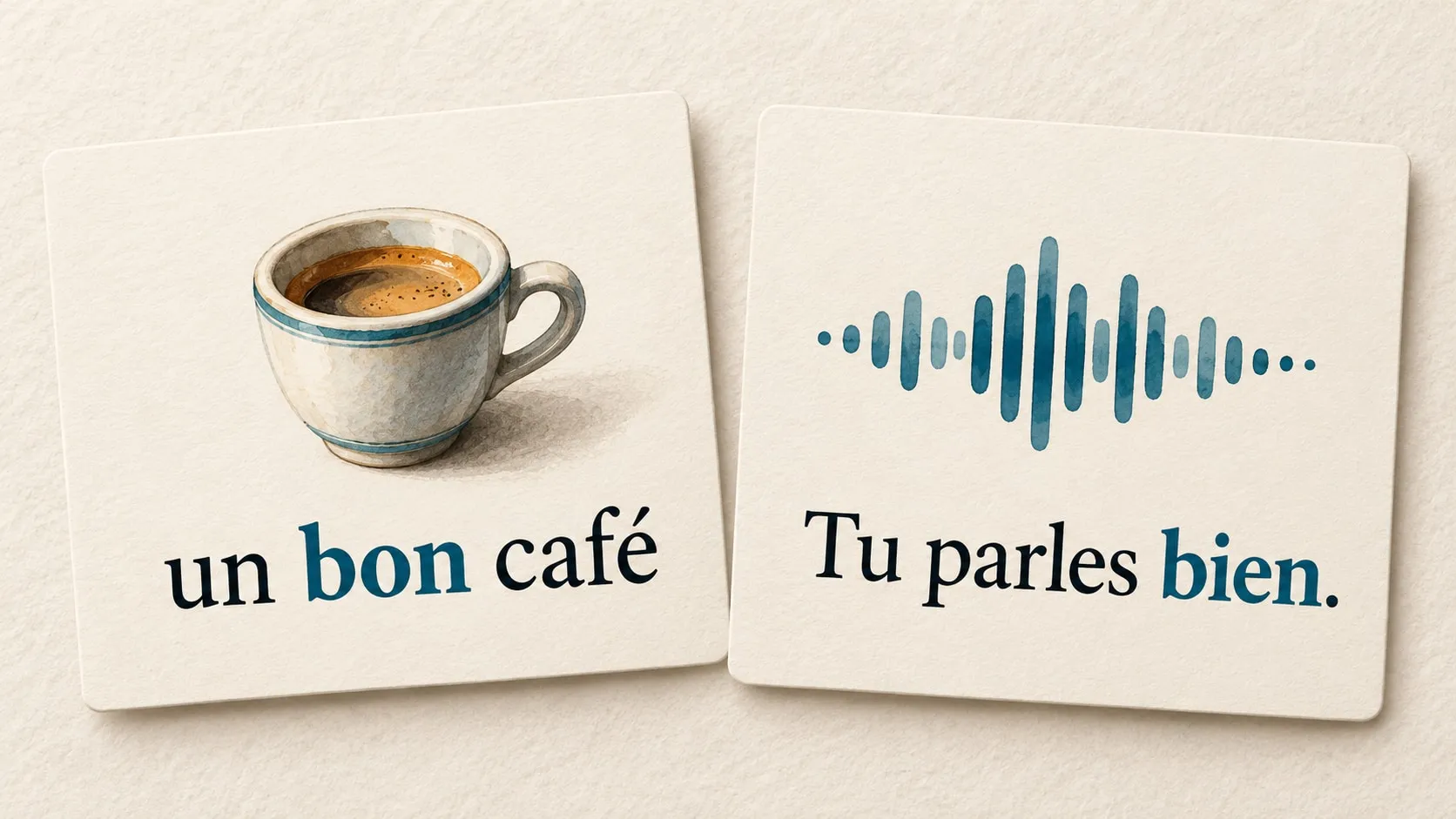
You can describe a good coffee with Le café est bon, but to say that someone speaks well, you need Tu parles bien. The key question is what you are judging: the quality of a person or thing, or the way someone does something.
Work through three everyday situations, then try ten exercises. You will also meet je me sens bien and ça sent bon, two useful expressions that show why “adjective versus adverb” is only a starting point.
A quick guide: what is good?
| What you are describing | Usual choice | Example |
|---|---|---|
| a person or thing | bon, bonne, bons, bonnes | C’est une bonne adresse. — It is a good place to know. |
| how an action is performed | bien | Tu expliques bien. — You explain well. |
| feeling comfortable or well | bien in the right expression | Je me sens bien. — I feel well. |
| a pleasant smell | sentir bon | Ça sent bon. — That smells good. |
This guide is a useful first check, not a rule covering every use. Lawless French and Lingolia also explain uses outside the basic pattern.
At a café: make bon agree with the thing
You taste your drink: Le café est bon. Now describe the soup: La soupe est bonne. Here, bon is an adjective, so its form follows the noun’s gender and number.
- un bon café — a good coffee
- une bonne soupe — a good soup
- de bons croissants — good croissants
- de bonnes tartines — good slices of bread with a topping or spread
Learn the combination, not just the dictionary meaning: une bonne soupe gives you both the word and its form. For the position of bon, see the guide to French adjective placement.
After your first bite, C’est bon ! can mean “That tastes good!” The eating situation supplies the meaning. In another setting, the same expression can mean “Okay” or “That’s enough”. It is not restricted to food.
While learning: bien describes the action
You tell a friend: Tu prononces bien ce mot. — “You pronounce that word well.” You are describing the pronunciation, rather than calling the word a good thing.
Compare two ways to talk about the same person:
- C’est une bonne cuisinière. — She is a good cook.
- Elle cuisine bien. — She cooks well.
In the first sentence, bonne describes the cook. In the second, bien describes the cooking. Bien does not change: il travaille bien, elle travaille bien, ils travaillent bien.
Ask “How is it being done?” If that question fits, bien is often the answer. But do not replace every bon that comes after a verb: La soupe est bonne is correct because the adjective describes the soup.
Feeling comfortable, smelling good and showing approval
Learn these everyday combinations as complete expressions:
- Je me sens bien ici. — I feel comfortable here.
- On est bien sur cette terrasse. — It is comfortable on this terrace.
- Ça sent bon dans la cuisine. — It smells good in the kitchen.
- Il fait bon aujourd’hui. — It is pleasantly mild today.
These show the limits of the shortcut. Bien can follow être. And bon has an adverbial use in expressions such as sentir bon and faire bon. In Les fleurs sentent bon, it therefore stays bon, despite the plural noun.
C’est bien is also common: Tu as aidé ton voisin ? C’est bien ! — “You helped your neighbour? That’s good!” Here, you approve of an action. Contrast this with C’est bon ! about the taste of food. It is a helpful comparison, not an absolute division: context and tone matter for both expressions.
Ten exercises: decide before checking
Fill the gaps with bon, bonne, bons, bonnes or bien. In 9 and 10, correct the wrong form. Explain each answer with “thing”, “action” or “fixed expression”.
- Cette soupe est vraiment ___ ; j’en reprends.
- Vous expliquez très ___ la règle.
- Ce sont de ___ chaussures pour marcher.
- Après cette pause, je me sens ___.
- Tu as une ___ idée pour le dîner.
- Les fleurs sentent ___ dans l’entrée.
- Nous avons de ___ voisins.
- Il fait ___ ; prenons le café dehors.
- Elles parlent bonnes français.
- C’est une bien occasion de pratiquer.
Answers and reasons
- bonne — the soup is being described; soupe is feminine singular.
- bien — how you explain the rule.
- bonnes — chaussures is feminine plural.
- bien — the expression se sentir bien describes how you feel.
- bonne — idée is feminine singular.
- bon — sentir bon describes a pleasant smell; no plural agreement here.
- bons — voisins is masculine plural.
- bon — il fait bon describes pleasant weather.
- Elles parlent bien français. — bien describes speaking and is invariable.
- C’est une bonne occasion de pratiquer. — occasion is feminine singular; the opportunity is being described.
Turn the answers into speaking practice
Make two connected sentences: C’est un bon restaurant. On y mange bien. Name a thing first, then describe an action. Next, change the noun: une bonne école and on y apprend bien. Check the form of bon each time.
Say the sentences while looking at them. Then cover the key phrase and supply it aloud. In a later session, use a different situation rather than memorising the order of the answers. This is a suggested exercise for your own examples.
In Lingo Phrase Cards, vocabulary comes in phrases, and target-language phrases include IPA and audio. Choose an available language direction and a suitable set, then notice what each expression describes as you read and listen. Some categorised sets require a licence. In regular learning, try an answer before turning the card over and rate it afterwards; free practice does not change Leitner progress.
Keep this question in mind: are you describing the thing, the action or how you feel? Explore the available language directions and sets in Lingo Phrase Cards.