Too, either or neither? Agree naturally with short English replies
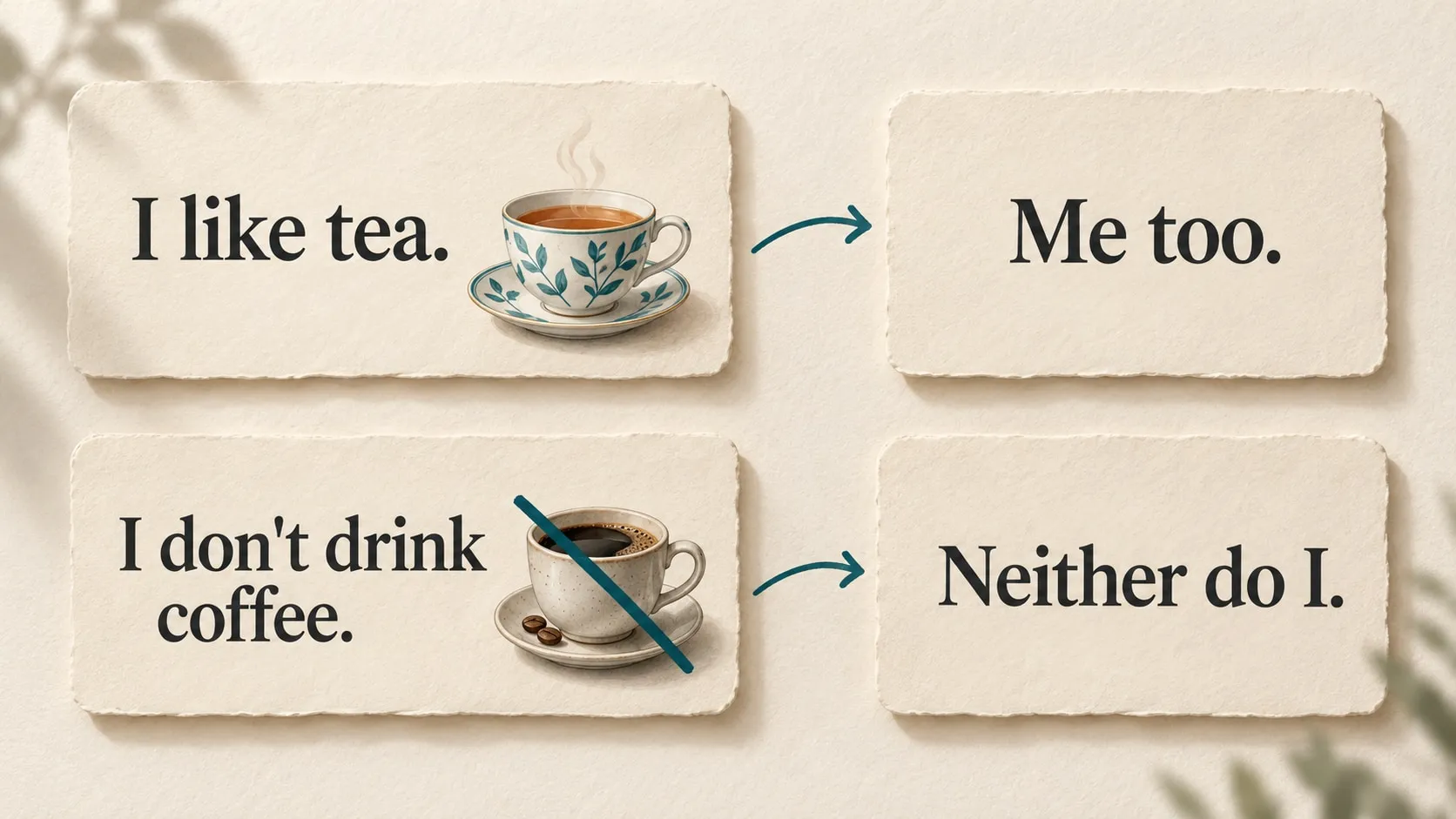
Someone says I like tea, and you like tea as well: Me too! But after I don’t drink coffee, you need a negative agreement pattern: I don’t either or Neither do I. The meaning is simple—something is true for both people—but the sentence structure changes.
Use three questions to choose your reply: Is the statement positive or negative? Where does the linking word go? Which auxiliary verb fits? Then try eight exercises with explained answers. This guide is about conversational agreement, rather than choices with either … or or neither … nor.
Four useful patterns
| Statement | Agreeing reply | Shared meaning |
|---|---|---|
| I like tea. | I like tea too. / Me too. | Both people like tea. |
| I like tea. | So do I. | Both people like tea. |
| I don’t drink coffee. | I don’t drink coffee either. / I don’t either. | Neither person drinks coffee. |
| I don’t drink coffee. | Neither do I. | Neither person drinks coffee. |
Look at the grammar of the statement, not whether the experience sounds pleasant. I hate waiting is grammatically positive. To say the same is true for you, use So do I or Me too.
Put too at the end of a positive clause
For a straightforward positive addition, use too at the end:
- Maya works here. I work here too.
- I’m tired. — I’m tired too.
- We can come tomorrow. — We can too.
Me too is a useful informal reply. If you want to practise a complete auxiliary pattern, express the same agreement with So do I, So am I or So can I.
Also and as well can express addition too, but their usual positions differ: I also work here, I am also tired, and I work here as well. The Cambridge guide to also, as well and too explains the positions in more detail. This use of too means “in addition”; too hot, meaning hotter than is wanted, is a different use.
Use either after a negative, or neither without not
There are two particularly useful ways to say a negative statement is true for you as well.
1. Negative clause + either at the end:
- I don’t drive. — I don’t drive either.
- I’m not ready. — I’m not ready either.
- I can’t swim. — I can’t either.
The verb keeps its negative form: don’t, isn’t, can’t. Either adds a second negative idea. Cambridge’s entry for either distinguishes this adverbial use from its other meanings.
2. Neither + auxiliary + subject:
- I don’t drive. — Neither do I.
- I’m not ready. — Neither am I.
- I can’t swim. — Neither can I.
Neither already carries the negative meaning. Say Neither do I, rather than Neither don’t I. Notice the word order too: the auxiliary comes before the subject.
So do I or so am I? Choose the auxiliary
So and neither do not always take do. Match the tense and verb type of the original statement, then adjust the verb to the new subject:
| Verb type in the statement | Positive agreement | Negative agreement |
|---|---|---|
| be: I’m tired. / I’m not ready. | So am I. | Neither am I. |
| can: I can swim. / I can’t drive. | So can I. | Neither can I. |
| auxiliary have: I’ve finished. / I haven’t eaten. | So have I. | Neither have I. |
| present simple: I like tea. / I don’t drink coffee. | So do I. | Neither do I. |
| past simple: I went home. / I didn’t stay. | So did I. | Neither did I. |
A different subject can require a different form: I work here. — So does Maya. Or: Maya isn’t ready. — Neither are we. You are matching a grammatical pattern, not simply copying the visible verb.
Do not repeat the main verb: So do I, rather than So do I like. Cambridge’s section on so and neither describes this inversion. For more practice choosing do, does and did, see the guide to English questions.
Agreement is not the same as saying yes
Neither do I agrees with a negative statement; it does not contradict it:
- I don’t like this song. — Neither do I. Both people dislike the song.
- I don’t like this song. — I do. The second person likes it.
- I like this song. — I don’t. The second person does not like it.
Start by asking: Is the statement true for me as well? Only then choose between so/too and neither/not … either. An otherwise grammatical reply can communicate the wrong meaning if you skip that decision.
Eight exercises: complete or correct
For 1–6, the statement is also true for the speaker replying. Follow the given pattern. Try without looking at the table.
- I enjoy cooking. — I enjoy cooking ___. (too/either)
- I don’t eat meat. — I don’t eat meat ___. (too/either)
- I’m cold. — So ___ I.
- I can’t drive. — Neither ___ I.
- I visited Rome last year. — So ___ I.
- I’ve never tried sushi. — Neither ___ I.
- Correct the agreeing reply: I don’t watch TV. — Neither don’t I.
- Someone says I don’t like coffee, but you do like coffee. Give a short reply beginning I ….
Answers and reasons
- too: the clause is positive, with too in end position.
- either: the reply already has don’t; either links the negative ideas.
- am: the statement uses be, and the form for I is am.
- can: keep the modal verb. Neither supplies the negative meaning.
- did: visited is past simple, so the reply uses did.
- have: I’ve means I have; never makes the statement negative. Use Neither have I without adding not.
- Neither do I. Alternatively: I don’t either. Keep the two negative patterns separate.
- I do. You are contrasting your positive statement with the other person’s negative one.
Turn the rule into a speaking routine
On paper or in your notes, write four statements: one with be, one with can, one in the present simple and one in the past simple. Say an agreeing reply to each. Then make the original statements negative and practise negative agreement. For example: I work on Saturdays. — So do I. Then: I don’t work on Sundays. — Neither do I.
In Lingo Phrase Cards, you can study prepared phrases with target-language IPA and audio. Choose an available language pair and set, attempt an answer before turning the card, and use the regular study mode for Leitner reviews. Extra Pool, box or error-card practice does not change card progress. Build your own short follow-up dialogues separately as a speaking exercise.
Keep the patterns together: positive agreement uses too or so + auxiliary + subject. Negative agreement uses a negative clause + either or neither + auxiliary + subject.
Explore the available language pairs and sets in Lingo Phrase Cards.