Buono vs bene: Italian examples and ten exercises with answers
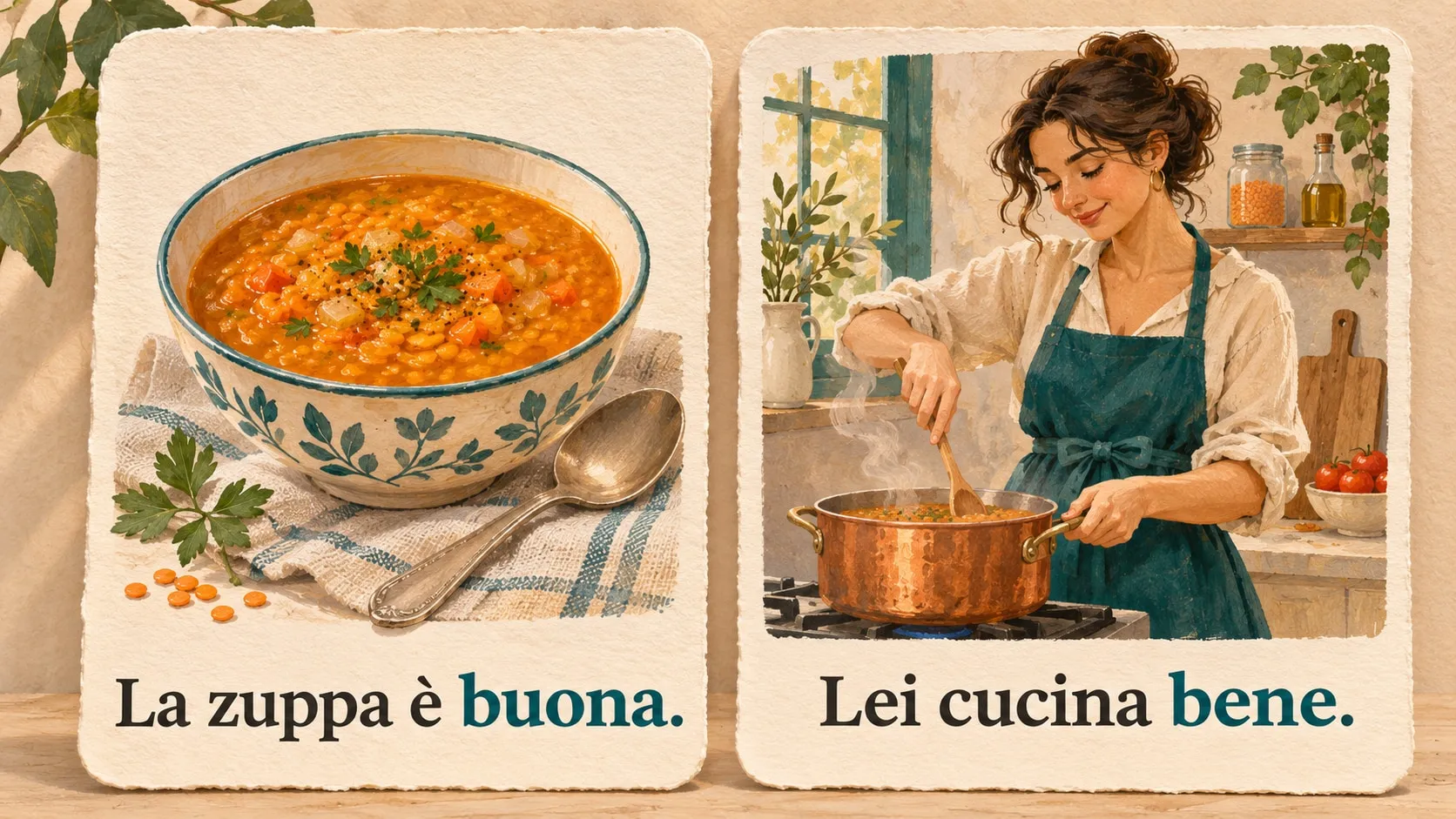
The soup is good, and she cooks well. Italian makes a similar distinction: La zuppa è buona and Lei cucina bene. The choice is about what you are describing, rather than how enthusiastic your compliment is.
Start by finding the word that your description refers to. If you need buono, choose its ending too. For everyday responses such as “I’m well” and “that’s fine,” learn the whole expression.
The basic difference: quality or how something happens?
Buono is an adjective. It describes a person or thing: their character, quality or taste, for example. In the basic uses covered here, bene is an adverb. It describes how something is done or how someone is feeling. LearnAmo and Dante Learning explain this adjective–adverb distinction.
| What you mean | Italian | What the description refers to |
|---|---|---|
| The soup is good. | La zuppa è buona. | the soup |
| She cooks well. | Lei cucina bene. | the cooking |
| The bread is good. | Il pane è buono. | the bread |
| We work well together. | Lavoriamo bene insieme. | working together |
Simply looking for a verb is not enough. La zuppa è buona contains a verb too. Ask whether you are describing the subject or saying how an activity is performed.
Buono, buona, buoni, buone: match the noun
The adjective agrees with the noun in gender and number. This also applies after è or sono:
| Noun | Form | Example |
|---|---|---|
| masculine singular | buono | Il gelato è buono. — The ice cream is good. |
| feminine singular | buona | La salsa è buona. — The sauce is good. |
| masculine plural | buoni | I biscotti sono buoni. — The biscuits are good. |
| feminine plural | buone | Le fragole sono buone. — The strawberries are good. |
Buono is not just for food. Una buona idea is a good idea; una persona buona can describe a kind-hearted person. Treccani includes quality, kindness and suitability among its meanings.
Why do you say un buon caffè?
Before many masculine singular nouns, buono becomes buon: un buon caffè, un buon libro, un buon amico. There is no apostrophe in that masculine shortened form, even before a vowel: un buon amico.
The full form remains before certain beginnings, such as s + consonant: un buono studente. After the verb, use the full form as well: Il caffè è buono, not è buon. Learn a few complete phrases first; Dante Learning’s guide to special adjective forms gives more detail.
Bene stays the same
Compare Lei canta bene (She sings well) and Loro cantano bene (They sing well). The verb changes; bene does not. Scrivete bene (You write well, plural) has no plural ending on the adverb either.
Useful patterns include:
- Capisco bene. — I understand well.
- Hai dormito bene? — Did you sleep well?
- Qui si mangia bene. — You can eat well here.
- Il telefono funziona bene. — The phone works well.
You do not need to invent a form ending in -mente for this meaning. Learn bene directly as the adverb “well.”
Sto bene and va bene: two everyday replies
To answer Come stai?, say Sto bene, grazie — “I’m well, thanks.” The pattern for this expression of well-being is stare bene. Sono buono, in an appropriate context, describes being good or kind-hearted; it is not the same answer about how you feel.
Va bene is another useful chunk. It can mean “okay,” “agreed” or “that’s fine.”
— Ci vediamo alle sei? — Shall we meet at six?
— Va bene! — That works!
ItalianPills also covers these expressions. Treat them as small conversational building blocks rather than isolated word translations.
Can bene come after essere?
Avoid the overly broad rule “never use bene after essere.” È bene riposare means roughly “It is good/advisable to rest.” You are evaluating an action as a whole. To describe the soup’s taste in La zuppa è buona, however, you need the adjective. These are different sentence patterns.
What about bravo and bello?
To praise a person’s skill, you will often use bravo: Giulia è brava a cucinare — Giulia is good at cooking. Giulia cucina bene describes how she cooks. Giulia è buona is more about her character.
Bello can describe beauty or an enjoyable experience. A cake can look bella and taste buona. Those are two separate judgements. Keep your main distinction in view: buono for quality, bene for how an activity is performed.
Ten exercises: identify the reference first
Fill each gap with bene or the right form of buono, including buon where needed. Number 10 is specifically about taste. Say the complete sentences aloud before checking the answers.
- La zuppa di lenticchie è davvero ___.
- I tuoi amici parlano italiano molto ___.
- Questi pomodori sono ___.
- Ti auguro un ___ viaggio!
- Come stai oggi? — Sto ___, grazie.
- Le tue proposte sono ___, ma dobbiamo scegliere.
- Hai scritto ___ il mio indirizzo.
- È un ___ amico: mi ascolta sempre.
- Ci incontriamo davanti alla stazione? — Va ___!
- Questo formaggio è ___, ma costa troppo.
Answers and explanations
- buona — zuppa is feminine singular; you are describing the soup.
- bene — the description concerns speaking, not the friends’ character.
- buoni — pomodori is masculine plural.
- buon — the shortened form directly before masculine singular viaggio. The phrase wishes someone a good journey.
- bene — the expression stare bene describes well-being.
- buone — proposte is feminine plural. Having sono in the sentence does not turn the description into an adverb.
- bene — the description concerns the way the writing was done.
- buon — the masculine shortened form before amico, without an apostrophe.
- bene — agreement with va bene.
- buono — the taste of masculine singular formaggio; use the full form after è.
Keep practising with complete phrases
Outside the app, write two pairs of your own sentences: one about something of good quality and one about doing something well. Cover the key word, then fill it in and explain what it refers to. Our guide to learning vocabulary in context with phrase flashcards develops this approach.
In Lingo Phrase Cards, one offered Italian-learning direction is German → Italian. Choose that direction and an accessible set if it suits your language background. The prepared target-language phrases include IPA and audio generated with Amazon Polly Neural. Try to answer before turning a card over; in the regular study mode, your ratings determine its box and next due date. The exercises above are editorial practice created for this article.
For another Italian word-choice question, try sapere vs conoscere. Or explore the available language directions and sets through the Lingo product page. Take this pair into your next practice session: La zuppa è buona. Lei cucina bene.