Rise vs raise: the difference and ten exercises with answers
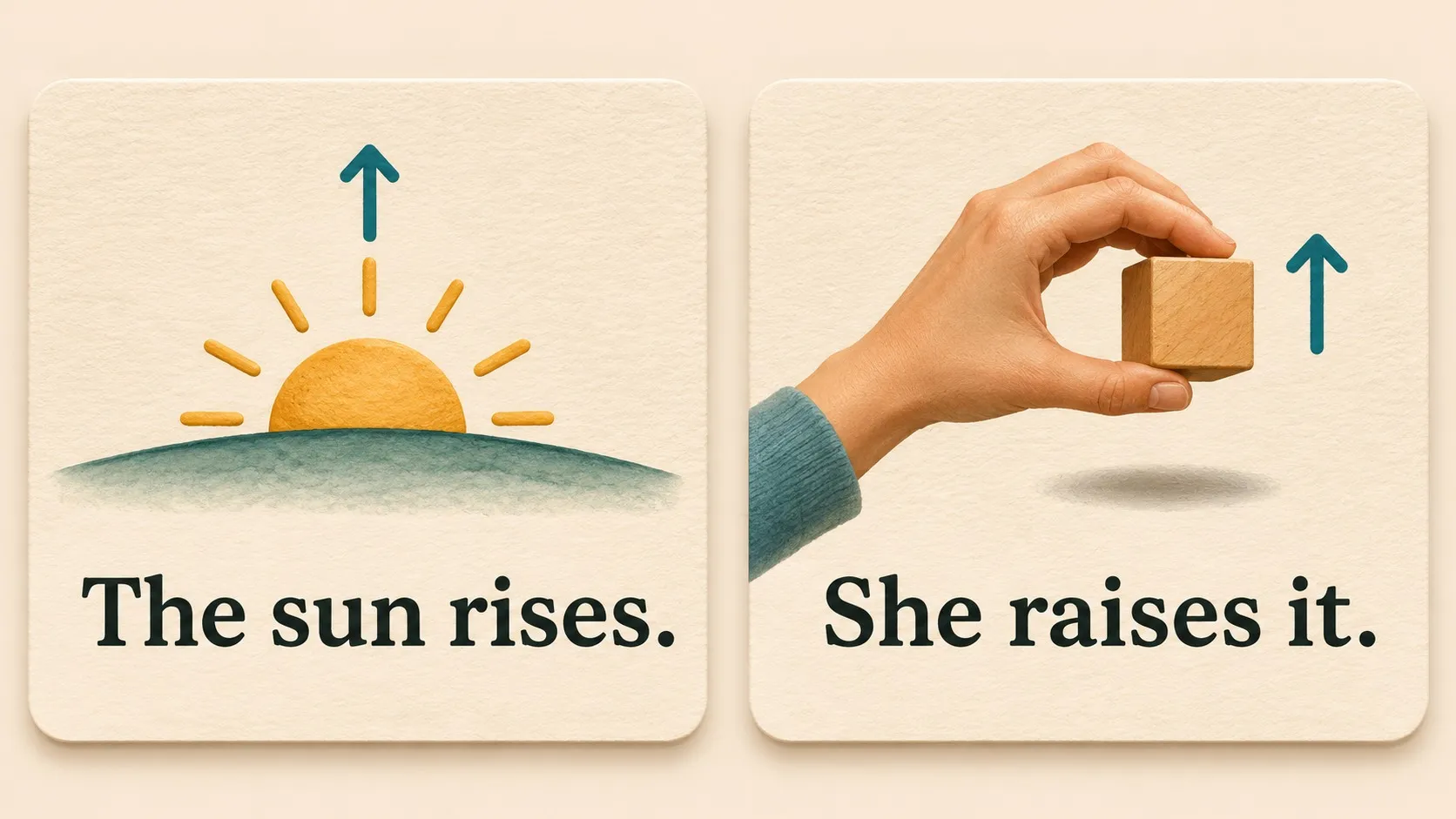
Prices rise, but a shop raises its prices. Both sentences describe prices becoming higher. The difference between rise and raise is the role of the subject: does it go up, or does it make something else go up? Looking at that relationship is more useful than memorising two similar definitions.
The basic difference
| Verb | Meaning in this comparison | Pattern | Example |
|---|---|---|---|
| rise | go up, increase | something/someone + rise | The sun rises. |
| raise | lift something or increase something | someone/something + raise + object | She raises it. |
Rise is intransitive: it has no direct object. Raise is transitive: in an active sentence, you raise something. Cambridge English Grammar Today explains this distinction and the verb forms.
“It goes up” describes the subject’s role, not the absence of a cause. Prices can rise because a business raises them. Choose the verb according to what your sentence makes the subject.
Describe one situation from two angles
Imagine a café where a coffee used to cost three euros and now costs four:
- The café raised its prices. The café is the subject. What did it increase? Its prices: the direct object.
- The prices rose. The prices are the subject. The sentence describes their change and has no direct object.
You can do the same with an arm: Mia raised her arm describes Mia lifting something. Her arm rose slowly makes the arm itself the subject. Learn the pair together so that the sentence pattern stays connected to the meaning.
Rise, rose, risen — raise, raised, raised
| Form | rise | raise |
|---|---|---|
| Base form | rise | raise |
| Past simple | rose | raised |
| Past participle | risen | raised |
| -ing form | rising | raising |
Rise is irregular; raise is regular. Pay particular attention to the past simple and past participle:
- The water level rose last night. A completed past situation.
- The water level has risen. The participle follows has.
- They raised the platform yesterday. They lifted the platform in the past.
- They have raised the platform. The participle is also raised.
Use has risen, not has rose. After did, use the base form: Did the water level rise? For more on time and context, see past simple vs present perfect.
Three traps to watch for
A word after the verb is not necessarily an object
The temperature rose yesterday is correct. Yesterday tells you when it rose. Prices rose by five percent also has no direct object: by five percent describes the size of the change. Don’t simply look for words after the verb. Ask what someone is lifting or increasing.
Raise can appear in the passive
The prices were raised is correct too. The prices receive the action and become the subject of the passive. In the corresponding active sentence, they are the object: The shop raised the prices. “Raise needs an object” is therefore not a visual shortcut for analysing every passive sentence. Our passive voice guide explains be + past participle.
Pay rise and pay raise are nouns
British English uses a pay rise, while American English uses a pay raise. EnglishClub compares the two noun phrases. This doesn’t change the verb pattern: The company raised my salary or My salary rose, not The company rose my salary.
Ten exercises: choose the verb and the form
Complete each sentence with a form of rise or raise. Read the whole sentence before deciding.
- Every morning, the sun ___ above the hills.
- Please ___ the box onto the shelf.
- The river ___ rapidly during last night’s storm.
- The hotel has ___ its room prices twice this year.
- Food prices have ___ since January.
- During yesterday’s meeting, Nora ___ her hand to ask a question.
- Did the temperature ___ during the night?
- The ticket price was ___ by the organiser yesterday.
- The balloons are ___ above the park now.
- The workers are ___ the heavy platform with a crane now.
Answers and explanations
- rises — The sun goes up; present simple with a singular subject.
- raise — The box is the direct object. Use the base form in this instruction.
- rose — The river went up during a completed past event.
- raised — The hotel increased its room prices; has requires the participle.
- risen — The prices increased; participle after have, no direct object.
- raised — Nora lifted her hand; past simple for yesterday’s meeting.
- rise — The temperature went up; did takes the base form, not rose.
- raised — Passive was raised: the organiser increased the price.
- rising — The balloons are going up; use the -ing form after are here.
- raising — The workers are lifting the heavy platform, the direct object.
A short practice routine
In your own notes, write The shop raised its prices, followed by The prices rose. Mark the subject in both sentences and the object in the first. Repeat with They raised the platform / The platform rose. Cover one version and reconstruct it from the other. This is a separate writing activity to complement prepared phrase practice.
In Lingo Phrase Cards, learners using an offered direction such as German → English can choose a suitable set. Target-language phrases include IPA and audio. In regular learning, attempt an answer before turning the card over, then assess it; this affects its box and due date. Free error-card practice doesn’t change card progress. Certain categorised sets require a licence.
For your next sentence, ask: What goes up, and who lifts or increases what? Explore the available language directions and sets in Lingo.