Sapere vs conoscere: Italian examples and exercises with answers
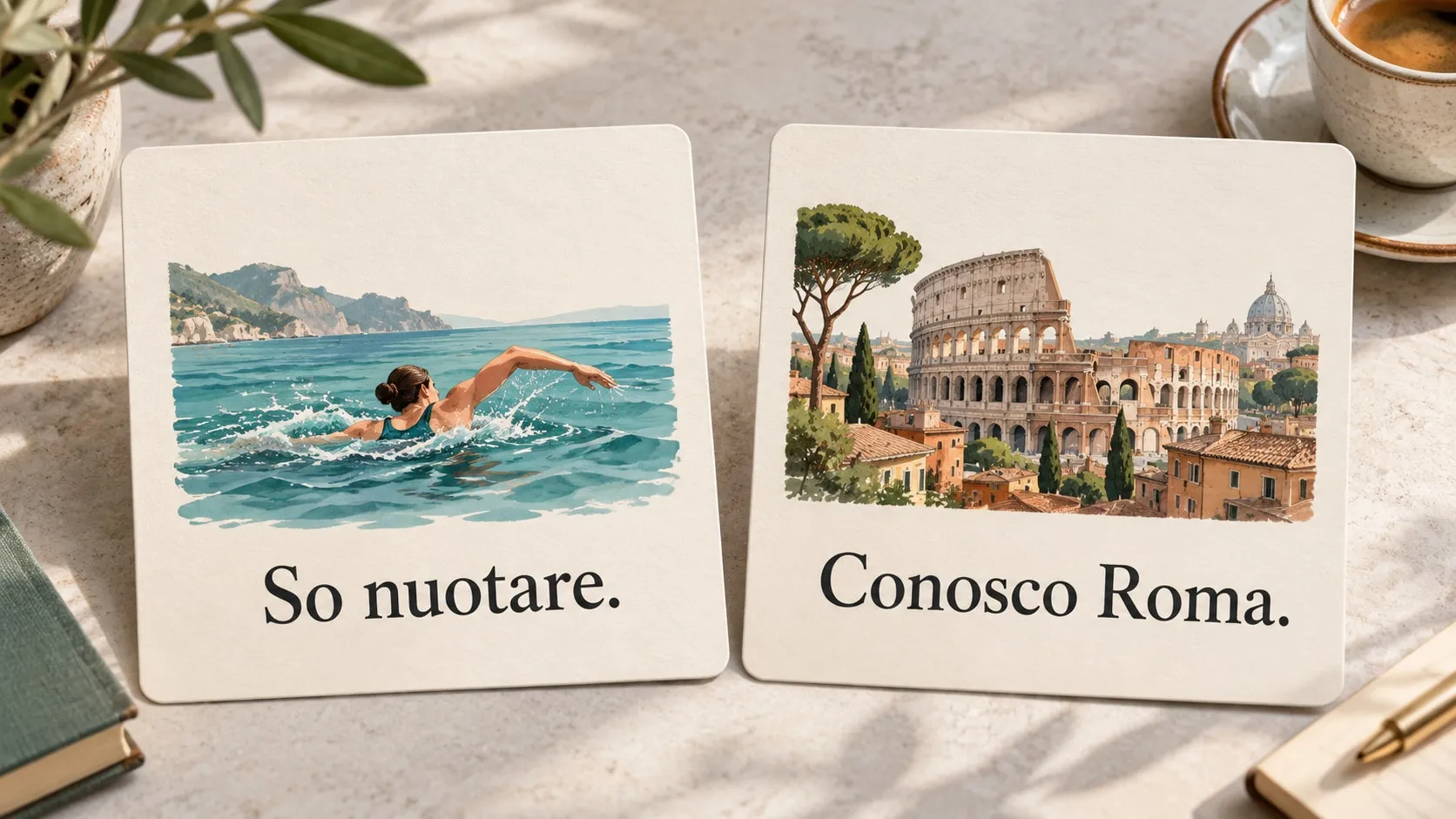
So dove abita Giulia means “I know where Giulia lives.” Conosco Giulia means “I know Giulia.” English uses know in both sentences, but Italian separates knowing information from being familiar with someone. There is a third useful pattern too: So nuotare means “I can swim.”
To choose between sapere and conoscere, ask what you mean: a fact, a skill, or familiarity? Then look at the structure that follows the verb. These examples and ten exercises help you practise both decisions together.
Three patterns to start with
| Your meaning | Pattern | Example |
|---|---|---|
| Know some information | sapere + clause | So che il museo è aperto. |
| Know how to do something | sapere + infinitive | So nuotare. |
| Know a person, place or thing | conoscere + direct object | Conosco Roma. |
These are starting points rather than an absolute dividing line. Sapere can also take a noun. Treccani’s dictionary entry, in Italian, describes knowledge of particular information and memorised material as well as clauses and infinitives.
Sapere: knowing information
Sapere often introduces a clause with che (that), se (whether), dove (where), quando (when), or another question word:
- So che il museo è aperto. — I know that the museum is open.
- Sai dove abita Giulia? — Do you know where Giulia lives?
- Non sappiamo se Paolo viene. — We don’t know whether Paolo is coming.
- Sapete quando parte il treno? — Do you know when the train leaves?
The information can still concern a person or place. Seeing a person’s name somewhere in the sentence does not automatically mean you need conoscere. Compare So chi è Giulia — “I know who Giulia is” — with Conosco Giulia — “I know Giulia.” Knowing someone’s identity does not mean you are acquainted with them.
Two practical short replies are Lo so (“I know”) and Non lo so (“I don’t know”). Here lo refers to the information. Learn the reply as a whole: the pronoun comes before the verb.
Sapere + infinitive: having a skill
With an infinitive immediately after sapere, you can describe something you know how to do:
- So nuotare. — I can swim.
- Marta sa guidare. — Marta can drive.
- I bambini sanno leggere. — The children can read.
There is no a or di between the verbs: so nuotare, not so a nuotare. Conosco nuotare does not express this skill either. Italiano Bello’s explanation, in German, also distinguishes this infinitive pattern.
It is useful to contrast potere: So guidare, ma oggi non posso guidare means “I know how to drive, but today I can’t drive.” You have the skill, while today’s circumstances or permission prevent you from using it. English can can cover both ideas; Italian makes the distinction through the verb.
Conoscere: being familiar with someone or something
Conoscere expresses acquaintance or familiarity. The person or thing follows as a direct object, without an extra preposition:
- Conosco Giulia. — I know Giulia.
- Conosciamo bene questo quartiere. — We know this neighbourhood well.
- Conoscete questo libro? — Do you know this book?
You can answer Conosci Giulia? with Sì, la conosco: “Yes, I know her.” Here la stands for a female person. In Lo so, by contrast, lo stands for information. Match the pronoun to what you are referring to.
For a travel contrast, compare Conosco Roma — “I know Rome” — and So dove si trova Roma — “I know where Rome is.” The second sentence does not claim familiarity with the city.
Present-tense forms
| Person | sapere | conoscere |
|---|---|---|
| io | so | conosco |
| tu | sai | conosci |
| lui / lei / Lei | sa | conosce |
| noi | sappiamo | conosciamo |
| voi | sapete | conoscete |
| loro | sanno | conoscono |
Notice sappiamo with two p’s and sanno with two n’s. So and sa have no written accent. A polite question uses the third-person singular: Scusi, sa dove si trova il museo? — “Excuse me, do you know where the museum is?”
Why “a noun always means conoscere” is too simple
Both So la risposta and Conosco la risposta can express knowing the answer. Songs provide another useful overlap: Conosco questa canzone can mean the song is familiar to you; So questa canzone can emphasise that you can sing or play it. Daily Italian Words explains this difference in emphasis.
Use the three patterns as your starting framework. With specific information or memorised material, the word class alone is not enough to choose the verb. The exercises below use clearly distinguishable situations.
Ten exercises: choose sapere or conoscere
Fill each gap with the correct present-tense form. The person appears in brackets where needed. Keep all other words unchanged.
- (io) ___ che il negozio è chiuso.
- (tu) ___ la mia collega Elena?
- Luca ___ suonare il pianoforte.
- (noi) Non ___ se Anna arriva oggi.
- (voi) ___ bene questo quartiere?
- I miei amici ___ cucinare molto bene.
- (noi) ___ i nuovi vicini: sono molto gentili.
- Scusi, ___ dove si trova il museo? (polite Lei)
- (io) Non ___ Paolo personalmente.
- (voi) ___ quando inizia il film?
Answers and reasons
- so — information introduced by che, first-person singular.
- conosci — acquaintance with Elena, second-person singular.
- sa — a skill with suonare, third-person singular.
- sappiamo — information with se, meaning “whether”.
- conoscete — familiarity with a neighbourhood, second-person plural.
- sanno — a skill followed by an infinitive, third-person plural.
- conosciamo — knowing the neighbours, first-person plural.
- sa — information with dove; polite Lei takes the third-person singular.
- conosco — knowing someone personally, first-person singular.
- sapete — information with quando, second-person plural.
Extra task: correct Conosco nuotare and So a nuotare. Both become So nuotare here. Say the complete phrase when checking, rather than just naming the verb.
Practise a short conversation
Conosci Elena? — Do you know Elena?
Sì, la conosco. — Yes, I know her.
Sai dove lavora? — Do you know where she works?
Non lo so. — I don’t know.
Change the name and add a question about a skill: Sa cucinare? Try your reply before looking back. When you later describe a first meeting, ho conosciuto can mean “I met”; ho saputo often means “I found out”. For the broader tense choice, read passato prossimo vs imperfetto.
For regular phrase practice, Lingo Phrase Cards lets you choose an offered language pair and a suitable set. Its prepared content combines phrases with IPA and Amazon Polly Neural audio for the target-language phrases. Try your answer before turning the card over, then use regular Leitner sessions for reviews. Free error-card practice offers an additional walkthrough without changing card progress. Categorised sets may require a licence.
Keep these patterns together: so che, so nuotare, conosco una persona. Explore the available language pairs and sets in Lingo Phrase Cards.