During or while? Sentence patterns and eight exercises
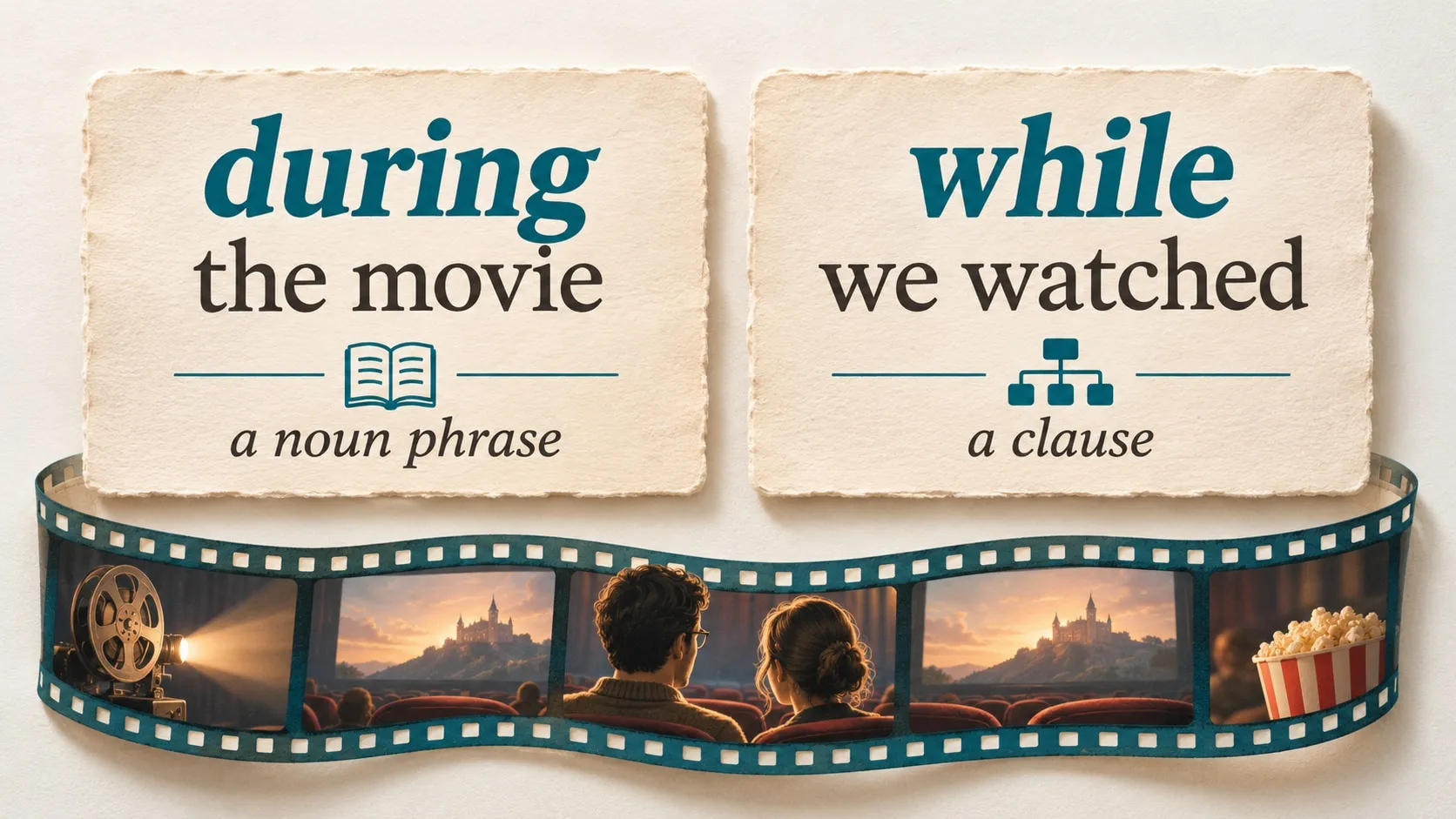
During the movie or while we watched the movie? Both locate something in time, but they take different structures: during + noun phrase, while + subject + verb. Checking what comes next is more useful than trying to assign each word a completely different meaning.
This guide covers time-related while, a quick comparison with for, and eight exercises with explained answers.
Look at what follows the gap
| What you want to add | Pattern | Example |
|---|---|---|
| a named event | during + noun phrase | We talked during the break. |
| someone doing something | while + subject + verb | We talked while we waited. |
| a measured duration | for + length of time | We talked for ten minutes. |
A noun phrase can contain several words. The long afternoon meeting is still a noun phrase. Count neither words nor syllables: ask whether you are naming an event or making a statement with a verb.
During: within an event or period
Use during the movie, during lunch, during our trip, or during the night. During does not automatically mean “from beginning to end.” My phone rang during the movie can describe a single moment. No phones during the exam can cover the entire exam.
Cambridge explains both uses of during. Avoid learning “during = the whole time” as a fixed rule.
The editorial example cards below pair English meaning cues with English learning sentences and broad US IPA. These are meaning-to-expression examples, not an English-to-English app course. The second sentence explicitly identifies the person watching the movie.
at some time in the movie
I slept at some time in the movie.
during the movie
I slept during the movie.
IPA of the complete target sentence: /aɪ slɛpt ˈdʊɹɪŋ ðə ˈmuvi/
at the same time as you watched the movie
I slept at the same time as you watched the movie.
while you watched the movie
I slept while you watched the movie.
IPA of the complete target sentence: /aɪ slɛpt waɪl ju wɑtʃt ðə ˈmuvi/
Learn this way in Lingo Phrase cards with example sentences, IPA and target-language audio you can listen to. Explore more content in the app.
Explore card sets in LingoWhile: during the time someone does something
In while you watched the movie, you is the subject and watched is the verb. Together they form a clause. You can put it first: While you watched the movie, I slept. Use a comma after this opening subordinate clause.
While does not always require a continuous tense. I listen to music while I cook describes a habit; The phone rang while I was cooking describes something in progress. Choose the tense for the situation, rather than automatically adding was and -ing.
You may also see reduced clauses: I read while waiting for the bus. Here, the person reading is also waiting. If you are unsure, expand the clause to while I was waiting. This shorter construction does not make during waiting for the bus a suitable replacement.
During or for: when versus how long
I slept during the movie tells you when. I slept for an hour tells you how long. You can combine both: I slept for an hour during the movie.
For a simple measured duration, use for two hours, not during two hours. However, numbers are not forbidden after during: during the first two hours of the trip identifies a particular part of an event. Cambridge compares during and for using this distinction.
For a starting point versus a duration, read the guide to for and since.
Repair three common mistakes
- During I was cooking … → While I was cooking …: during does not introduce this full clause.
- While the meeting … → During the meeting …, if you only name the event. A full clause would be while the meeting was taking place.
- We waited during twenty minutes. → We waited for twenty minutes.: This measures a duration.
One further distinction: while can express contrast. I like tea, while my brother prefers coffee contrasts preferences rather than locating an event in time. Cambridge discusses this use of while too.
Eight exercises: during, while or for?
Choose the word that fits. All eight questions concern time, not contrast.
- Please stay quiet ___ the exam.
- I made some tea ___ you were working.
- We waited ___ twenty minutes.
- It rained ___ the night.
- She takes notes ___ she listens to the podcast.
- He lived in Rome ___ three years.
- We met several people ___ the first two days of our trip.
- ___ I was washing the dishes, the phone rang.
Answers and reasons
- during: the exam is a noun phrase.
- while: you were working contains a subject and verb.
- for: twenty minutes measures duration.
- during: the night names the period; rain need not fall every minute.
- while: she listens is a clause; the simple present suits a habit.
- for: three years tells you how long he lived there.
- during: the first two days of our trip identifies a particular part of the trip.
- While: I was washing contains a subject and verb; capitalize the opening word.
Practise complete phrases
Describe one situation twice: first with during + event, then with while + subject + verb. Add for to say how long something lasted. This trains the structures rather than isolated definitions.
Lingo Phrase Cards provides words in phrases, with IPA and audio for the target-language phrases. Choose an offered language direction and an accessible set, try to recall the answer before turning the card, and listen to the target-language audio. Regular Leitner sessions schedule further reviews based on your ratings.
Explore the available language directions and sets in Lingo Phrase Cards.