For or since? Tell a duration from a starting point
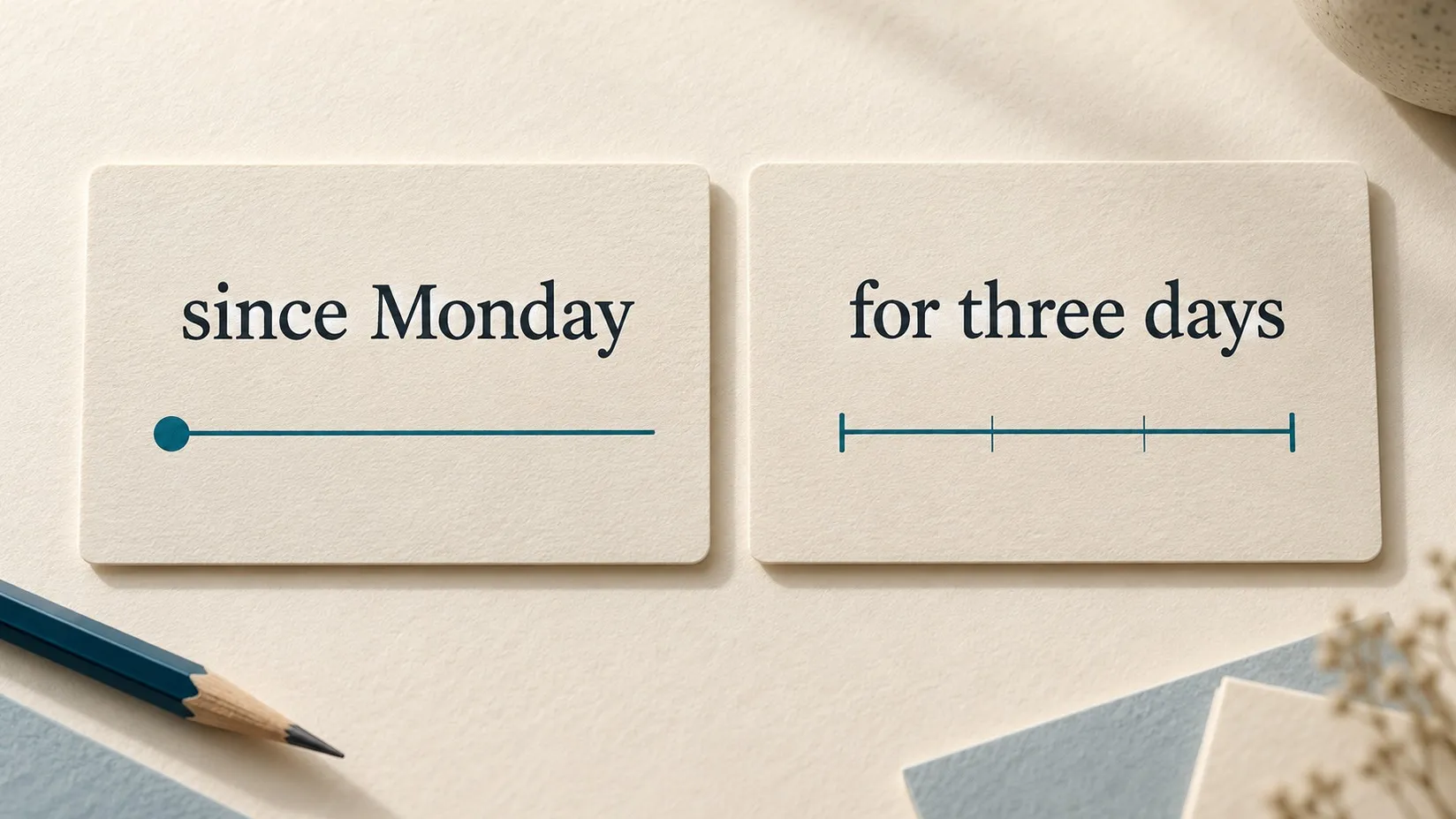
You can say since Monday or for three days, but not since three days. The choice depends on what the time expression tells you: when something began or how long it lasts. A precise duration still takes for: for exactly ten minutes.
This guide uses complete sentences and six practice questions to make the distinction clear. It also explains why for works with past events and future plans, not just the present perfect.
The basic rule
Use since for a starting point in the past. Think: Starting when?
- since Monday
- since 2022
- since nine o’clock
Use for for a period of time. Think: How long?
- for three days
- for two years
- for an hour
The year 2022 is a starting point on a timeline; two years is a length of time. Neither the size nor the precision of the number decides the answer. For a long time and for exactly ten minutes both describe duration.
Cambridge’s explanation of for and since makes this distinction and explicitly includes for with past, present, and future situations.
Two ways to describe one situation
Imagine it is Thursday. You arrived on Monday morning, exactly three days ago, and you are still here.
| Focus | Sentence | Information given |
|---|---|---|
| Starting point | I have been here since Monday. | the day you arrived |
| Duration | I have been here for three days. | the time that has passed |
Both sentences can describe the same stay. The expressions are not interchangeable in every situation, though. On Friday, the starting point would still be Monday, but the duration would be four days. Learn the whole pattern: since + starting point, for + period.
When a situation continues up to now
For a state that started in the past and still holds, you often use the present perfect: have/has + past participle.
- Maya has lived here since 2022.
- Maya has lived here for several years.
Both sentences describe Maya’s continuing residence. The first gives its beginning; the second gives its duration. In this meaning, Maya lives here since 2022 does not express the intended time relationship correctly.
For an ongoing activity, you may also see have/has been + verb-ing: I have been waiting for twenty minutes or I have been waiting since nine o’clock. The time expression still determines for versus since. The -ing form does not change the rule. See past simple versus present perfect for the wider tense distinction.
For also works with finished events and future plans
Do not treat for as an automatic present-perfect signal. Compare:
- I stayed in York for three days last summer. The stay is over.
- I have been in York for three days. The stay continues up to now.
- I will stay in York for three days next month. This is a future plan.
All three sentences use for three days because all three give a duration. The verb tense locates the stay in time. Changing the tense does not turn a period into a starting point. Likewise, since is not a general substitute for from when announcing a future starting date.
Three mistakes to fix
- Not since three weeks. Three weeks is a period. Use for three weeks.
- Not for Monday when you mean a situation began on Monday and continues. Use since Monday. In a different context, for Monday can describe something intended or scheduled for that day; that is a different use.
- Not I have lived there for two years last decade for a completed stay. Say I lived there for two years. The tense needs changing, but for two years remains correct.
This guide covers time expressions. Other meanings of for and since are separate uses, not exceptions to the starting-point/duration distinction here.
Practice: identify the meaning before choosing
Fill each gap with since or for. First decide whether the expression gives a starting point or a period. Keep the verb tense as written.
- I have been here ___ Monday.
- We have been waiting ___ twenty minutes.
- She has worked here ___ 2022.
- Last summer, we stayed in York ___ a week.
- Next month, I will stay with my cousin ___ three days.
- He has been studying ___ nine o’clock.
Answers and reasons
- since: Monday is the starting day.
- for: twenty minutes is the length of the wait.
- since: 2022 is a starting point, not a number of years.
- for: a week is the duration of the completed stay.
- for: three days is the planned duration, even though it is in the future.
- since: nine o’clock is when the studying began.
Turn the pattern into a sentence of your own
Write two true statements about yourself: one with a past starting point and one with a duration. Try I have lived … since … and I have been learning … for …. Check that the situation really continues up to now and that the time expression is accurate. Say each complete sentence aloud rather than rehearsing the preposition alone.
Lingo Phrase Cards presents vocabulary in phrases, with IPA and audio for the target-language phrases. For your own language study, choose an available language direction and a suitable set, try to answer before revealing the card, then rate your answer in regular learning mode. These ratings update the Leitner box and due date. Additional incorrect-card practice lets you work through mistakes without changing that progress. The examples in this article are editorial exercises that also work on paper.
For other time expressions, explore in, on, and at for time. Or browse the available language directions and sets in Lingo Phrase Cards.