Each or every? Sentence patterns and eight exercises
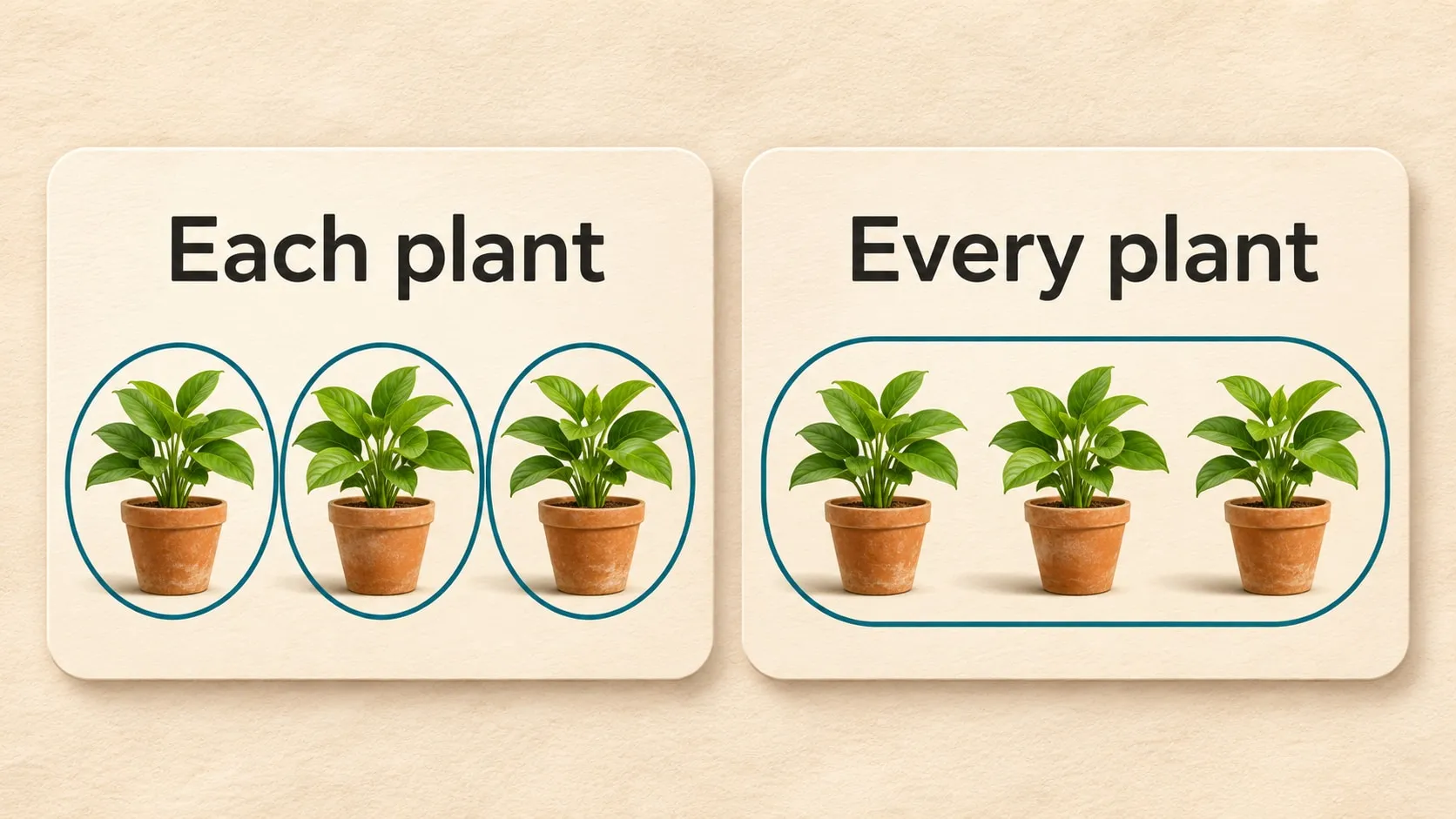
Each highlights individual members of a group; every includes all members without exception. Both often fit the same sentence, so a gap does not always have just one correct answer. Sometimes, though, the construction decides: each of us, every one of us, every two days.
Start with the difference in emphasis, check the sentence patterns, then try eight exercises with explained answers. “Small group versus large group” is not a reliable rule on its own.
Individual attention or the complete group?
Imagine three plants on a windowsill. When you consider their needs one by one, say Each plant needs water. When you emphasize that none is excluded, say Every plant needs water. The underlying fact stays the same; the perspective changes.
These editorial example cards pair English meaning cues with English sentences, using broad US IPA. They illustrate emphasis rather than a translation direction or an English-to-English app course.
each individual plant
Each individual plant needs water.
each plant
Each plant needs water.
IPA of the complete target sentence: /itʃ plænt nidz ˈwɔtɚ/
all the plants
All the plants need water.
every plant
Every plant needs water.
IPA of the complete target sentence: /ˈɛvɹi plænt nidz ˈwɔtɚ/
Learn this way in Lingo Phrase cards with example sentences, IPA and target-language audio you can listen to. Explore more content in the app.
Explore card sets in LingoCambridge English Grammar Today explains this distinction. Each can refer to two or more: She held a bag in each hand. Every refers to a group of three or more. Once both are possible, the number alone does not determine your choice.
A singular noun and usually a singular verb
Before a countable noun, use each/every + singular noun. When that phrase is the subject, use a singular verb too:
| Pattern | Example |
|---|---|
| each + singular | Each ticket has a number. |
| every + singular | Every visitor needs a ticket. |
| each of + a specified group | Each of the tickets has a number. |
| every one of + a specified group | Every one of the visitors needs a ticket. |
Avoid every visitors and each ticket have. But We each have a ticket is correct: we is the plural subject. The word each adds an individual meaning without making we singular.
Each of, but every one of
Before us, you, them, or a specified group, learn the complete pattern:
- Each of us has a key.
- Every one of us has a key.
- Each of the rooms is different.
Do not write every of us: you need one. You can also use each by itself: There are three rooms. Each is different. Every needs a noun or one: Every room is different.
Every day, intervals, and almost every
Use every for regular intervals: every day, every two days, every other day. The last two expressions both describe a two-day cycle. With a number, the noun is plural: every twenty minutes. This interval pattern is different from every visitor.
Each day is possible when you focus on the individual days. But each two days is not the usual way to describe a regular interval.
Write every day as two words for a time expression. Everyday is an adjective meaning ordinary: everyday problems. After almost or nearly, use every, not each: Almost every seat is taken. See Cambridge’s guide to Every.
Notice the negative too: Not every answer is correct means some answers are not correct. It does not mean that all answers are wrong.
Eight exercises
Choose from the alternatives and keep everything else unchanged. In 1, allow both answers if appropriate and explain the difference in emphasis.
- ___ student has a notebook. (Each / Every)
- ___ of us has a notebook. (Each / Every)
- Every ___ of the rooms has a window. (one / —)
- The bus leaves every twenty ___. (minute / minutes)
- Almost ___ shop is closed. (each / every)
- Each of the keys ___ a label. (has / have)
- We each ___ a different task. (has / have)
- I practise English ___ day. (every / everyday)
Answers and reasons
- Each or Every: individuals versus the complete group; both take the singular here.
- Each: each of us. With every, you would need every one of us.
- one: every one of the rooms, not every of.
- minutes: a number plus a plural noun for an interval.
- every: almost every, not almost each.
- has: each of the keys is a singular subject here.
- have: the subject is plural we.
- every: every day is the two-word time expression.
Practise the pattern, not just the word
Write your own sentence with each of us, every one of us, and every two days. Hide the pattern and try saying the full sentence before checking the noun and verb separately. For related choices, read about some and any and in, on, and at for time.
In Lingo Phrase Cards, vocabulary comes in phrases, with IPA and audio for the target-language phrases. Choose an offered language direction and an accessible set. During regular study, attempt your answer before turning the card over, then assess it yourself. Some categorized sets require a license.
Explore the available language directions and sets in Lingo.