Some or any? Choose the right word for questions, offers and negatives
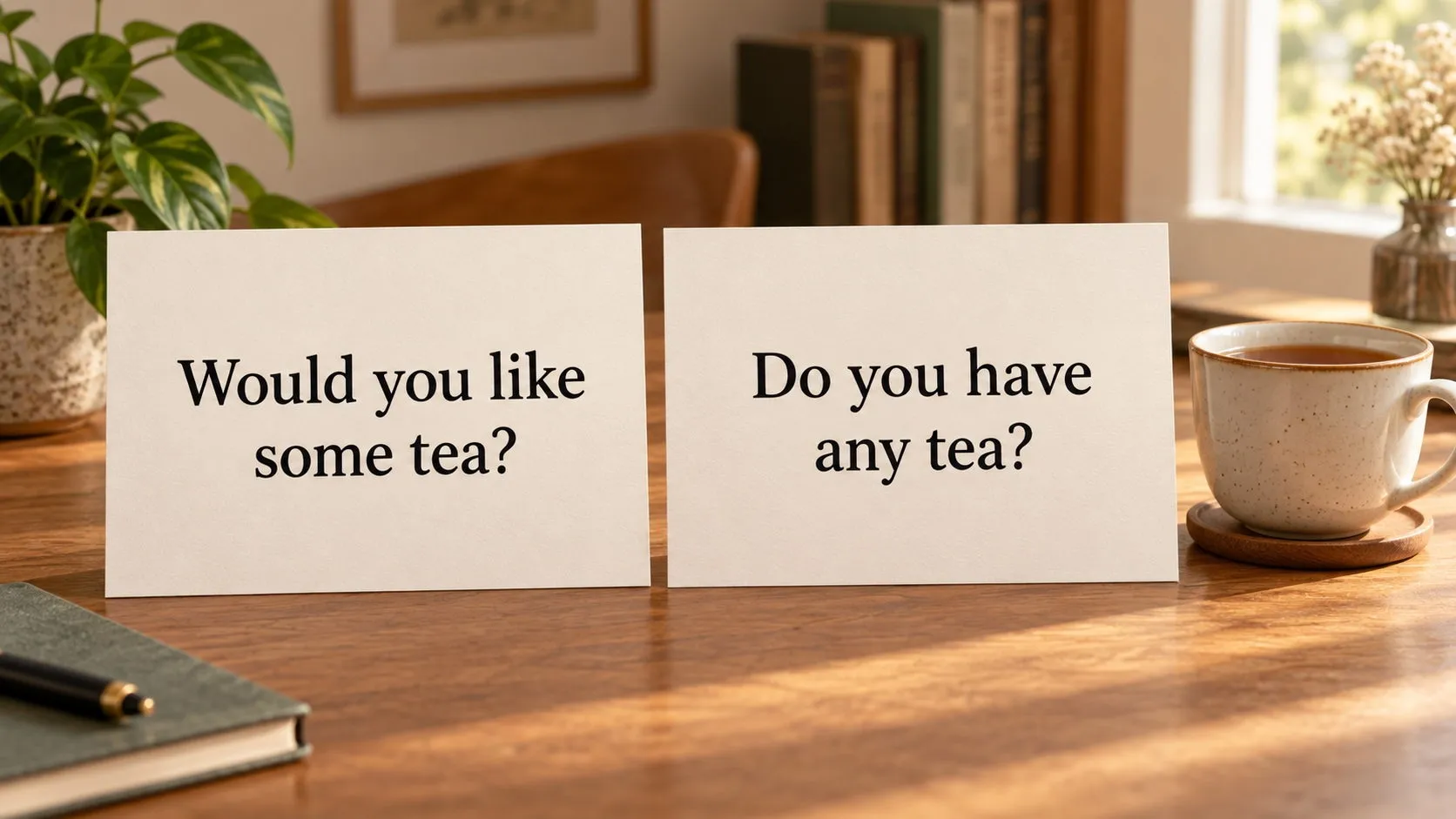
Would you like some tea? and Do you have any tea? are both questions, but they do different jobs. The first offers a drink. The second asks whether tea is available. That difference helps explain why one uses some and the other uses any.
“Some in positive sentences, any in questions and negatives” is a useful starting point, not a rule for every situation. This guide shows how to choose by meaning and conversational purpose, with a short tea-time scene and six practice tasks.
Start with the amount and the purpose
We often use some and any to talk about an amount without giving an exact number: some milk, some cookies, or whether there is any tea at all. Think about what you want the sentence to do.
| Your purpose | Usual choice | Example |
|---|---|---|
| Say that an amount is available | some | There is some tea. |
| Ask openly whether something is available | any | Is there any milk? |
| Say that none is available | not … any | There isn’t any milk. |
| Offer something or ask to receive it | often some | Would you like some tea? |
Cambridge’s overview of some and any describes these patterns and explains that questions can also use some when the speaker expects a positive answer. A question mark doesn’t make any compulsory.
Which nouns can follow some and any?
For an ordinary, unspecified quantity, use these words with plural countable nouns or uncountable nouns:
- some cookies / any cookies: individual items you can count.
- some milk / any milk: milk considered as an amount.
- some water / any water: water considered as an amount.
You can say one cookie, two cookies. When referring to one ordinary cookie, use a cookie: Would you like a cookie? For an unspecified plural amount, use some cookies.
Cambridge’s separate guides to some and any explain the distinctions in more detail. These quantity patterns don’t cover every meaning of the words. In particular, any can also mean “whichever you want,” including before a singular noun.
Five lines from the same tea-time scene
Imagine you’re preparing tea for a guest. Each line has a different purpose.
1. Say what you have
I have some tea and some cookies.
You’re reporting available amounts without counting them. Some fits the positive statement. It doesn’t automatically mean “very little” or specify a particular amount.
2. Ask what is available
Do you have any milk?
You don’t know whether milk is available. Any suits an open question. If you’re still working on the sentence structure, see the guide to questions with do, does and did. Forming the question and choosing its quantity word are separate decisions.
3. Say that something is missing
I don’t have any milk.
The negative word is don’t. Any doesn’t mean “none” on its own, so I have any milk doesn’t express an absence of milk. Remember the whole pattern don’t have any.
4. Offer a drink
Would you like some tea?
This is a question, but its purpose is an offer. Some is the usual choice in that ordinary offer: you present a portion of tea as something available to give. Your guest can still say no.
5. Ask to receive something
Can I have some milk, please?
Your guest is asking for milk, rather than simply investigating whether any exists. Some is common in requests of this kind. The Englisch-hilfen explanation, written in German, explicitly includes offers and requests among these uses of some.
Questions with some: expectations matter
Compare two questions with the same verb:
- Do you have any milk? An open question about whether milk is available.
- Do you have some milk? A question with a stronger expectation that milk is available.
Both can be grammatical. Choosing any doesn’t automatically make a question impolite, and choosing some doesn’t guarantee a yes. The context matters. Seeing a carton on the table can give you a reason to expect milk; knowing nothing about the supply makes any a neutral starting point.
The purpose is especially clear in Would you like some tea? and Can I have some milk, please?: offering and requesting. Learn the complete expressions with their situations instead of memorizing “question = any.”
Positive sentences with any: a free choice
Any can also mean it doesn’t matter which:
You can choose any cup.
Here you’re allowing a free choice. You’re not asking whether cups exist or saying how many someone should take. This is why any cup, with a singular countable noun, works. Cambridge’s guide to any distinguishes this meaning from an unspecified quantity in questions and negatives.
Compare Do you have any cups?, which asks about availability, with You can choose any cup, which allows a choice. “Never use any in a positive sentence” would be misleading.
Avoid three common mistakes
Choosing only by the question mark: In an ordinary tea offer, Would you like some tea? is the useful pattern. Don’t automatically replace some with any.
Treating any as a negative word: Say I don’t have any milk when no milk is available. You still need the negative part of the sentence.
Mixing up one item and an amount: Use a cookie for an ordinary single cookie and some cookies for an unspecified plural amount. Any cup meaning “whichever cup” belongs to a different pattern: free choice.
Practice: let the situation guide you
Choose some or any. Write the whole sentence and explain your choice before reading the answers. The situations specify the intended meaning.
- You report that cookies are available: There are ___ cookies on the table.
- You don’t know whether tea remains and ask neutrally: Do we have ___ tea left?
- You say that no milk is available: We don’t have ___ milk.
- You offer your guest a drink: Would you like ___ tea?
- Milk is on the table and you ask for a portion: Can I have ___ milk, please?
- Your guest may choose whichever cup they want: You can choose ___ cup.
Answers explained:
- Some: There are some cookies on the table. An unspecified amount is available.
- Any: Do we have any tea left? This is an open availability question. Some could work in a different situation with a positive expectation.
- Any: We don’t have any milk. Don’t supplies the negative meaning; any goes with it.
- Some: Would you like some tea? The question makes an offer.
- Some: Can I have some milk, please? You request a portion of something you expect to be available.
- Any: You can choose any cup. Whichever cup is fine: a free choice, not a negative.
Turn the patterns into a short conversation
Choose something from everyday life and make three sentences: We have some water. Do we have any water? We don’t have any water. Add an offer: Would you like some water?
Say the sentences with a model first, then try them using only the situation as your cue. Next, change water to milk or cookies to apples. Check whether you’re naming an amount, asking openly, saying none is available, or offering something.
In Lingo Phrase Cards, you can choose an offered language pair with English as the language you’re learning and preview suitable sets. The prepared content presents words in phrases, with IPA pronunciation notation and audio for the target-language phrases. Certain categorized sets require a license; their previews remain available.
Start with an unlocked set in regular study mode. Try answering before turning the card over, then indicate whether you knew the answer. Due cards are selected before new ones. Use the pronunciation aids to repeat phrases, and practice the tea-time conversation from this article as a separate sentence activity.
Ask not just “statement or question?” but “What am I trying to say?” To continue with prepared phrases, explore the offered language pairs and sets on the Lingo page.