First or second conditional? Real possibilities and imagined situations
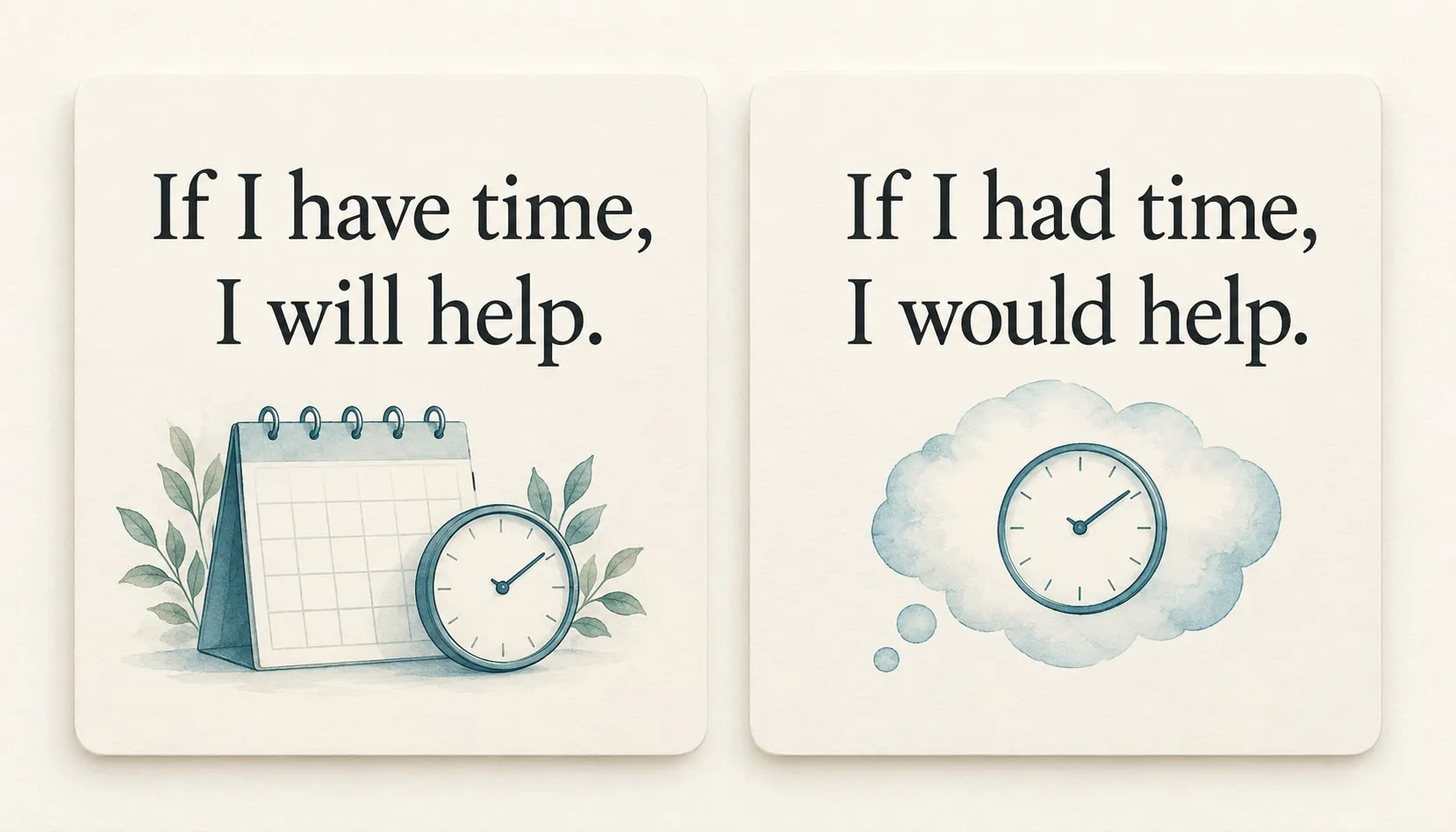
“If I have time, I will help” makes a different offer from “If I had time, I would help.” The first leaves a future possibility open; the second imagines a different situation. To choose between the first and second conditional, start with your meaning, then choose the verb forms.
The difference at a glance
| Your perspective | Basic pattern | Example |
|---|---|---|
| A real future possibility | if + present simple, will + base form | If I have time, I will help. |
| An imagined present or future situation | if + past simple, would + base form | If I had time, I would help. |
The first sentence suggests that having time later is a genuine option. The second may mean that you are busy now or do not expect to have time. Second conditional does not automatically mean impossible. It presents the situation as more distant from reality.
As Cambridge explains, the past form in a second conditional marks that distance. It does not necessarily refer to past time: had can be about today or tomorrow.
One situation, two viewpoints
Imagine discussing tomorrow’s outing:
- If the weather is good tomorrow, we will walk to the lake. — Good weather is a real possibility, and your plan depends on it.
- If the weather were good tomorrow, we would walk to the lake. — You imagine good weather but consider it unlikely, perhaps because of the forecast.
Both sentences can contain tomorrow. A time word alone does not select the conditional. The speaker’s viewpoint matters, and there is no fixed probability percentage separating the two patterns.
Forming the first conditional
The usual future pattern is present simple in the if-clause and will + base form in the result clause:
If Mia finishes early, she will call us.
Keep the third-person -s in finishes. For a negative condition or result, use the normal negative forms: If Mia doesn’t finish early, she won’t call us before dinner. After doesn’t, use finish, not finishes. Won’t means will not.
You can reverse the order: Mia will call us if she finishes early. Normally, use a comma when the if-clause comes first, but not when it comes second.
The result does not always require will: If you finish early, you can join us expresses an available option. If it rains, we might stay home expresses a possible result. Begin with present + will when practising the basic contrast.
Forming the second conditional
Use past simple in the if-clause and would + base form in the result clause:
If I lived closer, I would visit more often.
This describes an imagined change to where you live now, not a past visit. A negative example is If I didn’t work on Saturdays, I would join the club. After didn’t, use the base form.
For hypothetical be, were is a useful standard choice with every person: If she were here, she would know what to do. You will also hear was with I/he/she/it in informal usage. Learn this advice phrase as a complete unit: If I were you, I would …
Three common traps
- Putting will in the condition: For an ordinary future condition, say If it rains, we will stay home, rather than If it will rain ….
- Putting would in both clauses: The basic pattern is If I knew the answer, I would tell you, rather than If I would know ….
- Reading every past form as past time: If I had a car, I would drive imagines car ownership now.
These guidelines apply to the basic patterns here. Special if-clauses expressing willingness or polite requests can contain will or would.
Two neighbouring patterns answer different questions. If I am tired, I go to bed early describes a habit: a zero conditional. If I had left earlier, I would have caught the train imagines a different past: a third conditional. Neither is the present/future contrast we are practising.
Practice: choose the viewpoint first
Complete the verbs, using will or would for the result.
- A real plan for tomorrow: If the bus ___ (arrive) on time, we ___ (reach) the museum before ten.
- You do not own a car: If I ___ (have) a car, I ___ (drive) to the coast.
- Lea really might finish early tomorrow: If Lea ___ (finish) early, she ___ (join) us.
- Advice to a friend: If I ___ (be) you, I ___ (ask) for help.
- Your room is too small now: If my room ___ (be) bigger, I ___ (buy) a larger desk.
- An open possibility this evening: If we ___ (not leave) soon, we ___ (miss) the last bus.
Answers and reasons
- arrives / will reach — an open future condition, with third-person -s.
- had / would drive — imagined ownership, unlike the current reality.
- finishes / will join — a genuine option for tomorrow.
- were / would ask — the familiar hypothetical advice phrase.
- were / would buy — the room is not actually bigger.
- don’t leave / will miss — a possible real consequence; use the base form after don’t.
Without context, both viewpoints may be grammatically possible. Explain what you mean as well as which form you chose.
Turn the patterns into phrase practice
On paper, write two sentence pairs: a realistic weekend plan and an imagined alternative. Cover the result and complete it aloud. Then deliberately change viewpoint: If I have …, I will … becomes If I had …, I would …. These are editorial practice examples.
For your wider study routine, Lingo Phrase Cards provides vocabulary in phrases, with IPA and audio on the target-language side. Choose an available language pair and set, attempt an answer before revealing it, then rate it in regular learning mode. Those ratings update the card’s Leitner box and due date.
Continue with will vs going to or explore the Leitner study routine.
Further reading
Explore the available language pairs and sets in Lingo Phrase Cards.