Used to, be used to or get used to? Meaning, examples and practice
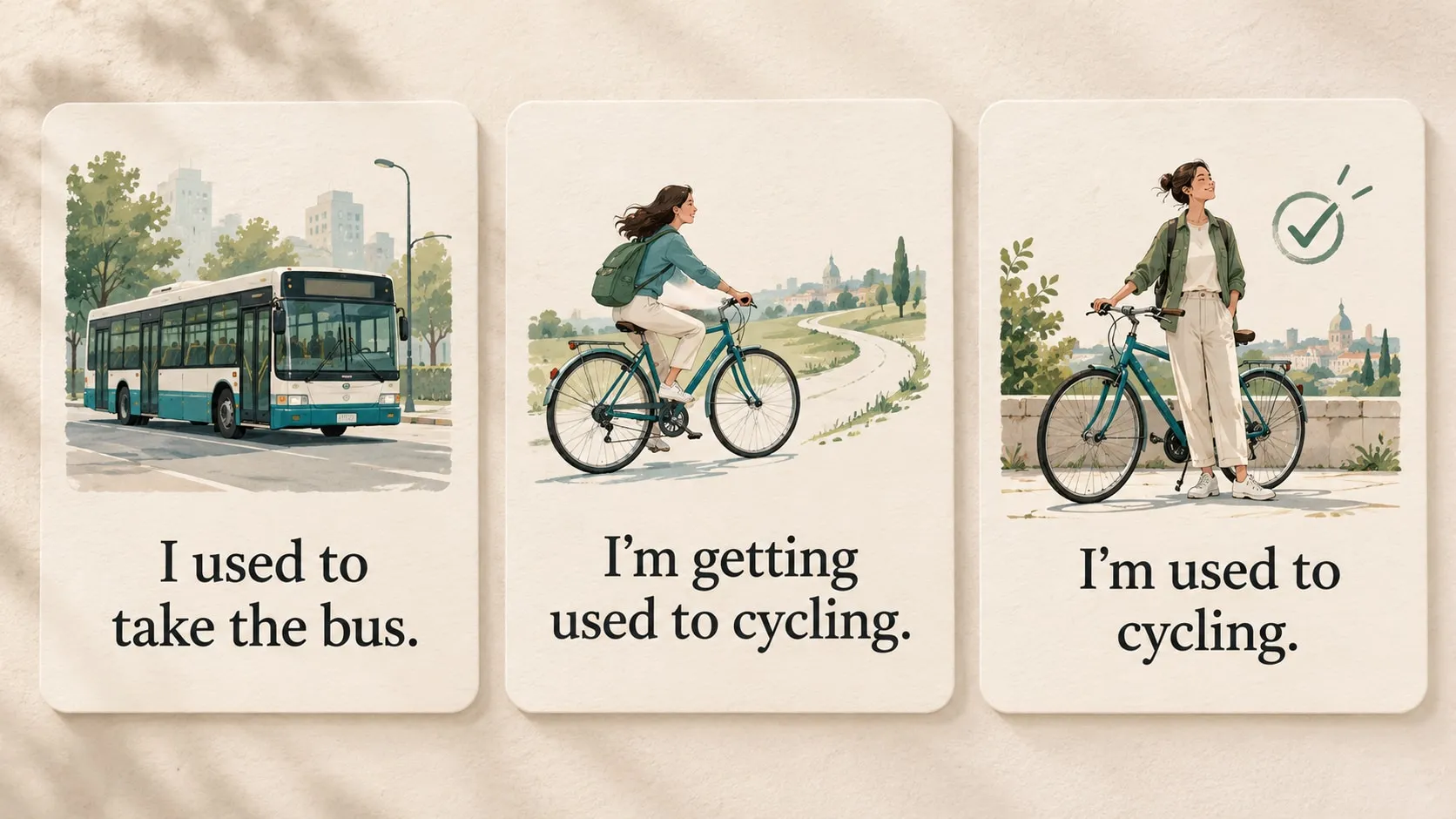
I used to cycle describes a past habit. I’m used to cycling says cycling is familiar to you. I’m getting used to cycling means you are becoming comfortable with it. These similar-looking phrases answer three different questions.
Choose your meaning first, then build the sentence. This guide gives you a practical comparison, a short commuting story and six exercises with explained answers.
A quick decision table
| What do you mean? | Pattern | Example |
|---|---|---|
| This was true before, but it isn’t now. | used to + base verb | I used to take the bus. |
| This is familiar or normal for me. | be used to + noun/-ing | I’m used to cycling. |
| This is becoming familiar. | get used to + noun/-ing | I’m getting used to cycling. |
Think past habit – familiarity – adaptation. Calling all three “habits” hides the distinction: a former routine and being comfortable with an activity aren’t the same thing.
Used to: a past habit or state
Use used to + base verb for repeated actions or states that are no longer true:
- I used to take the bus to work. That was my regular way of travelling, but it isn’t now.
- Maya used to live near the station. She lived there before; she doesn’t now.
- We used to have a smaller office. Our previous office was smaller.
This pattern works with states as well as activities. You can use verbs such as live, have and be. Don’t add am/is/are before it. The form stays the same for every subject: I used to, she used to, they used to.
For one particular event, use the past simple: I took the bus yesterday. You are reporting one journey, not a former routine. For a present habit, say I usually take the bus. There is no present-habit form I use to take the bus.
You may also see would describing repeated actions in a past narrative. It isn’t a direct replacement for used to when describing a past state such as We used to have a smaller office.
Be used to: something is familiar
Be used to means “be accustomed to”. Follow it with a noun, a pronoun or an -ing form:
- I’m used to the traffic. The traffic is familiar to me.
- I’m used to it. It isn’t something new or strange for me.
- I’m used to cycling in the city. Cycling there feels normal.
Here, to is a preposition. That’s why a following verb becomes cycling, not cycle. Learn the complete pattern be used to doing something, rather than assuming every to must introduce a base verb.
The form of be gives you the tense. I’m used to working late describes familiarity now; I was used to working late describes familiarity at a past time. The second sentence doesn’t simply mean “I regularly worked late”: it says the routine was familiar.
Get used to: becoming familiar
Get used to describes adaptation. Something unfamiliar becomes more normal. Again, use a noun, a pronoun or -ing afterwards:
- I’m getting used to cycling. The adjustment is happening now.
- You’ll get used to the traffic. It will become more familiar.
- I got used to getting up early. I became accustomed to an early start.
In the last example, got is the past form of the verb expressing adaptation. Getting up names the activity. Having both forms in the same sentence is correct.
Compare three stages of a change:
- I used to take the bus. This was my old commute.
- Now I’m getting used to cycling. My new commute still feels unfamiliar.
- After a few months, I’m used to cycling. It feels normal now.
Notice that be used to and get used to aren’t restricted to the past. You can change be or get to express the time you need.
Questions and negatives: check the first verb
For past habits, use did … use to and didn’t use to as your standard written learning patterns, without -d after did:
- Did you use to take the bus?
- I didn’t use to cycle.
With be used to, move or negate be instead:
- Are you used to cycling?
- I’m not used to cycling.
For get used to, the question depends on the tense: Did you get used to cycling? asks about a past adjustment; Are you getting used to cycling? asks about a process happening now. For more on auxiliary verbs, see English questions with do, does and did.
Six practice questions
Choose the option that matches the context before checking the answers.
- I had a car before, but I don’t now: I (used to have / am used to having) a car.
- Early starts feel normal to me: I’m used to (get / getting) up early.
- My new job is gradually becoming familiar: I’m (getting used to / used to) the new job.
- Ask about someone’s former routine: Did she (use / used) to work here?
- Tell someone they will adapt: You’ll get used to (it / do it).
- Report just yesterday’s journey: I (used to take / took) the bus yesterday.
Answers and explanations
- used to have: a past state that is no longer true.
- getting: a verb after be used to takes the -ing form.
- getting used to: the adjustment is in progress. Here a noun follows the phrase.
- use: after did, the standard written learning form has no final -d.
- it: a pronoun can follow get used to. With an activity, you could say doing it.
- took: the sentence reports a single event in the past simple.
Turn the contrast into a speaking exercise
Choose work, food or travel. Make three statements: something you did before, something you are adapting to and something that now feels normal. Say them without looking at a model, then check be/get and the form after to. This is a practice suggestion you can do yourself.
In Lingo Phrase Cards, choose an available language direction and a suitable set. Prepared phrases connect vocabulary with context, and target-language phrases include IPA and supplied audio. In regular study, attempt your answer before revealing the card, then rate it. Additional free practice doesn’t change Leitner boxes or due dates.
Keep the three patterns together: used to do = past habit; be used to doing = familiarity; get used to doing = adaptation. Explore the available language directions and sets on the Lingo product page.