Lose vs loose: meaning, pronunciation and ten practice questions
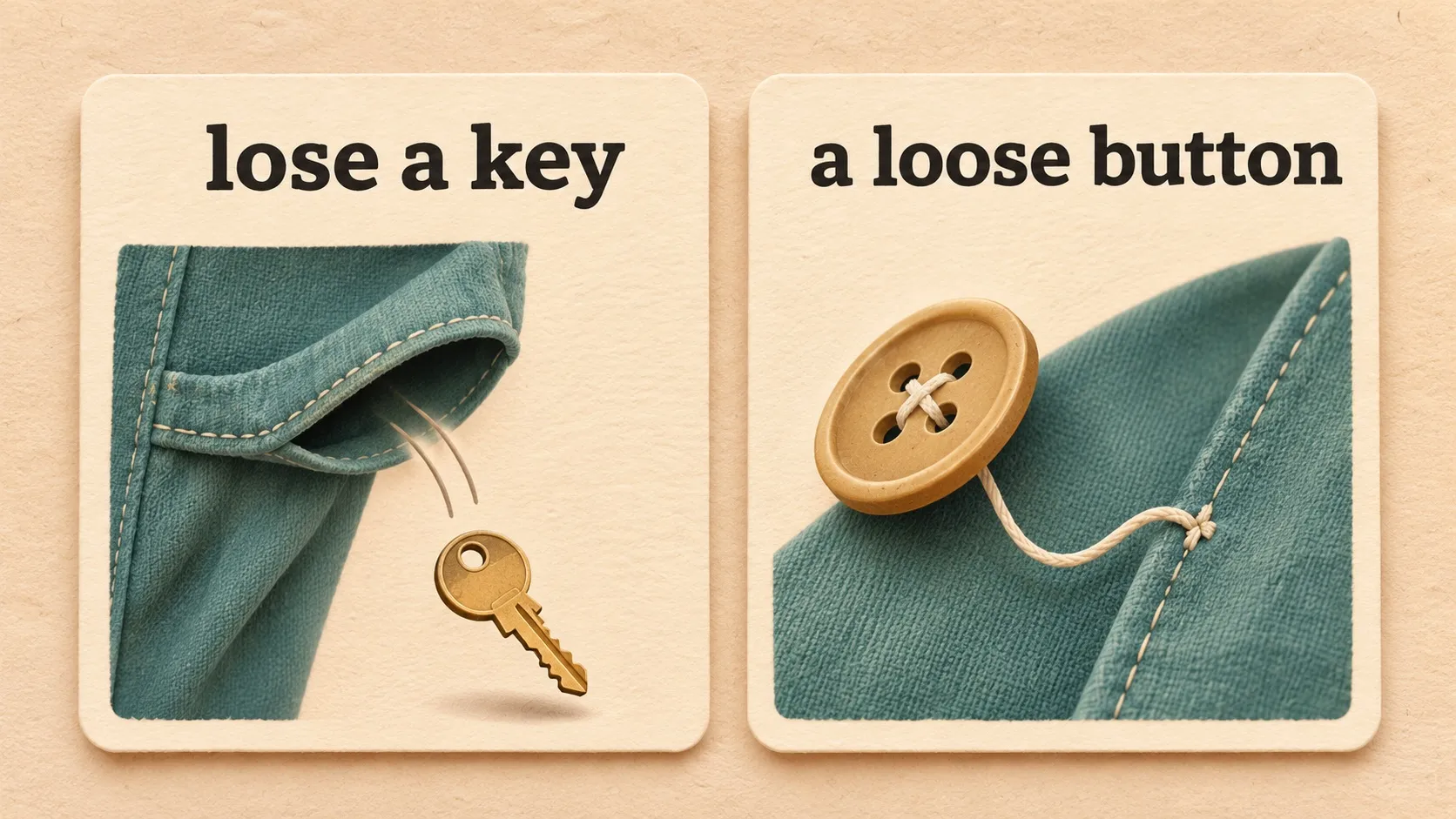
Lose means to stop having something or to be defeated: Don’t lose your ticket. Loose usually describes something that is not firmly attached or not tight: This button is loose. The extra o changes both the meaning and the final sound: lose /luːz/, loose /luːs/.
When you hesitate, start with the meaning: Is someone losing something, or are you describing how something fits or is attached? Then check the spelling and, if you need a verb, its form.
The difference at a glance
| What you mean | Word | Example |
|---|---|---|
| no longer have something | lose | I don’t want to lose this receipt. |
| fail to win a game | lose | We might lose the final. |
| stop being interested | lose | I lose interest in long meetings. |
| not firmly attached | loose | The handle is loose. |
| not tight-fitting | loose | I prefer loose shirts. |
Cambridge documents the meanings of lose and the adjective loose. For everyday sentences, start with lose = stop having; loose = not tight.
Lose: misplace something, stop having it or fail to win
Lose is a verb. You can lose a physical object, a competition or something less tangible:
- I often lose my shopping list. I put it somewhere and cannot find it.
- They don’t want to lose the match. They want to win.
- Try not to lose your patience. Try to remain patient.
Learn short combinations such as lose a ticket, lose a match and lose interest. These give you usable phrases rather than a definition disconnected from a sentence.
Lose, loses, losing and lost
| Form | Example |
|---|---|
| base form: lose | We can’t lose another key. |
| third-person singular: loses | She sometimes loses her notes. |
| -ing form: losing | We’re losing time. |
| past tense: lost | I lost my umbrella yesterday. |
| past participle: lost | I’ve lost my umbrella. |
Write losing, with one o, when you mean losing something. The past form is lost, not losed. After didn’t, return to the base form: I didn’t lose it, not I didn’t lost it.
Loose: not tight, secure or firmly attached
In these sentences, loose is an adjective. It can come before a noun or after be:
- There is a loose screw in the chair. The screw is not secure.
- The screw is loose. This describes its condition.
- These trousers are too loose. They do not fit closely enough.
Compare a loose button and a lost button. The first is attached insecurely; the second has gone missing. The words describe different situations, not alternative spellings of the same idea.
“Loose is an adjective” is useful here, but it is not an absolute rule. Loose can also be a less common verb meaning, for example, to release, with forms loosed/loosing. That does not make I’m loosing my keys correct when you mean I’m losing my keys.
Pronunciation: the same vowel, a different ending
Cambridge gives lose /luːz/ and loose /luːs/ in both its British and American pronunciation guides. Both contain a long /uː/ vowel. Listen for the final consonant:
- /z/ in lose is voiced: your voice vibrates.
- /s/ in loose is voiceless: there is a hiss without a voice sound.
Lightly rest your fingertips on your throat and alternate the individual sounds /ssss/ and /zzzz/. Then say lose a key and a loose button, without adding an extra vowel at the end. If the symbols are unfamiliar, see the guide to using IPA for pronunciation, which introduces the notation through Spanish and French examples.
Three common mistakes to fix
- I don’t want to loose my phone. For something you do not want to misplace: I don’t want to lose my phone.
- My jacket is too lose. For a fit that is not tight enough: My jacket is too loose.
- She is loosing interest. For becoming less interested: She is losing interest.
A spelling reminder: lose has “lost” an o; loose has room for two. This is a mnemonic for this pair, not a general rule about English spelling.
Ten practice questions: meaning first, form second
Fill each gap with lose, loses, losing, lost or loose. Give a brief reason before checking the answers.
- Put the receipt somewhere safe. Don’t ___ it.
- This lid is too ___. It doesn’t fit tightly.
- Yesterday, our team ___ the final.
- Marta often ___ her gloves on the bus.
- We’re ___ daylight. Let’s finish the walk.
- There’s a ___ button on your coat.
- I haven’t ___ your number; it’s in my contacts.
- You might ___ your balance on this wet floor.
- I prefer ___ clothing when I travel.
- Did you ___ the little key, or is it still in your bag?
Answers and explanations
- lose — Do not misplace the receipt; don’t takes the base form.
- loose — The lid does not fit tightly; this describes a condition.
- lost — The team failed to win yesterday; use the past tense.
- loses — A repeated action with a third-person singular subject.
- losing — The available daylight is decreasing; we’re takes the -ing form here.
- loose — The button is still present but insecurely attached.
- lost — Haven’t is followed here by the past participle of lose.
- lose — Lose your balance is the phrase; might takes the base form.
- loose — Clothing that is not tight-fitting.
- lose — Did takes the base form, even though the question is about the past.
Turn the distinction into your own sentences
Write one sentence about something you do not want to lose, one about a past loss and one about something loose: I don’t want to lose … / Last week I lost … / … is loose. Hide the sentences and try to recall them later from their meanings. Check the word choice, verb form and final sound separately. The guide to learning vocabulary in context offers more ways to work with short phrases.
For your wider language practice, Lingo Phrase Cards lets you choose an offered language direction and set, then study prepared phrases with target-language IPA and audio. In the regular study mode, try to answer before revealing the card, then mark whether you knew it; those answers determine Leitner reviews. Listen to the supplied audio and repeat the phrase yourself as a pronunciation exercise.
Explore the available language directions and sets in Lingo Phrase Cards.