Muy vs mucho: Spanish examples and ten exercises with answers
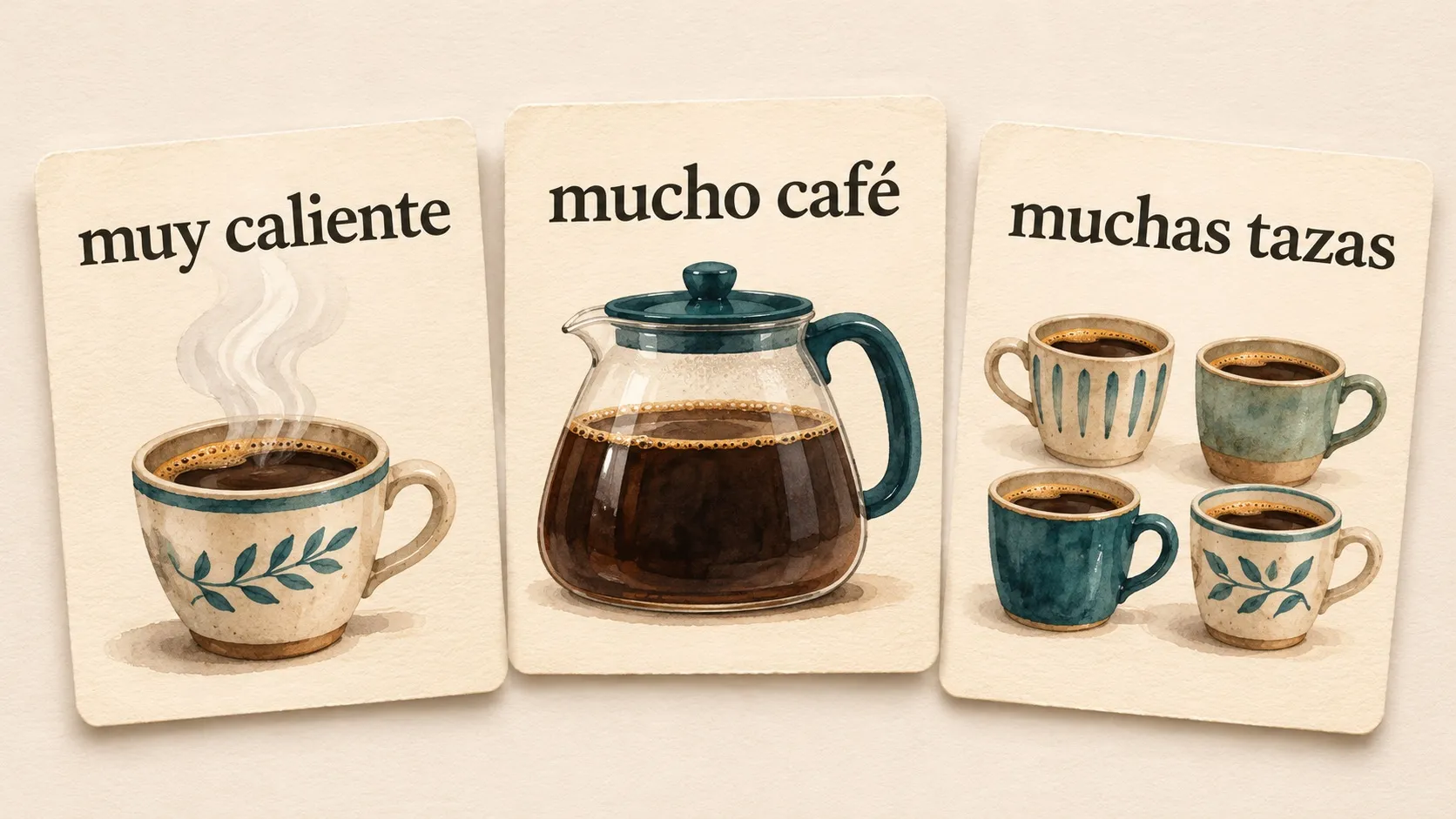
El café está muy caliente means “The coffee is very hot.” Bebo mucho café means “I drink a lot of coffee.” Both sentences belong at the same breakfast table, but muy intensifies a quality while mucho describes an amount. To choose between them, ask what the word modifies rather than translating “very” or “much” in isolation.
This guide covers the basic patterns, the endings mucho, mucha, muchos, muchas, and comparisons such as mucho mejor. Ten original exercises let you put the distinction into practice.
The quick decision table
| What do you describe? | Pattern | Original example |
|---|---|---|
| an intense quality | muy + adjective | El café está muy caliente. — The coffee is very hot. |
| how something happens | muy + adverb | Ana habla muy despacio. — Ana speaks very slowly. |
| a large quantity | mucho/mucha/muchos/muchas + noun | Tenemos muchas tazas. — We have lots of cups. |
| how much an action happens | verb + mucho | Ana trabaja mucho. — Ana works a lot. |
| a substantial difference | mucho + comparative | Hoy estoy mucho mejor. — I’m much better today. |
Lingolia’s guide to Spanish quantifiers explains the basic patterns. The RAE/ASALE entry for mucho, in Spanish, provides the reference for agreement and comparative constructions.
Muy before an adjective or adverb
Muy makes an adjective or adverb stronger and does not change its ending:
- La taza es muy pequeña. — The cup is very small.
- Las tazas son muy pequeñas. — The cups are very small.
- Explicas muy bien. — You explain very well.
- El autobús llega muy temprano. — The bus arrives very early.
In the second sentence, pequeñas takes a feminine plural ending. Muy stays the same. There is no muya or muys in this pattern.
Seeing a verb somewhere in the sentence does not mean you should use mucho. In Ana habla muy despacio, muy modifies despacio. In Ana habla mucho, mucho describes how much Ana speaks. Speaking slowly and speaking a lot are different claims.
Mucho, mucha, muchos and muchas with nouns
When you mention a quantity, match the form to the Spanish noun, not its English translation:
| Form | Noun phrase | Meaning |
|---|---|---|
| mucho | mucho café, mucho tiempo | a lot of coffee, a lot of time |
| mucha | mucha agua, mucha paciencia | a lot of water, a lot of patience |
| muchos | muchos libros, muchos días | many books, many days |
| muchas | muchas tazas, muchas preguntas | many cups, many questions |
English “a lot of coffee” can tempt you to insert de. In these straightforward Spanish quantity phrases, use mucho café, not mucho de café.
Another useful phrase is Tengo mucha hambre, “I’m very hungry.” Hambre is feminine even though its singular definite article is el: el hambre. The same principle gives mucha agua, despite el agua. RAE/ASALE explicitly notes the feminine form with nouns of this type.
With a verb, mucho does not agree with the subject
When mucho modifies an action, it is an adverb. Its ending does not change to match the person doing the action:
- Pablo estudia mucho. — Pablo studies a lot.
- Marta estudia mucho. — Marta studies a lot.
- Mis amigas estudian mucho. — My female friends study a lot.
The last sentence still uses mucho, not muchas. You are describing the amount of studying, not counting friends.
Use the same reasoning with Me gusta mucho este barrio, “I like this neighborhood a lot.” Here you intensify the liking itself. There is no adjective for muy to modify.
Comparisons: muy bien, but mucho mejor
Before comparative forms such as mejor, peor, más, menos, mayor, menor, antes and después, use the full form mucho:
- Hoy duermo muy bien. — I’m sleeping very well today.
- Hoy duermo mucho mejor. — I’m sleeping much better today.
- Esta ruta es mucho más corta. — This route is much shorter.
- Llegamos mucho antes. — We arrive much earlier.
Learn muy bien → mucho mejor and muy mal → mucho peor as pairs. Muy mejor does not fit the standard comparative pattern practised here.
With a larger quantity of a noun, agreement returns: Tenemos muchas más preguntas, “We have many more questions.” Compare Estas preguntas son mucho más fáciles, “These questions are much easier.” In the first sentence, you describe the number of questions; in the second, you intensify más fáciles.
Ten exercises: choose and explain
Fill each gap with muy, mucho, mucha, muchos or muchas. Identify the reason too: quality, manner, quantity, action or comparison.
- Esta sopa está ___ caliente.
- Necesitamos ___ agua para la excursión.
- Mis hermanas trabajan ___ los lunes.
- En esta biblioteca hay ___ libros.
- La profesora explica ___ bien.
- Hoy me siento ___ mejor.
- Tengo ___ hambre después del paseo.
- Tenemos ___ más preguntas que ayer.
- Estas preguntas son ___ más fáciles.
- Me gusta ___ este café.
Answers with reasons
- muy — Caliente is an adjective.
- mucha — Agua is feminine singular.
- mucho — The amount of work does not agree with mis hermanas.
- muchos — Libros is masculine plural.
- muy — It modifies the adverb bien.
- mucho — It comes before the comparative mejor.
- mucha — Hambre is feminine: mucha hambre.
- muchas — A quantity comparison with feminine plural preguntas.
- mucho — It intensifies más fáciles, rather than quantifying a noun.
- mucho — It intensifies the liking: me gusta mucho.
Turn the rule into your own phrases
Write three sentences: a quality with muy, a quantity with the appropriate mucho ending, and an action with mucho. For example: El café está muy caliente. Bebo mucho café. Leo mucho. Cover the model, say the sentences, then change one noun or quality. These are editorial practice examples you can try on paper.
For more Spanish sentence patterns, read Ser vs estar and Spanish vocabulary in everyday sentences.
In Lingo Phrase Cards, you can choose English → Spanish and open a set preview. Vocabulary appears in phrases, with IPA and audio for the target-language phrases. Pick a set you have access to, answer before turning the card over, and assess your answer in the regular Leitner study mode. Some categorized sets require a license.
Explore the available language directions and sets. For your next sentence, start with one question: What am I intensifying or counting?