Do, does or did? Turn English statements into questions
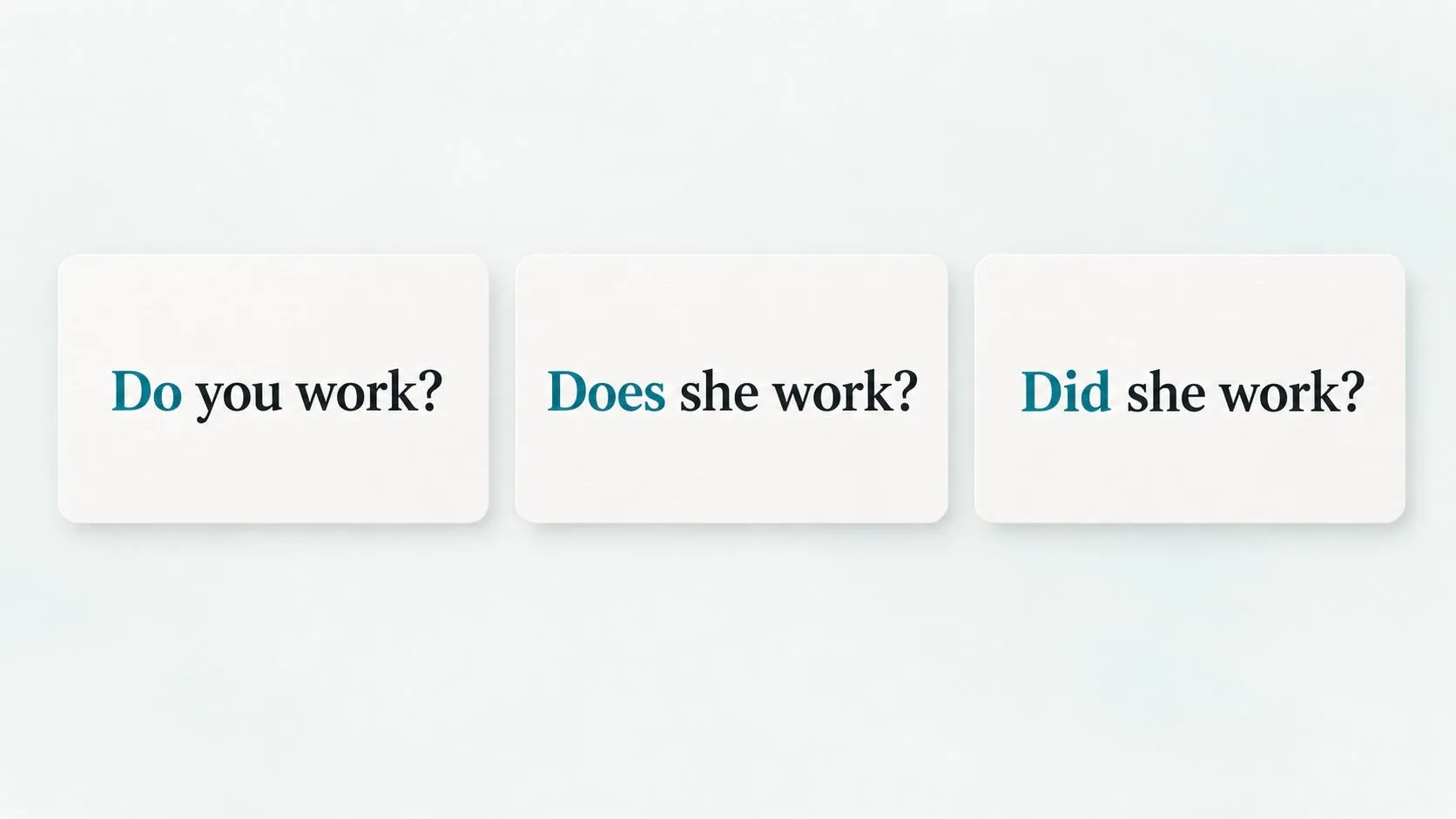
She works here. To ask about that statement, say Does she work here?, not Does she works here? You aren’t just moving words around: does carries the third-person singular marking, so the main verb goes back to its base form. The same division of jobs works in the past: She worked yesterday becomes Did she work yesterday?
Once you understand which verb does which job, question formation becomes easier to follow. This guide covers neutral, direct questions in the present simple and past simple, with the main exceptions and seven practice tasks.
Check the tense, the subject and the base form
In a simple statement, the main verb shows the person or past tense: she works, she worked. In the corresponding question, a form of do helps build the sentence. Here it is an auxiliary verb: its job is grammatical, rather than describing the action “do”.
| Statement | Question | Why this form? |
|---|---|---|
| You work here. | Do you work here? | Present simple with you: do. |
| She works here. | Does she work here? | Present simple with she: does, then work. |
| She worked yesterday. | Did she work yesterday? | Past simple: did, then work. |
For questions with ordinary main verbs such as work, like and live:
- Use do with I, you, we, they in the present simple: Do they live here?
- Use does with he, she, it: Does Maya live here? A person’s name can also be a third-person singular subject.
- Use did with every person in the past simple: Did Maya live here? / Did they live here?
After do, does or did, use the base form without to. Irregular verbs follow the same question pattern: They went home becomes Did they go home?, not Did they went home? The explanations of present-simple questions and past-simple questions show the underlying structure.
Put the words in the right order
For a yes/no question, use:
Do/Does/Did + subject + base form + rest?
The subject tells you who performs the action: you, she, Maya, the children. It stays after the auxiliary. The children like music becomes Do the children like music? Don’t simply move the main verb to the front.
When you want a particular piece of information, put a question word first:
Question word + do/does/did + subject + base form + rest?
- She works in a café. → Where does she work?
- They arrived on Monday. → When did they arrive?
- You like this song. → Why do you like this song?
Leave out the information you are asking for: Where does she work? doesn’t repeat in a café, because the workplace is what you want to find out. Check the whole word order, rather than choosing an auxiliary and stopping there.
When don’t you need do, does or did?
Not every English question uses do. Before changing a statement, look for a verb form that already does the job.
| Statement | Question | What changes? |
|---|---|---|
| She is tired. | Is she tired? | With be, move is before the subject. |
| They were at home. | Were they at home? | Be doesn’t need did in the past simple either. |
| She can help. | Can she help? | The modal verb can is already there. |
| They have arrived. | Have they arrived? | Move the present-perfect auxiliary have to the front. |
Don’t say Does she be tired? or Does she can help? Cambridge’s guide to yes/no questions explains these distinctions. This doesn’t mean that have can never go with do: when have is a main verb, Do you have a car? is a normal question.
Another important distinction: Are you asking who performed the action? Compare:
- Who called Maya? You don’t know the caller. Who is the subject, so called keeps its past form in this positive, neutral past-simple question.
- Who did Maya call? The subject Maya is known; you want to identify the person she called. Use did + Maya + call.
It isn’t the word who on its own that decides whether you need did. Its role in the sentence matters. The subject- and object-question comparison shows the difference in meaning.
Spot three common mistakes
Marking the verb twice: Does she likes coffee? → Does she like coffee? The third-person marking is already in does. Likewise, Did they went home? → Did they go home? The past tense is already in did.
Leaving out the subject: Where does work? → Where does she work? A question about someone’s workplace still needs to name the person or use a pronoun.
Deleting the second do: She does yoga. → Does she do yoga? The first word is the question auxiliary; the second do is the main verb describing the activity. Both have a job. The main verb returns to its base form after does.
Practice: turn statements into questions
Write each whole question before checking the answers. Then identify the tense, subject and main verb. The last two tasks specify which person you are asking about.
- They like coffee. → Make a yes/no question.
- Maya works here. → Make a yes/no question.
- They went home yesterday. → Make a yes/no question.
- She is ready. → Make a yes/no question.
- He can swim. → Make a yes/no question.
- Maya called Leo. → Ask for the identity of the person Maya called.
- Maya called Leo. → Ask for the identity of the person who called Leo.
Answers explained:
- Do they like coffee? Present simple with they: do, followed by like.
- Does Maya work here? Maya is third-person singular: does, then work without -s.
- Did they go home yesterday? Past simple: did. The base form of went is go.
- Is she ready? Move the form of be to the front; don’t add do.
- Can he swim? Put the existing modal verb before he.
- Who did Maya call? Maya stays the subject, while who asks about the object. Use call after did.
- Who called Leo? Who replaces the subject; called keeps its past form in the neutral, positive question.
Take the pattern into a short conversation
Write three statements of your own: one with you, one with she or he, and one about yesterday. Turn them into questions and add short answers. For example: Do you work? – Yes, I do. Does she work? – No, she doesn’t. Did she work? – Yes, she did. When someone asks you, your answer about yourself uses I. Keep the appropriate auxiliary in the short answer.
If you’re unsure which past tense expresses your meaning, see the guide to past simple versus present perfect. Choosing a tense and forming a question are separate decisions.
In Lingo Phrase Cards, learners using German → English can choose an available set, answer a card before turning it over and then mark whether they knew the answer in the regular study mode. The sentence transformations above are an activity of your own to complement those reviews. Categorised sets may require a licence. Explore the available language pairs and sets in Lingo.