Passé composé or imparfait? Tell a story in French
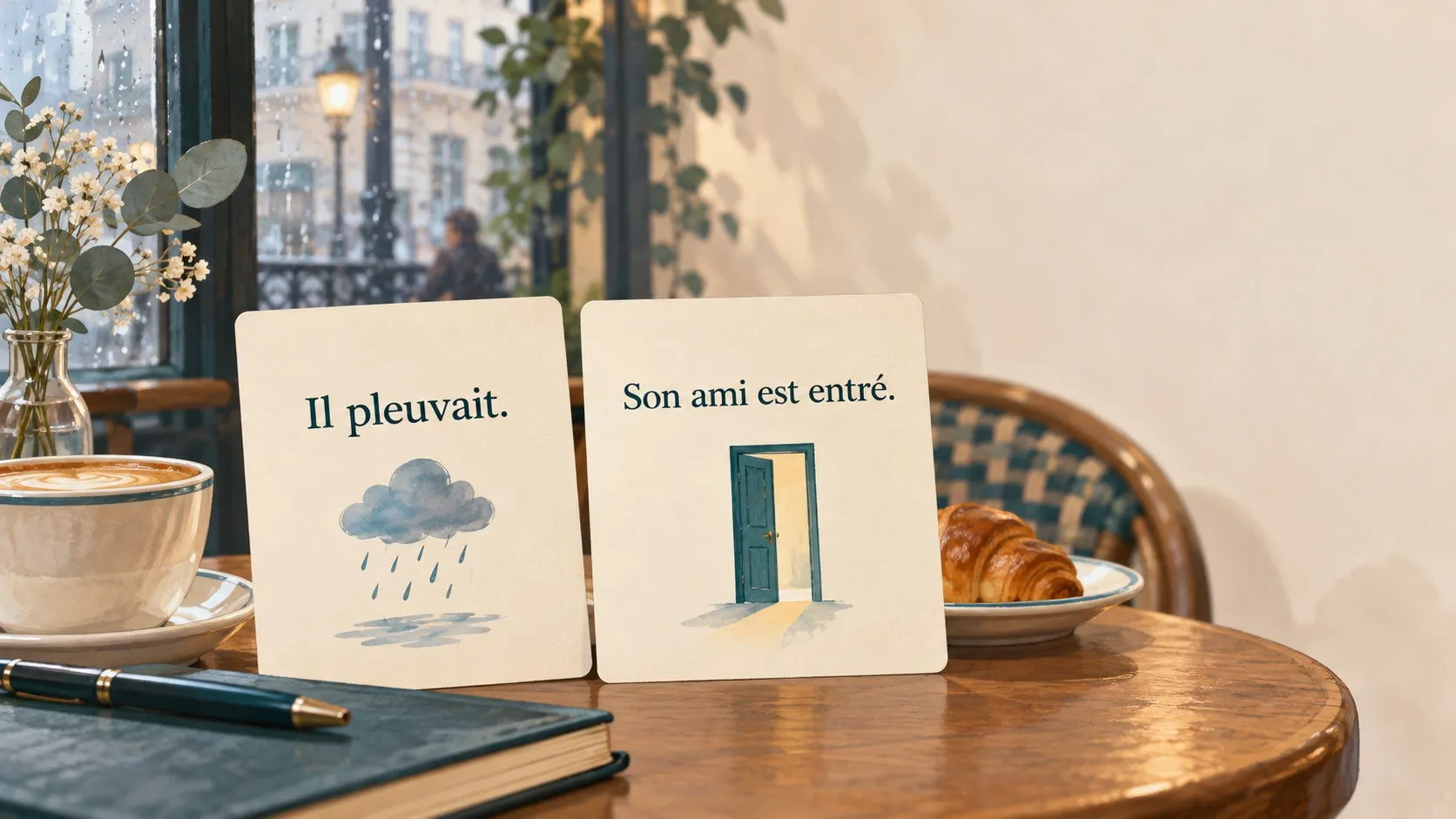
Il pleuvait. Léa lisait dans un café. Soudain, son ami est entré. It was raining; Léa was reading in a café; then her friend walked in. Why are the first two verbs in the imparfait and the last in the passé composé? Think of what each verb contributes to the story rather than translating both as a generic past tense.
What was already happening? What happened next?
The imparfait often paints the setting: weather, a state of affairs or an action in progress. The passé composé places an event on that background. Here il pleuvait sets the scene, Léa lisait describes what she was doing, and son ami est entré moves the story forward. Both Lingolia’s comparison and Lawless French explain how the tenses work together.
| Sentence | Ask yourself | Function |
|---|---|---|
| Il pleuvait. | What was the weather like? | Imparfait: setting. |
| Léa lisait dans un café. | What was she doing? | Imparfait: action in progress. |
| Son ami est entré. | What happened? | Passé composé: new event. |
“Long action versus short action” is not a reliable rule. The point is how you present an action: as a background, a habit or a distinct occurrence.
Habit or a particular Saturday?
Compare Tous les samedis, Léa lisait au café (Léa used to read at the café every Saturday) with Samedi, son ami est entré. Ils ont commandé un thé (On Saturday her friend came in; they ordered tea). The first sentence describes a recurring habit. The others tell us what happened on one occasion.
You can combine the two perspectives in a single sentence: Léa lisait quand son ami est entré. Léa was reading when her friend came in. The reading was underway; the entrance adds an event. A word such as samedi is a clue to the context, not an automatic tense selector. First decide what you want to say. This French contrast is different from the English choice between past simple and present perfect.
Form the verbs you need
For most verbs in the imparfait, take the stem of the present-tense nous form and add an ending: nous lisons → lis- → elle lisait. For the weather in this scene, learn the impersonal form il pleuvait. The passé composé uses an auxiliary and a past participle: il est entré, ils ont commandé. See Lingolia’s explanations of the imparfait and passé composé for the full patterns. With être, the participle agrees here with the subject: il est entré, but elle est entrée.
Learn each form in a meaningful sentence; a verb table alone will not tell you whether your sentence is setting the scene or reporting an event.
Try it: finish the scene
Choose imparfait or passé composé for the verb in parentheses. Is the blank a setting, a habit, an ongoing action or a new event?
- Il ___ (pleuvoir) quand Léa est arrivée au café.
- Léa ___ (lire) quand son ami est entré.
- Soudain, son ami ___ (entrer).
- Ils ___ (commander) un thé, puis ils ont parlé.
- Avant, Léa ___ (lire) là tous les samedis.
Answers: 1. pleuvait — weather forms the setting. 2. lisait — reading was already in progress. 3. est entré — his arrival is the new event; entrer takes être here. 4. ont commandé — the order is a step in the sequence. 5. lisait — the sentence describes a past habit.
Now write three sentences about a meeting: What was the weather like? What was someone doing? What happened next? Underline your background verbs and circle the event. If you use Lingo Phrase Cards, explore the available language directions and sets for regular card practice; for learners using German as their course source language, German → French is one of the listed directions. Write this café scene as your own exercise.