French y or en? Choose the right pronoun for places and quantities
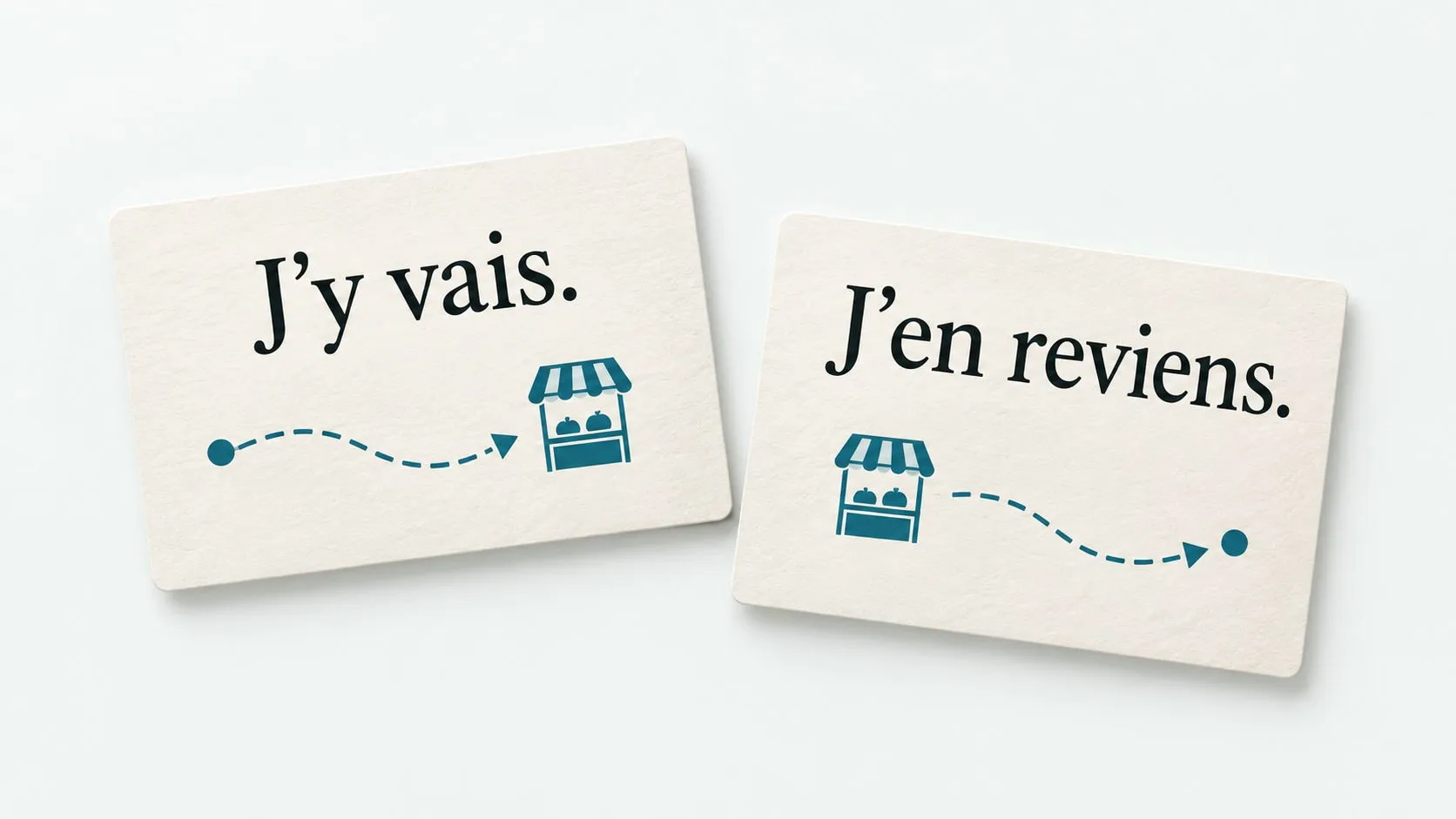
Je vais au marché and Je reviens du marché both mention the market. But one becomes J’y vais (“I’m going there”), while the other becomes J’en reviens (“I’m coming back from there”). So when do you use y, and when do you use en? Start by identifying the part of the French sentence you want to replace—not by translating the English word “there.”
Going to a place or staying there: try y
Y can replace a previously mentioned place introduced by à:
| Full sentence | Shorter sentence | Meaning |
|---|---|---|
| Je vais au marché. | J’y vais. | I’m going to the market / there. |
| Je suis au marché. | J’y suis. | I’m at the market / there. |
It can also point back to places introduced by other prepositions, including dans and sur: Le livre est sur la table. Il y est. The book is on the table; it’s there. The key question is whether you are referring back to that place. Lingolia’s guide to French adverbial pronouns covers these uses with further examples.
Coming from somewhere, talking about something, or counting: use en
En often replaces a phrase introduced by de. Compare two directions involving the same market:
| Full sentence | Shorter sentence | Replaced phrase |
|---|---|---|
| Je reviens du marché. | J’en reviens. | du marché — from the market |
| Je parle de la recette. | J’en parle. | de la recette — about the recipe |
For a quantity, en stands for the thing being counted; keep the number: J’achète trois pommes. J’en achète trois. (“I’m buying three apples. I’m buying three of them.”) Or answer Tu veux du pain ? with Oui, j’en veux: “Yes, I’d like some.” Lawless French’s explanation of en distinguishes these patterns.
Here is a practical three-step check:
- Underline what you would omit: au marché, du marché, de la recette, or trois pommes.
- Look at its role: a destination or location with à (or a similar place phrase) often calls for y; an origin or topic with de calls for en; the noun in a quantity also calls for en.
- Keep the quantity: J’en achète trois still says how many.
“Place = y” is too broad a rule: du marché starts with de, so the return trip is J’en reviens. The same location can call for a different pronoun when the relationship changes.
Where does the pronoun go? What about people?
In these simple statements, put y or en before the conjugated verb: J’y vais, J’en reviens, J’en achète trois. In a negative statement: Je n’y vais pas; Je n’en veux pas. Other constructions, such as commands, have their own word-order rules; see the Lawless French pronoun overview.
Do not apply the rule for things to a person introduced by de. Je parle de Léa becomes Je parle d’elle, rather than J’en parle when you mean Léa. Lingolia also makes this person–thing distinction. Start with unambiguous place, origin, topic, and quantity examples before tackling longer sentences.
Quick practice: replace the repeated information
Fill in y or en, keeping any stated number:
- Tu vas au marché ? → Oui, j’___ vais.
- Tu reviens du marché ? → Oui, j’___ reviens.
- Tu parles de la recette ? → Oui, j’___ parle.
- Tu achètes trois pommes ? → Oui, j’___ achète trois.
- Le livre est sur la table ? → Oui, il ___ est.
Answers: 1. y: destination with à (au = à + le). 2. en: origin with de (du = de + le). 3. en: topic introduced by de. 4. en: the apples are replaced, but trois stays. 5. y: it refers back to sur la table.
Now try one destination and one return journey of your own. Say exactly what y or en replaces. It’s more useful than memorizing either word on its own.
If you study German → French, you can browse the available sets in Lingo Phrase Cards and review cards in regular study sessions. The transformations above are a separate exercise with sentences you make yourself; access to additional category sets may require a licence.