Depuis, pendant or en? Choose the right French time expression
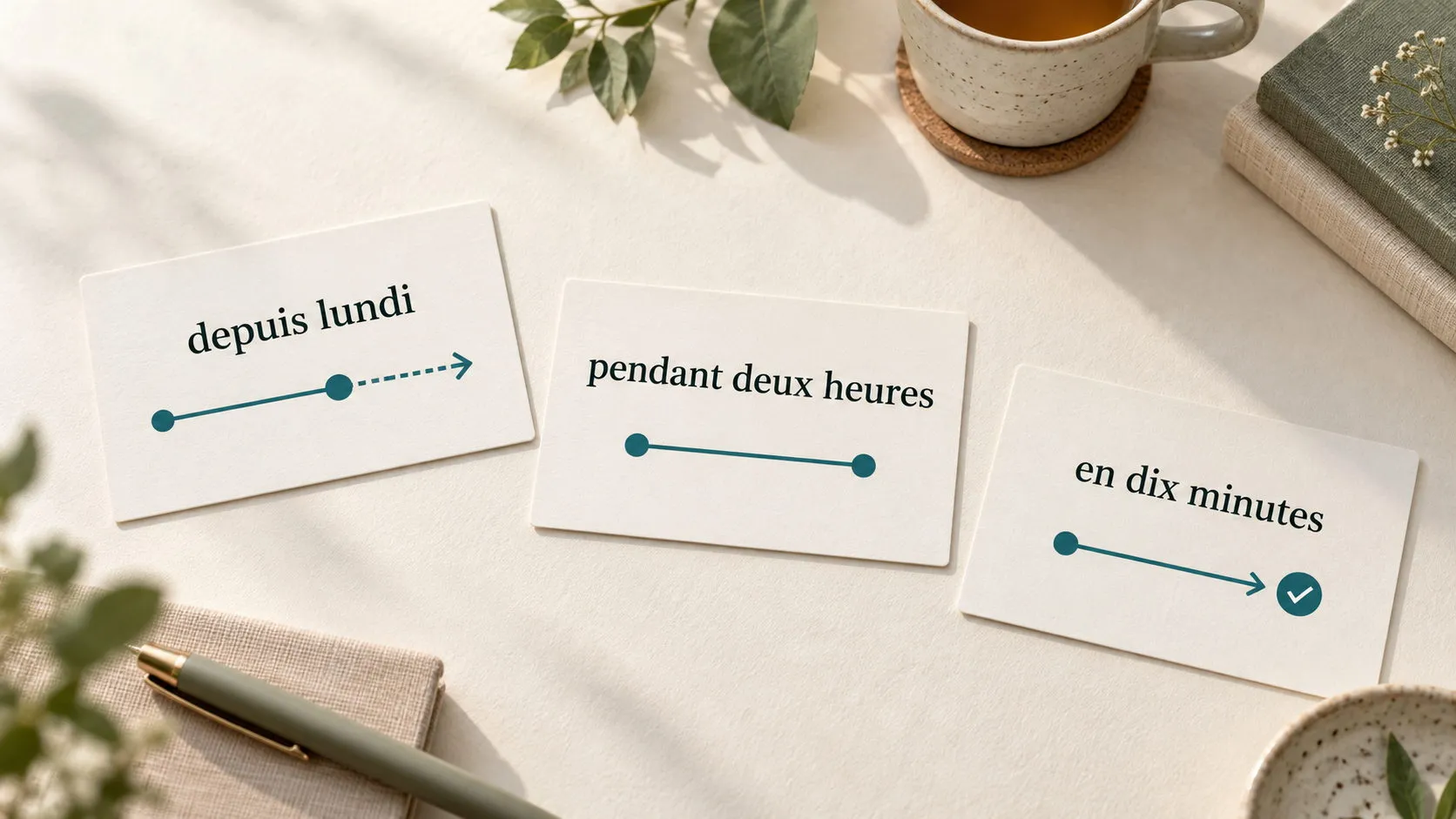
You have been learning French for two months, read for two hours, or finish an exercise in ten minutes. Each sentence mentions time, but the relationship is different: Is something still happening? How long does an activity last? How much time does it take to reach a result?
Those questions help you choose between depuis, pendant and en. Learn them with situations rather than treating each as a single English translation.
Three meanings at a glance
| What do you mean? | Preposition | Example |
|---|---|---|
| Something started earlier and is still happening. | depuis | J’apprends le français depuis deux mois. |
| An activity lasts for a certain amount of time. | pendant | Hier, j’ai lu pendant deux heures. |
| A certain amount of time is needed to achieve a result. | en | J’ai terminé l’exercice en dix minutes. |
The number does not decide the preposition. Deux heures can follow different words depending on your meaning. This guide focuses on lengths of time, rather than other uses such as en janvier (“in January”).
Depuis: how long has it been going on?
Depuis connects an earlier starting point with a situation that still holds at the time you are talking about. In simple affirmative statements about the present, French uses the present tense:
- J’habite ici depuis lundi. — I have lived here since Monday.
- J’apprends le français depuis deux mois. — I have been learning French for two months.
Notice the difference from English: j’apprends is a French present-tense form, even though “have been learning” is natural in English. Depuis lundi gives the starting point; depuis deux mois gives the duration so far. Both situations are still true.
You can ask:
- Depuis quand habites-tu ici ? — Since when have you lived here?
- Depuis combien de temps apprends-tu le français ? — How long have you been learning French?
Picture a line starting in the past and continuing through the present. UT Austin’s French grammar explains this use of depuis with both starting points and durations. The present tense fits the cases above; it is not a rule for every sentence containing depuis.
Pendant: how long does the activity last?
Pendant describes the duration of an activity or a period during which something happens:
- Hier, j’ai lu pendant deux heures. — Yesterday I read for two hours.
- Chaque soir, je lis pendant vingt minutes. — Every evening I read for twenty minutes.
- Demain, je vais étudier pendant une heure. — Tomorrow I’m going to study for an hour.
These sentences tell you how long the activity lasts. They do not automatically say that a particular goal is reached: reading for two hours does not necessarily mean finishing a book.
Pendant is not limited to past events. It also works with habits and future plans, as UT Austin’s explanation shows. The tense and the rest of the sentence provide the time frame.
En: how long does it take to reach the result?
Use en + a length of time to say how much time is needed to carry out or complete something:
- J’ai terminé l’exercice en dix minutes. — I finished the exercise in ten minutes.
- J’ai lu ce petit livre en deux heures. — I read this short book in two hours.
The second example presents reading the book as a completed achievement. Compare:
| Sentence | Meaning |
|---|---|
| J’ai lu pendant deux heures. | I spent two hours reading. |
| J’ai lu ce petit livre en deux heures. | It took me two hours to read the short book from start to finish. |
Larousse’s definition of en includes the time needed to complete an action. As a practical cue, look for the result: an exercise finished, a book read, a journey completed.
En or dans? Two meanings of “in”
English “in ten minutes” can also mean that you wait ten minutes before something happens. French uses dans for that:
- Je vais commencer dans dix minutes. — I’m going to start in ten minutes.
- Je peux terminer l’exercice en dix minutes. — I can finish the exercise in ten minutes.
Dans measures the wait until the event, here the start. En measures the time needed to carry out the task. Translating every English “in” as en misses that difference.
Try six sentences
Choose depuis, pendant, en or dans. Use the context as well as the French sentence:
- You have lived here since Monday and still live here: J’habite ici ___ lundi.
- Yesterday you spent twenty minutes reading: Hier, j’ai lu ___ vingt minutes.
- The whole exercise was finished after ten minutes of work: J’ai terminé l’exercice ___ dix minutes.
- You will wait ten minutes before starting: Je vais commencer ___ dix minutes.
- You started learning French two months ago and are continuing: J’apprends le français ___ deux mois.
- Every evening you spend half an hour reading, with no claim about finishing a book: Chaque soir, je lis ___ trente minutes.
Answers and reasons
- depuis — Monday is the start of a situation that still holds.
- pendant — You state the duration of a past activity.
- en — The time leads to a completed result.
- dans — You state the wait until the beginning.
- depuis — Two months is the duration so far of ongoing learning.
- pendant — You describe the duration of a regular activity.
Make three situations of your own
Write one sentence about something you still do, one about time spent on an activity, and one about a result you achieved. Start with depuis deux mois, pendant vingt minutes and en dix minutes, then change the activity and time to fit your life. Cover the preposition and explain your choice before checking it.
For French phrases with pronunciation support, Lingo Phrase Cards offers an English → French direction. Choose a suitable set preview: the prepared target-language phrases include IPA and audio. Some categorized sets require a license; previews help you choose. In the regular study mode, try the answer before flipping the card, then mark whether you knew it so your answer is taken into account for later reviews.
If you also want to understand en as a pronoun, read the separate guide to French y and en. Explore available directions and sets on the Lingo page.