Why does the Moon have so many craters?
How lunar craters form, why they survive longer than Earth's impact scars, and how to recognize rims, central peaks and shadows when observing.
Most of the Moon’s familiar craters are impact scars. Asteroids, meteoroids and comets strike the surface and blast rock out of the ground. But impacts explain only half the picture: we see so many craters because the Moon preserves them for a very long time. On Earth, weather, flowing water and the renewal of the crust erase or bury many of the marks.
A lunar crater therefore tells two stories: how it formed, and what has happened to the surrounding surface since. Separating those stories helps make sense of bright rays, dark plains and small craters sitting inside larger ones.
How does an impact make a crater?
A high-speed impact is not simply a rock pressing its own shape into soft ground. A huge amount of kinetic energy is released in a short time. Rock is compressed, shattered, partly melted or vaporized. Shock waves travel through the ground, while material is thrown upward and outward.
NASA’s guide to lunar craters distinguishes the excavation of the initial cavity from the changes that follow. Walls can slump inward, and in larger craters the compressed ground can rebound.
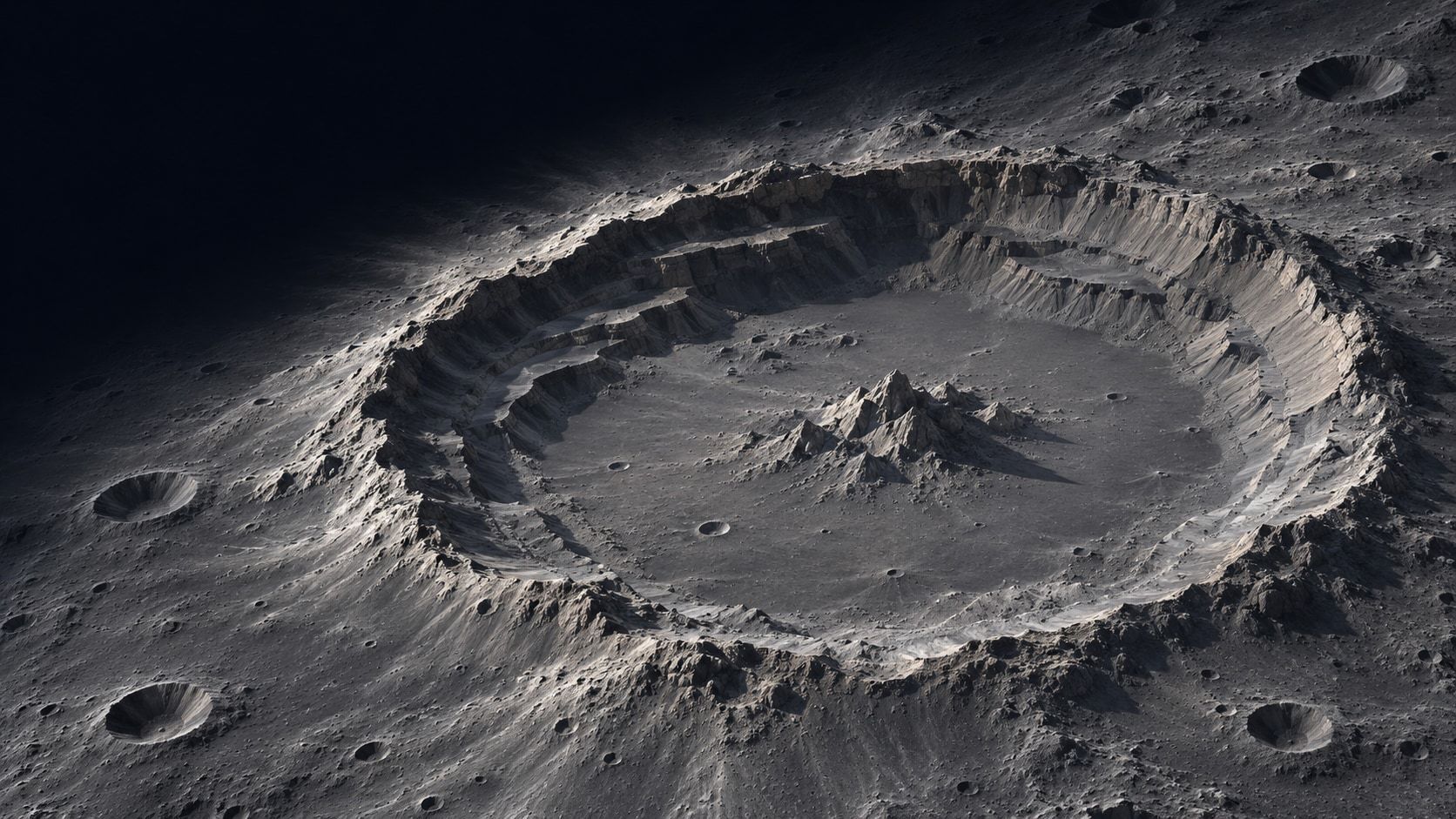
The result has several recognizable parts:
- Floor: the low-lying surface inside the crater.
- Rim: raised ground around the depression.
- Ejecta blanket: material thrown out and deposited around the crater.
- Rays: bright streaks of ejecta extending away from some craters.
Larger pieces of ejecta can make smaller secondary craters when they land. A chain of craters need not record a series of separate objects arriving from space.
Why is there a mountain in the middle?
Small, simple lunar craters often look like bowls. Larger, complex craters can have flatter floors, terraced inner walls and central peaks. These features develop as the initial cavity changes: the ground rebounds while parts of the rim collapse inward.
A mountain in the center is therefore not, by itself, evidence of a volcano. In a complex impact crater, it is part of the rock’s response to the collision. Tycho is a well-known example with a central peak and a prominent ray system.
The largest impact structures are called basins. They can develop rings rather than a single central mountain. The impactor’s size, speed and composition, along with the ground it strikes, help determine the outcome.
Why doesn’t Earth look the same?
Earth has been struck many times too. Counting visible craters is not a straightforward way to count past impacts, because the two worlds preserve their surfaces differently.
| On Earth | On the Moon |
|---|---|
| Rain, rivers, ice and wind wear down landforms. | There is no rain or wind-driven weathering like Earth’s. |
| Sediments can bury older structures. | Many ancient surfaces remain exposed. |
| Plate tectonics deforms and renews the crust. | There is no comparable global system of plate tectonics. |
| A thick atmosphere slows or destroys many small incoming objects. | The extremely thin exosphere offers no comparable protection. |
Low erosion and less extensive resurfacing are crucial to the Moon’s ancient crater record. NASA Space Place’s Earth–Moon comparison explains why preservation matters so much.
This does not mean lunar craters stay unchanged forever. Later impacts overlap earlier ones, ejecta can bury features, and countless small impacts break surface rock into regolith, a layer of dust and rocky debris.
Why do the dark lunar “seas” look smoother?
The dark patches are called maria, Latin for seas. They are not bodies of water. They are largely basalt plains formed when lava filled low-lying areas and large impact basins, covering some earlier craters completely and others only partly.
The bright highlands are much more heavily cratered in many places. Under comparable conditions, a surface with more craters may have been collecting impacts for longer. Looking through binoculars cannot turn that observation into an exact age, though.
There is an easier sequence to read in a good image: if a small crater cuts across the rim of a larger one, the small crater formed later. The feature it interrupts had to be there first.
A simple way to observe crater relief
Full Moon is not automatically the best time to see terrain. Near the terminator, the boundary between lunar day and night, sunlight strikes the ground at a low angle. Rims and mountains cast long shadows. NASA’s viewing tips recommend trying phases other than full for this reason.
On a clear evening:
- Steady your binoculars and find the light–dark boundary.
- Compare a bowl-shaped depression with a larger crater. Can you pick out terraces or a raised feature inside?
- Sketch a distinctive rim and its shadow, recording the date and time.
- Revisit the same region on another evening. The crater remains; the lighting changes how it looks.
Our guide to what causes Moon phases explains why that illumination changes through the month.
Put the Moon in its wider setting
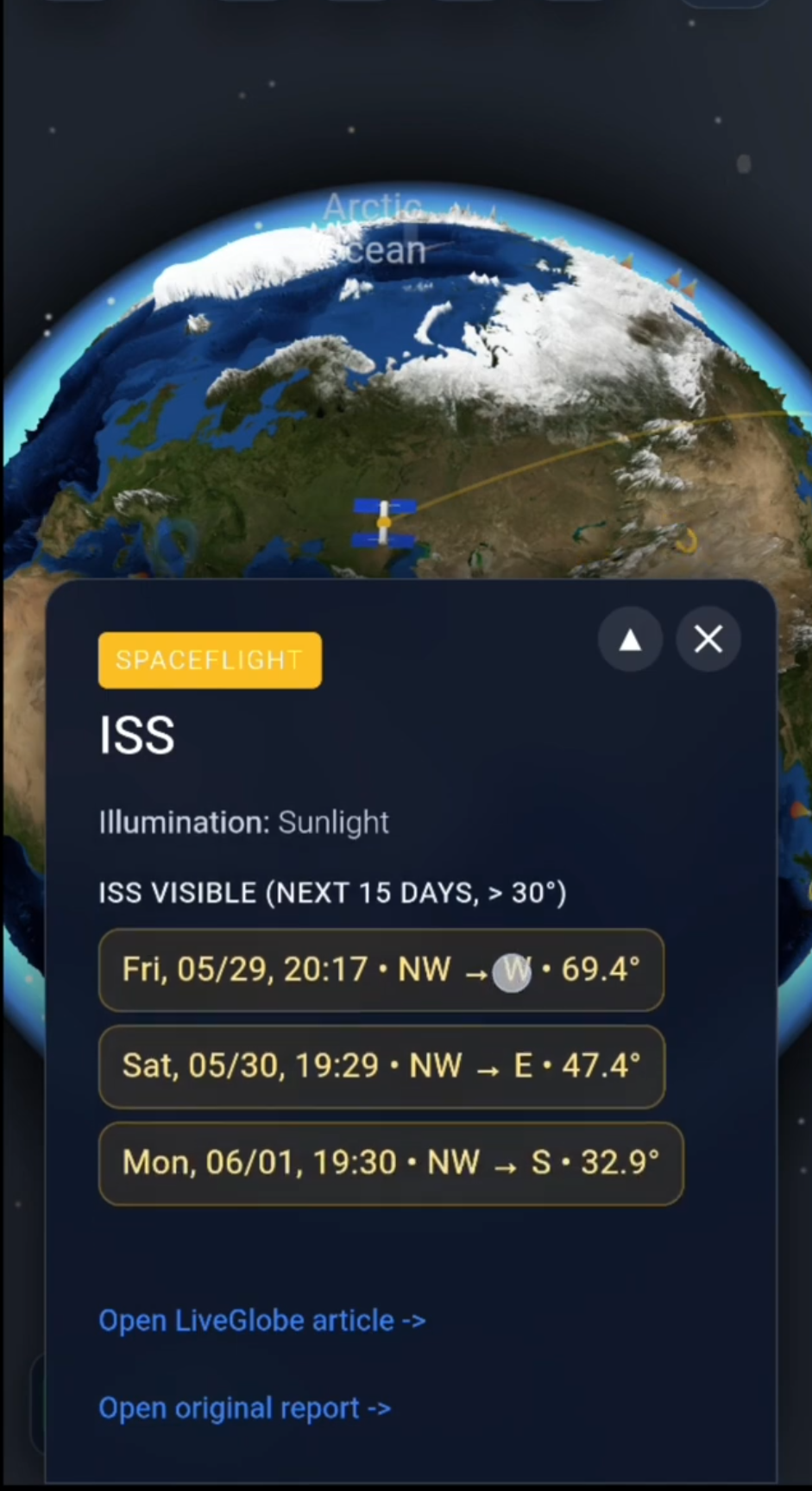
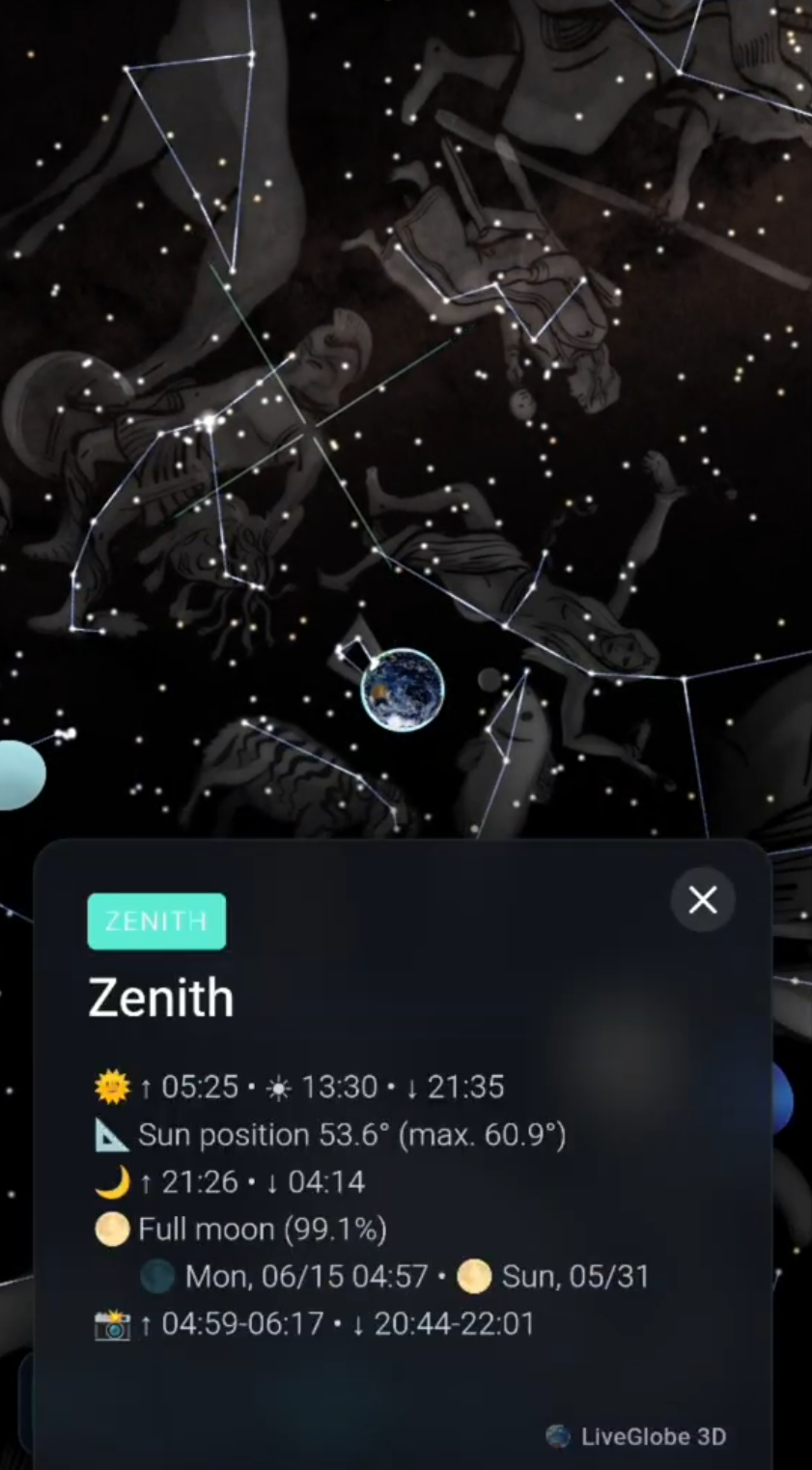
In LiveGlobe 3D, you can switch between Earth and Sky views and turn on the Moon display from the space menu. That provides a starting point for exploring the Moon in its spatial setting. Use a lunar atlas or the NASA images linked above to identify individual craters.
Explore LiveGlobe 3D and the views available to you. For your next look at the real Moon, keep one question in mind: Which part is the landform, and which part is sunlight revealing it?
Short clips
The app in motion: short, genuine glimpses straight from use.
At a glance
How the app feels on your phone.