Why does the Moon look bigger on the horizon? The Moon illusion explained
Why does a low Moon look huge? Understand the Moon illusion, atmospheric effects and supermoons, then test perceived size with two comparable photographs.
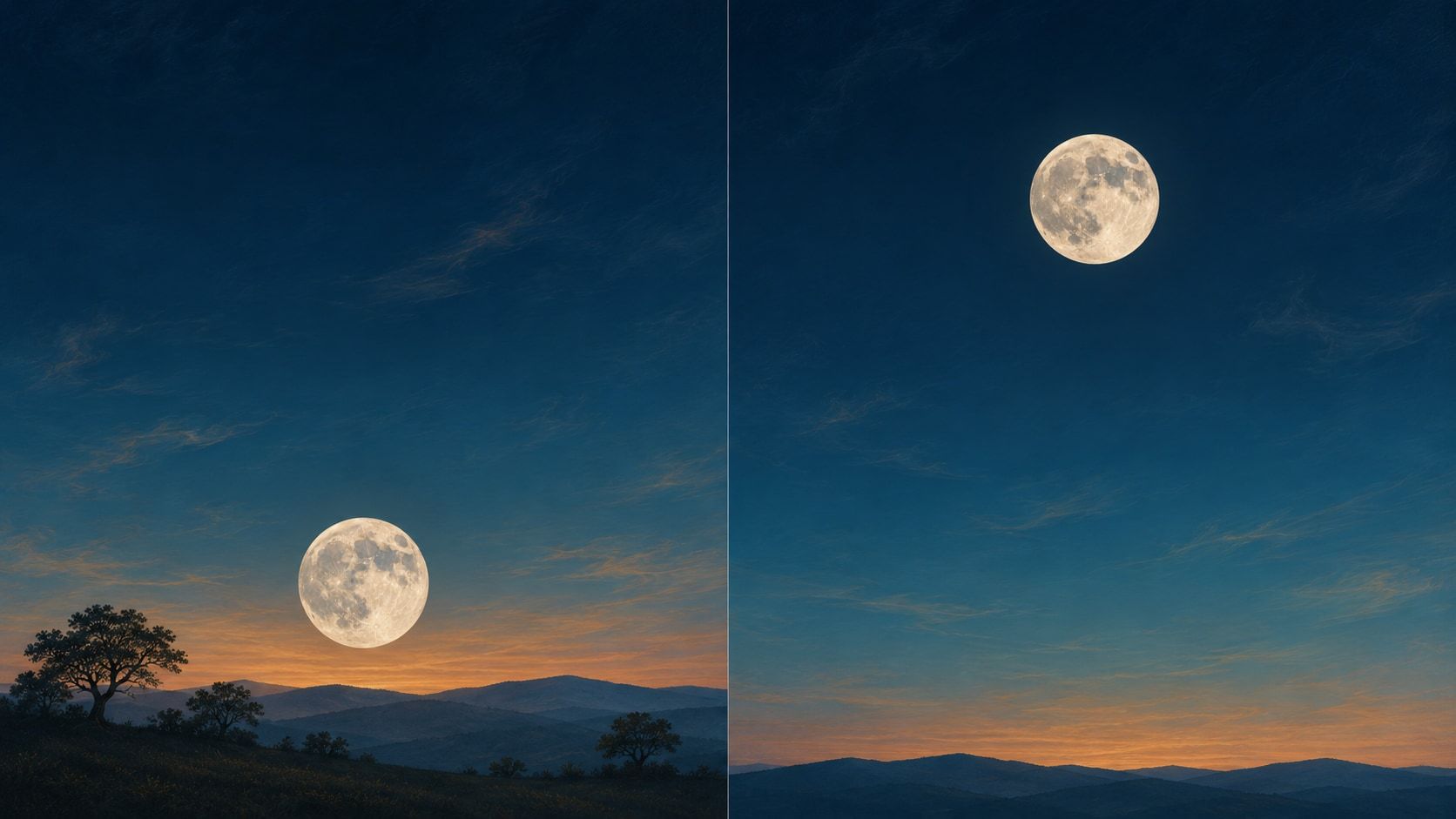
A full Moon rising above rooftops or hills can look enormous. A few hours later, high in the sky, it seems to have shrunk. That dramatic change happens mainly in our perception: the lunar disk has not suddenly become much wider near the horizon. This is the Moon illusion.
You can check the difference between your impression and a measurement with two comparable photographs. The key is to keep the camera settings that control image scale unchanged.
What does “the same size” mean?
Separate the Moon’s physical diameter, its angular size in the sky, and the size you feel you are seeing. Angular size describes how wide something appears within your field of view. A small nearby object can occupy the same angle as a much larger, distant one.
The Moon’s measured width changes only slightly during an evening. The impression of a huge horizon Moon and a tiny high Moon is much stronger. NASA explains the Moon illusion as an effect of visual processing: photographs taken at the same zoom show a disk of approximately the same width.
This article’s cover is a schematic illustration of two viewing situations, not a photographic time sequence.
Why does our perception get fooled?
Our brains judge size together with distance and surroundings. Trees, buildings and ridgelines provide clues near the horizon that are absent in open sky. Those clues can influence how large the Moon seems.
A related example is the Ponzo illusion. Two equal-length bars can look unequal when placed between converging lines that suggest depth. The same image size can lead to a different perceived size depending on its setting.
That does not fully explain the Moon illusion. NASA emphasizes that there is still no complete, satisfying scientific account. The perceptual effect is well observed; its exact cause is not settled. “Buildings make it look bigger” is therefore too simple as a final answer.
Does the atmosphere magnify it like a lens?
Not in the way the enormous-looking horizon Moon suggests. The atmosphere does change its appearance, but in other ways:
- Shape: Near the horizon, the disk can look vertically flattened. Refraction shifts different parts of the image by different amounts.
- Color: Moonlight takes a longer path through the atmosphere. More short-wavelength blue light is scattered out of the direct path, so the Moon may look yellow or orange.
An orange, flattened Moon can combine real atmospheric effects with an illusion of size. Its color is not evidence of magnification.
Is the Moon illusion the same as a supermoon?
No. The Moon follows a noncircular orbit, so its distance from Earth varies. A nearby full Moon really can have a larger angular diameter than a distant one. “Supermoon” is a popular term for a full Moon near its closest approach, rather than an officially defined astronomical term.
NASA gives a difference of up to about 14 percent in apparent diameter between a particularly close full Moon and a particularly distant one. That compares different orbital positions, not moonrise with a higher Moon on the same evening.
| What you notice | What it means |
|---|---|
| A Moon above trees seems enormous | Mainly the Moon illusion |
| Different full Moons have measurably different diameters | Changing distance along the lunar orbit |
| A low Moon looks orange and flattened | Atmospheric scattering and refraction |
A supermoon can also produce the Moon illusion. The two names describe different processes.
Try a photo comparison
- Photograph the low Moon. Find a clear view with the entire disk visible. A full Moon makes a convenient subject.
- Record your setup. Use the same camera, lens, focal length or zoom setting, and image resolution for both pictures. On a phone, avoid automatic lens switching or a different digital zoom.
- Take another picture later. Wait until the Moon is substantially higher. Avoid overexposing it so much that the bright edge spreads out.
- Compare horizontal pixel widths. Measure from the left edge to the right, rather than using the potentially flattened height. Display the original images at the same scale; do not crop and enlarge each disk separately to fill the screen.
- Separate your impression from the result. How large did the Moon feel outdoors? How different are the measured widths?
For this everyday comparison, the widths should be approximately equal. Small differences and blurred edges do not make this a precise measurement of lunar distance. The useful question is whether the photograph supports the dramatic size change you perceived.
Without a camera, try looking through a narrow paper tube to hide part of the surroundings. Your impression may change. That compares perceptions rather than measuring an angle.
Why do some city photographs show a giant Moon?
A telephoto lens can make both the Moon and distant buildings large in the frame. When the photographer stands far from the buildings, those buildings look smaller relative to the Moon than they would from nearby. A long focal length then fills the photograph with that selected view.
The result need not be a composite. It reflects a carefully chosen viewpoint and magnification, rather than an atmospheric magnifying glass.
Common questions
Does the Moon shrink as it rises?
Its physical diameter does not change as a result of rising. Its angular size remains approximately constant during the evening; the striking difference is mainly perceptual.
Does it have to be a full Moon?
No. A bright full Moon is simply conspicuous and easy to recognize in a photographic comparison.
Does an orange Moon mean there is an eclipse?
No. A long atmospheric light path near the horizon can produce orange colors. A lunar eclipse instead involves Earth’s shadow.
Put the Moon in context with LiveGlobe 3D
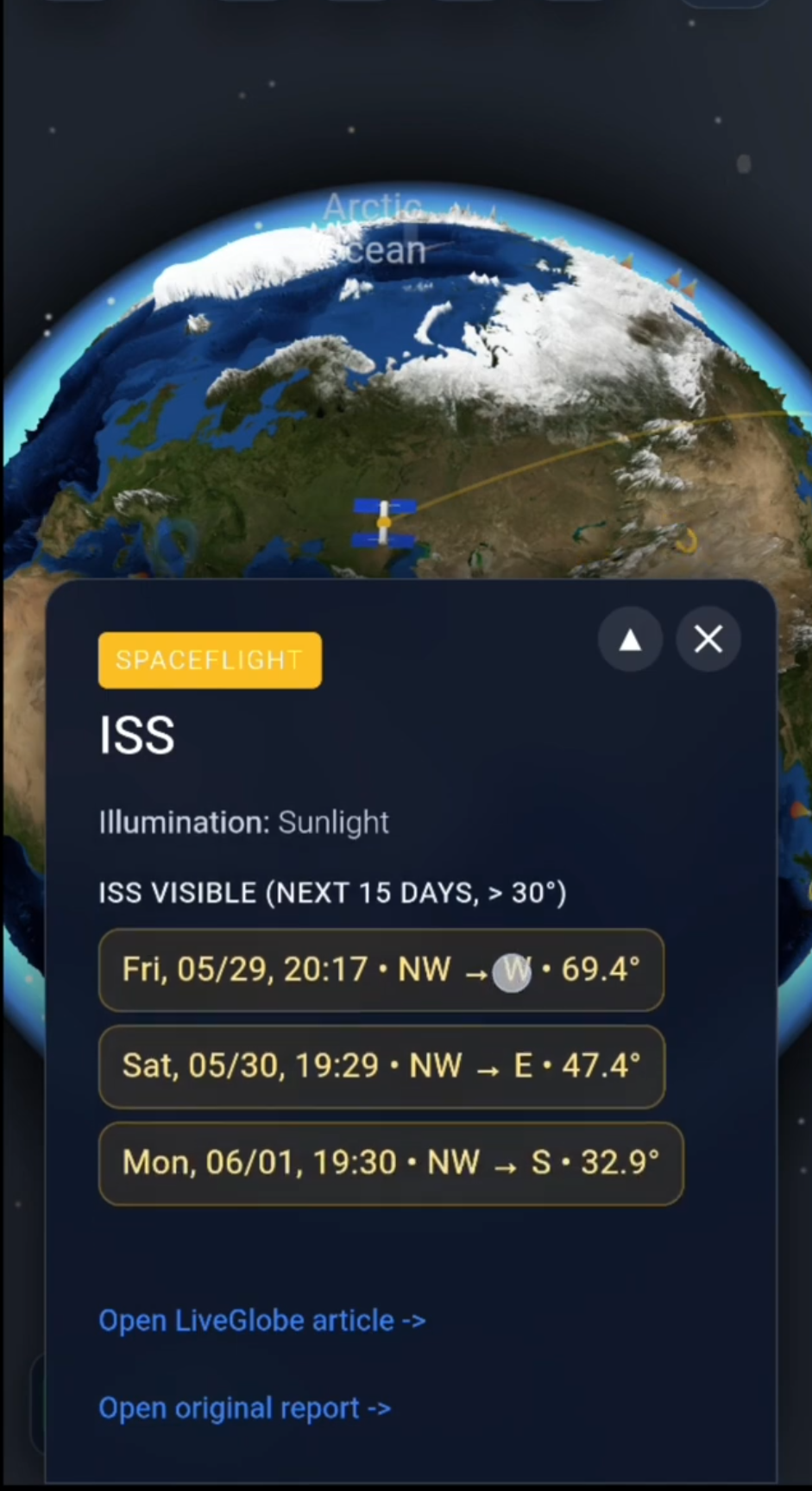
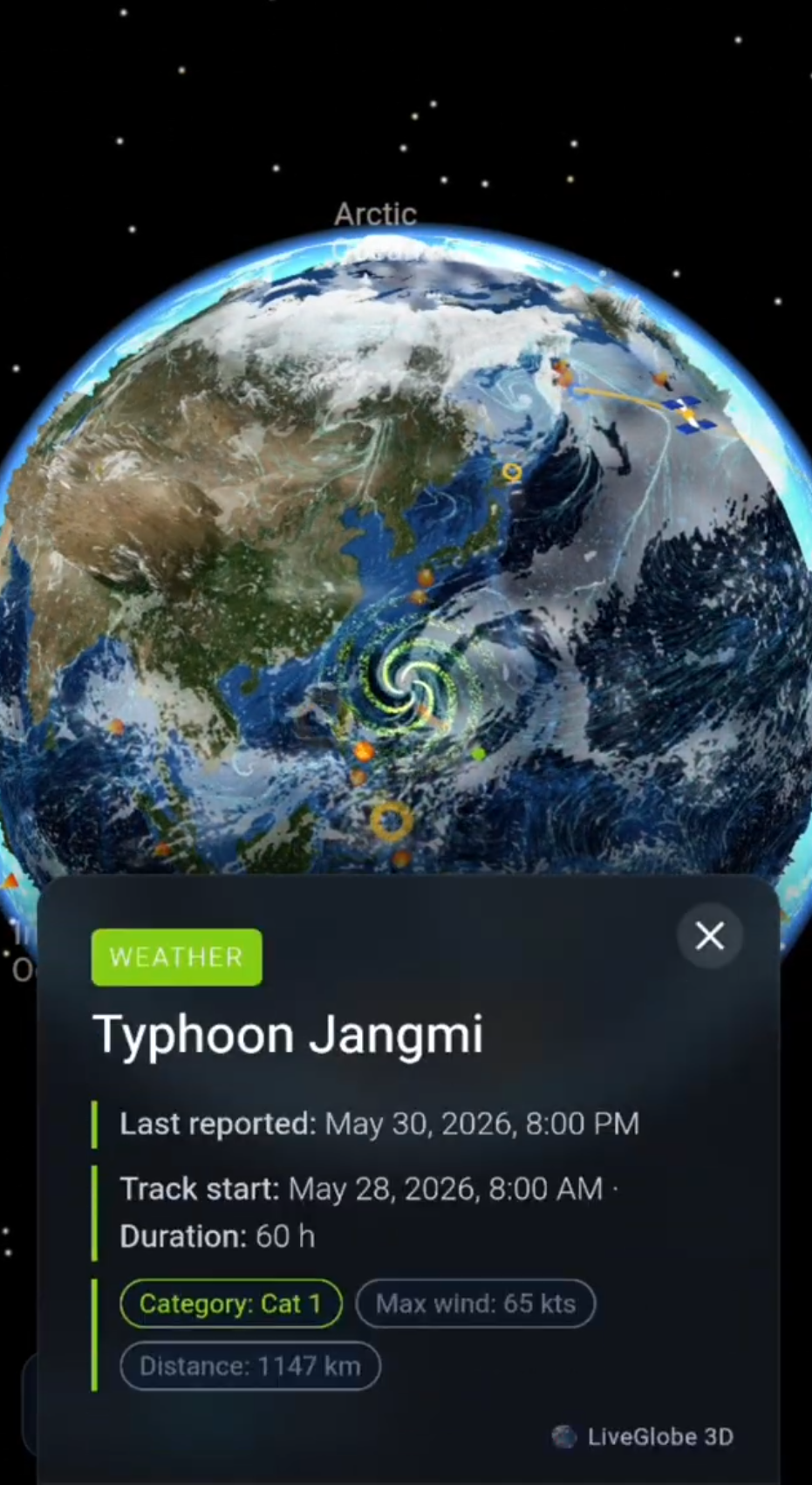
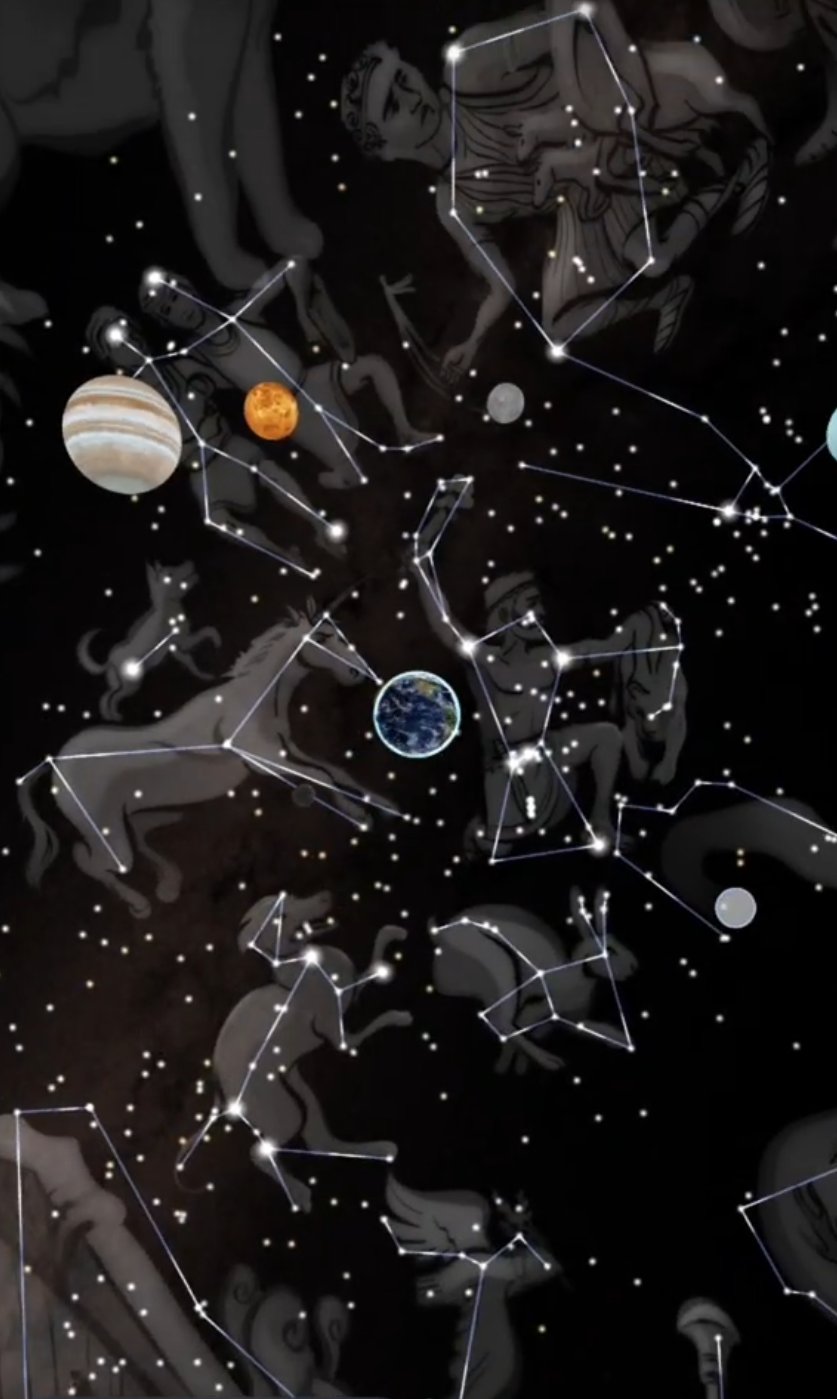
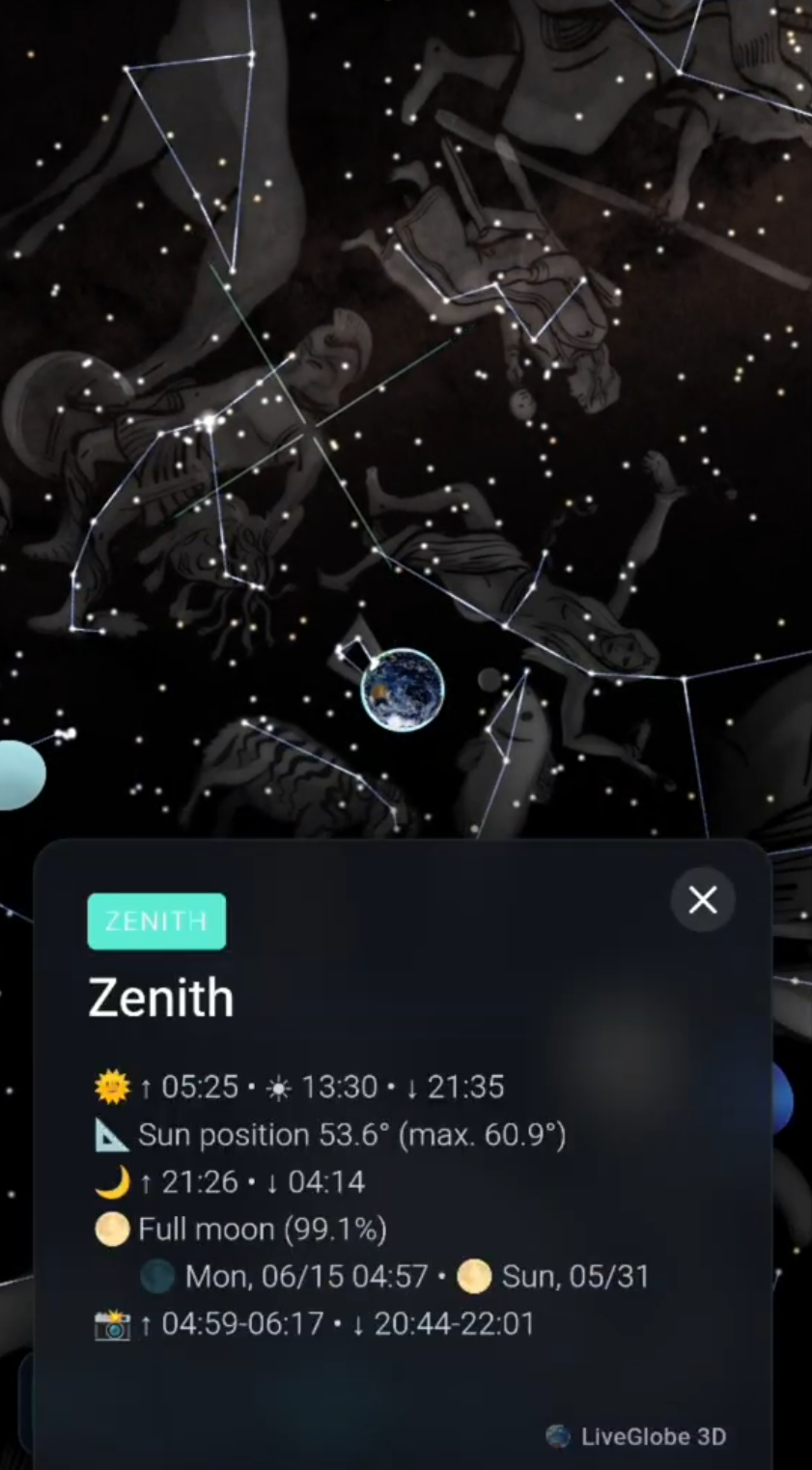
In LiveGlobe 3D, you can switch between Earth and Sky and enable the Moon through the space menu. The web app is set up to require sign-in; access determines which additional views are available. Use the sky view for spatial orientation and your photographs for the size comparison.
For another observing question, read when you can see the Moon during the day. Explore the LiveGlobe 3D views available to you—and next moonrise, compare your impression with the width in your pictures.
Short clips
The app in motion: short, genuine glimpses straight from use.
At a glance
How the app feels on your phone.