Home care: talking together about everyday wishes

A drink before a walk? A rest first? Or a question about when a visitor is coming? In home care and support, small questions are part of everyday life. Without a shared language, even simple preferences can go unspoken.
Miteinander can support everyday conversations between care workers and people receiving care. Two people share a smartphone or tablet, speak or type in their own languages and check their original text before sending. Medical and critical care decisions, however, require qualified communication support.
Ask about wishes instead of making assumptions
The person receiving care remains your conversation partner. Address them directly, allow time for a reply and ask about preferences rather than guessing from a nod. Germany’s Centre for Quality in Care (ZQP) identifies self-determination, personal habits and good communication as important features of good care.
Choose a quiet moment. Can the person read the text comfortably and use the device, or do they need help? A translation tool does not automatically overcome hearing, sight or comprehension difficulties. If communication is not working, arrange appropriate support rather than relying on the app.
Start together on one device
First check whether the person wants to use the app and what rules your care service or organisation has. Open the Miteinander web app in a browser. You need an internet connection and access to AI usage. Choose your language, optionally describe the situation briefly, then select the other person’s language.
A short context is enough:
We are discussing afternoon preferences, a planned walk and visiting times during home care. This is not a conversation about medical decisions.
You do not need diagnoses, full names or a care report for this.
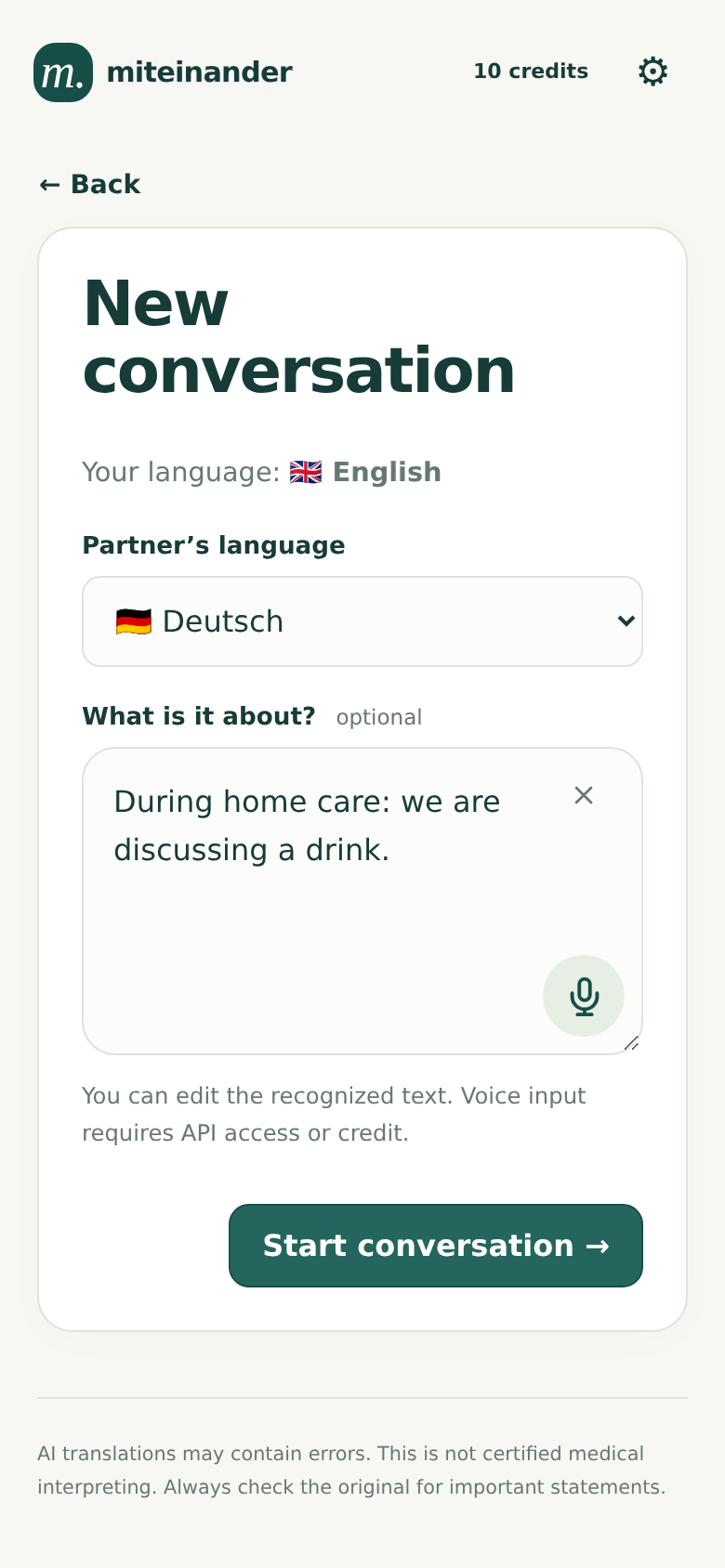
An example before a walk
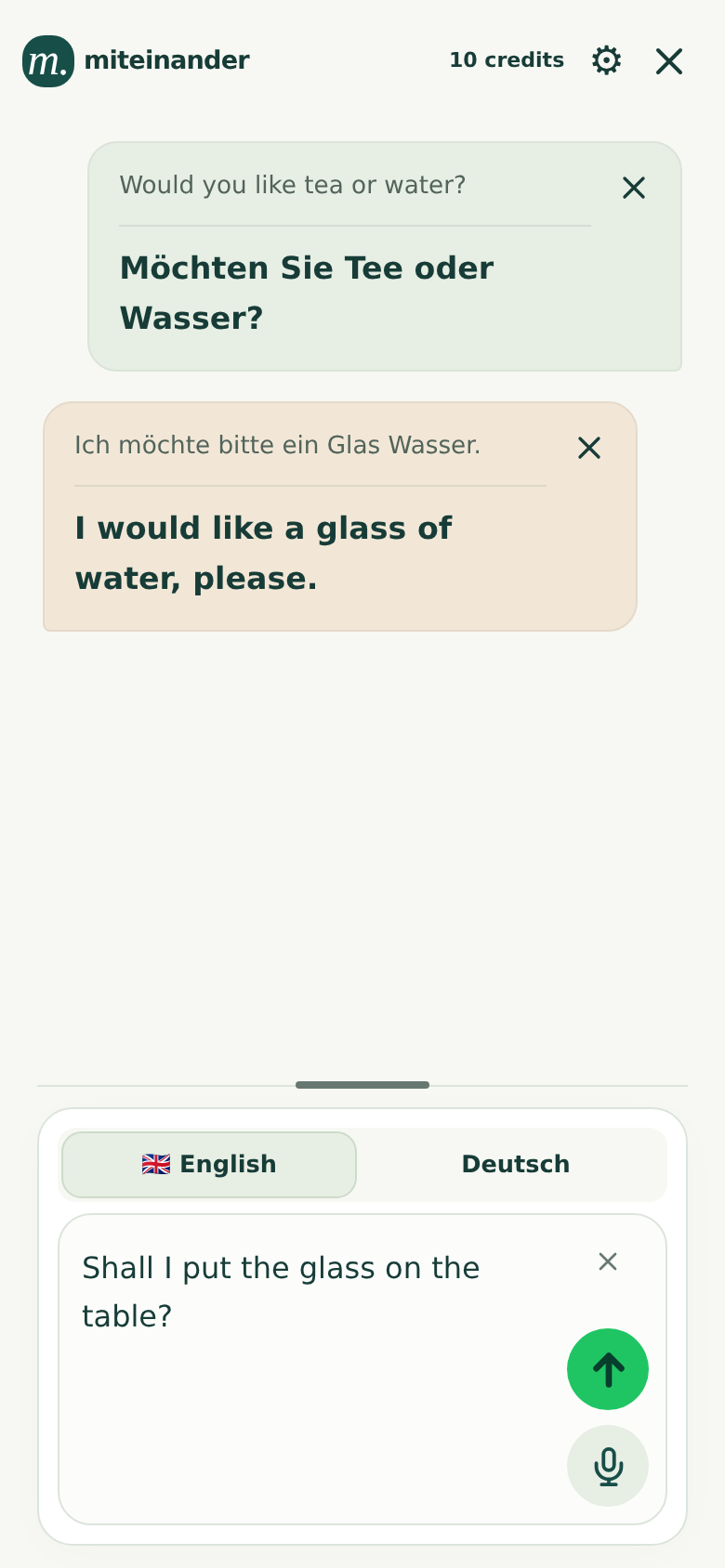
This fictional scene assumes that the walk and a drink are already possible within the person’s established care arrangements. It is not advice about fluids or exercise. In the app, each person would use their own language.
Care worker: “Would you like something to drink before the walk, or would you prefer to rest?”
Person receiving care: “I’d like to rest first.”
Care worker: “Shall I ask you again later?”
Person receiving care: “Yes, please. I’d like to decide then whether to come along.”
That answer is not a fixed instruction for later: preferences can change. If two options in one question are too much, split it up: “Would you like to rest now?” Leave room for the next question afterwards.
Check your own words, then send
Type your message or speak it. Voice input requires microphone permission and supported audio recording in the browser. Recognised speech first appears as an editable text draft, not a sent translation. Pay particular attention to negatives and times: “not now” must not become “now”.
After you deliberately send, the original and translation appear in the history. Once translation succeeds, input switches to the other person. Use short, specific follow-up questions when something is unclear; a nod alone does not establish understanding.
Other everyday questions include:
- Visitors: “What time would you like to arrange the visit for?”
- Rest: “Would you like the door open or closed?”
- Practical arrangements: “Where shall I put your reading glasses?”
- Daily preferences: “Would you like some music today, or would you prefer quiet?”
Record confirmed practical arrangements through the usual channels. The app history is not a substitute for care documentation.
Sensitive information and firm limits
Enter only what the question needs. Saved history stays locally in the browser; the contents needed for AI processing pass through the Miteinander server to OpenRouter and the relevant AI provider. On shared devices, local histories may remain visible to others using the same browser profile. Follow privacy rules and do not add extensive health information just in case.
AI translations can contain errors. The app is not sufficient for medication, swallowing difficulties, new symptoms, assessing fall risks, consent or other medical or critical care decisions. Involve the responsible professionals and qualified interpreting support. For acute symptoms or an emergency, professional or emergency help comes first; do not wait for a translation. A translated preference does not override established clinical instructions.
For a simple everyday question, open Miteinander and start with a short sentence. For the basic workflow, see “One device, two languages”.