Affect vs effect: the difference and ten exercises with answers
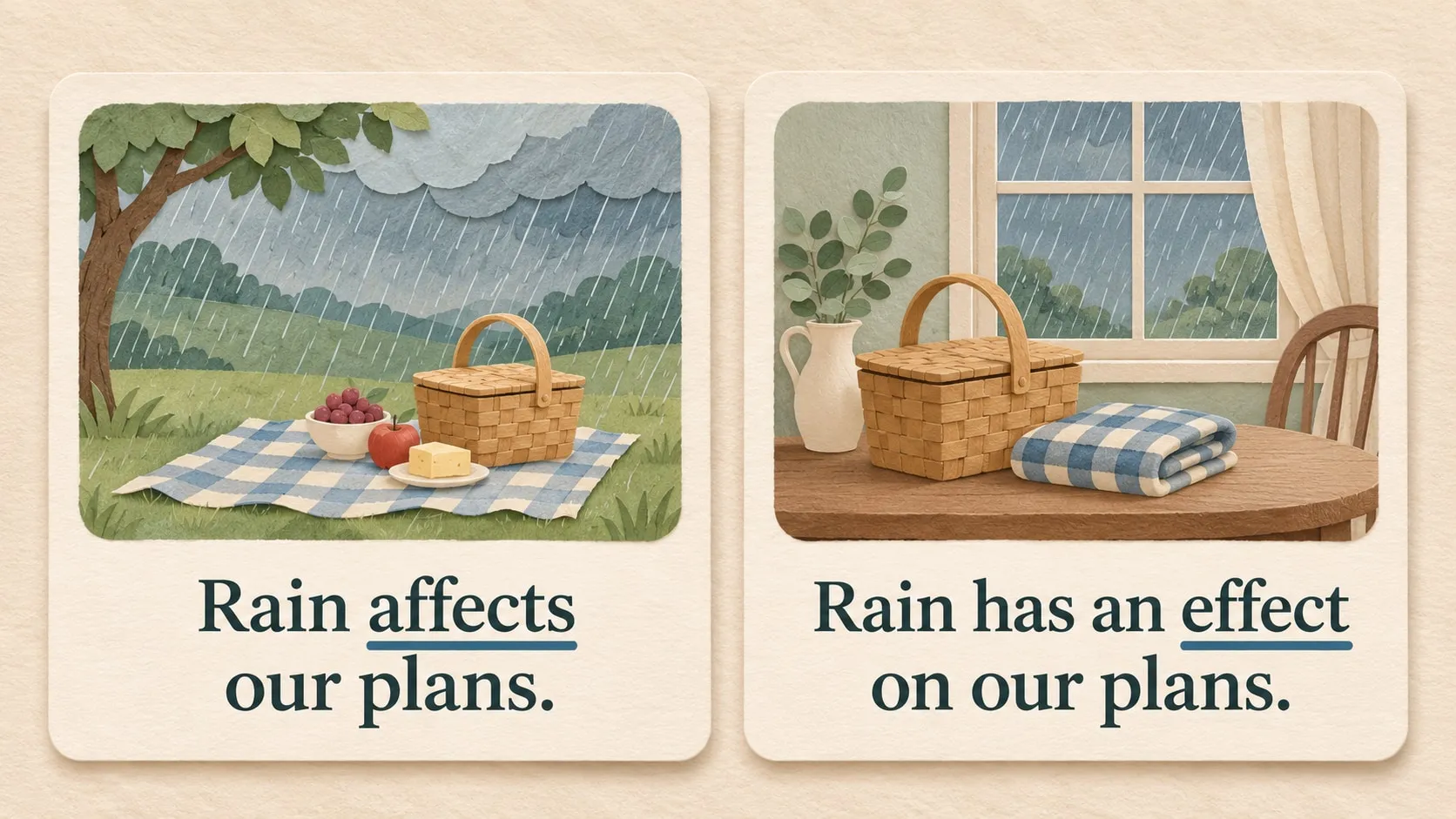
Affect is usually a verb meaning “influence”. Effect is usually a noun meaning “a result” or “an impact”. Compare The rain affects our plans with The rain has an effect on our plans. Both can describe the same situation, but they use different sentence patterns.
Before choosing a spelling, ask: Am I saying that something influences something else, or naming the impact it has?
The difference at a glance
| Your meaning | Pattern | Example |
|---|---|---|
| something influences something else | affect + object | Noise affects my concentration. |
| something has an impact | have an effect on + object | Noise has an effect on my concentration. |
| more than one result | effects | We discussed the effects of the delay. |
Cambridge English Grammar Today explains this basic distinction. Use affect = influence and effect = result as your starting point, rather than treating the first letter as a guessing game.
Affect: name what is influenced
The object follows affect directly. You don’t add on:
- The new timetable affects my journey.
- Did the delay affect your plans?
- The change didn’t affect us.
Use affects with a third-person singular subject in the present simple. The past tense and past participle are affected. After did, didn’t or will, use the base form: Did it affect you?, not Did it affected you?
Avoid The rain affects on our plans. Write The rain affects our plans. The preposition belongs to the other pattern: has an effect on.
Effect: name the impact or result
As a noun, effect can take a determiner, an adjective or a plural ending:
- The change had an immediate effect.
- It had no effect on the result.
- We noticed several effects.
Learn have an effect on something as a complete phrase. For this singular countable use, include a determiner: an effect, a strong effect, no effect. Don’t write It had effect on me when you mean that something influenced you.
Change the pattern, keep the meaning
Try these transformations:
- The rain affected our picnic. → The rain had an effect on our picnic.
- The new rule affects everyone. → The new rule has an effect on everyone.
You need to change more than the first letter: the verb, the determiner and the preposition may all change. The new rule effects everyone does not mean that the rule influences everyone.
Is affect always a verb?
No. Merriam-Webster also explains effect as a verb meaning “bring about”, as in effect change. The noun affect is used mainly in psychology for observable emotional expression. These are different uses; the everyday exercises below focus on influence and its results.
Ten exercises: choose the correct form
Use affect, affects, affected, effect or effects. Decide whether the gap needs a verb or a noun before checking the form. Cover the answers first.
- The roadworks will ___ our bus route.
- The announcement had an unexpected ___ on the team.
- Does the price ___ your decision?
- The change ___ everyone in the office yesterday.
- One small mistake can have several ___ on a project.
- Background noise ___ my concentration.
- The extra sign had no ___ on the traffic.
- The delay didn’t ___ our booking.
- We are discussing two possible ___ of the new timetable.
- The rain had a noticeable ___ on our picnic.
Answers and explanations
- affect — use the base form after will; the bus route is influenced.
- effect — an unexpected effect on names an impact.
- affect — does is followed by the base form, not affects.
- affected — yesterday calls for the past tense here.
- effects — several signals more than one result.
- affects — background noise is a singular subject in the present simple.
- effect — the phrase is have no effect on.
- affect — didn’t already marks the past tense.
- effects — the sentence refers to the timetable’s consequences, a plural noun.
- effect — a noticeable effect on contains a determiner, adjective and noun.
A short phrase-based practice routine
Choose a situation from your day. Describe it once with affect, then again with have an effect on. Say both versions aloud. Later, try the transformation without looking. For another practical distinction between easily confused words, explore remember vs remind.
In Lingo Phrase Cards, choose an offered language direction and preview a suitable set. Prepared target-language phrases include IPA and audio. In regular study, attempt an answer before flipping the card, then rate it; the rating changes its box and due date. Free mistake-card practice lets you go through difficult cards without changing card progress. Certain categorised sets require a licence.
Explore the available directions and sets on the Lingo product page or in Lingo Phrase Cards. Start with one useful contrast: It affects us. — It has an effect on us.