Remember vs remind: sentence patterns and ten exercises with answers
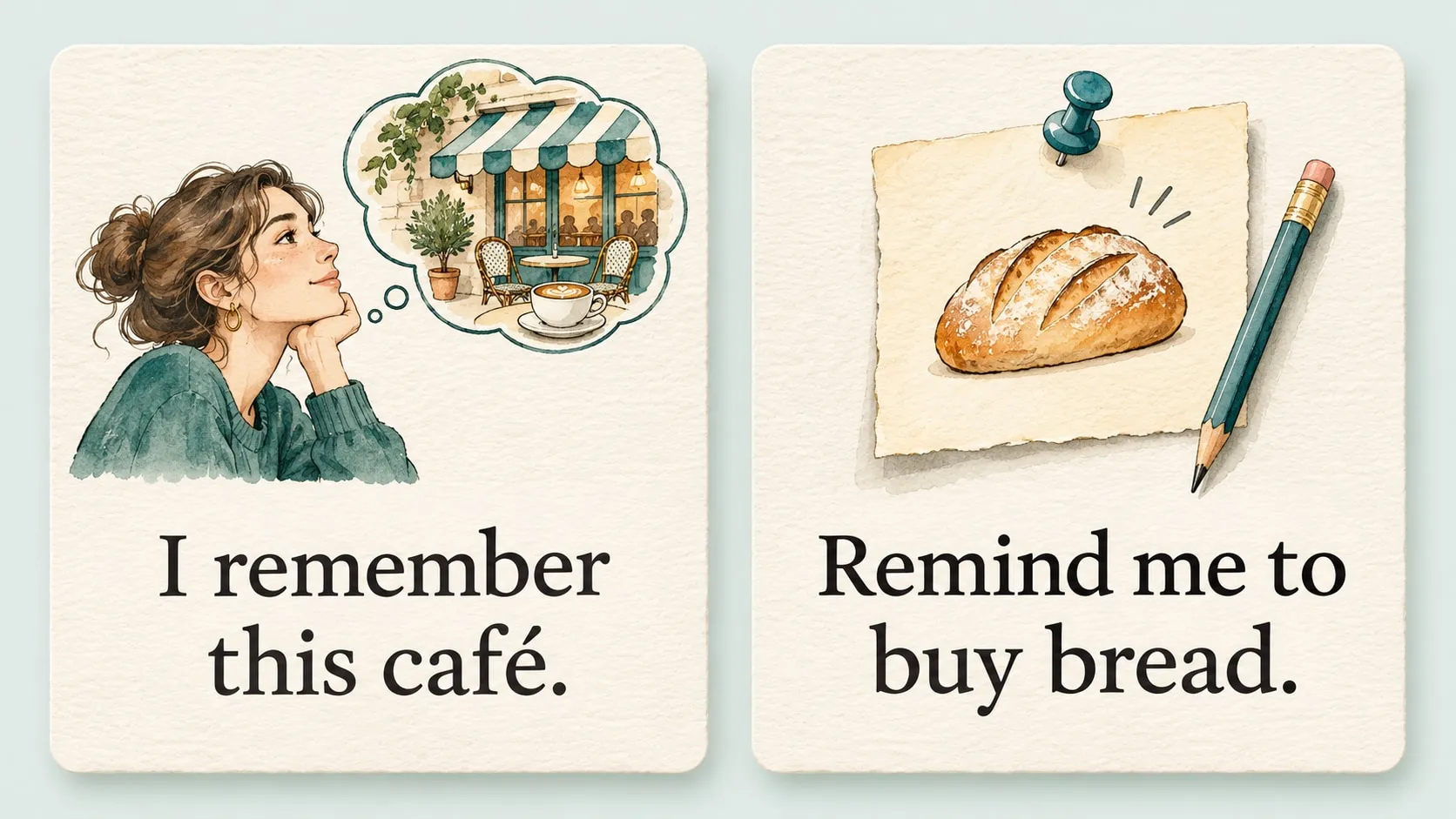
Remember means having something in your memory or bringing it back to mind. Remind means causing someone to remember or helping them not to forget. I remember the appointment says that it is in my mind. Please remind me about the appointment asks you to help me keep it in mind.
Start with one question: Who has the memory, and who or what brings it to mind? Then choose the sentence pattern, not just the verb.
The difference at a glance
| What you mean | Pattern | Example |
|---|---|---|
| Having a memory | remember + thing/person | I remember that café. |
| Not forgetting an action | remember to + verb | Remember to lock the door. |
| Having a memory of an action | remember + -ing | I remember locking the door. |
| Giving a task reminder | remind + person + to + verb | Remind me to lock the door. |
| Bringing back a memory | remind + person + of | This photo reminds me of our trip. |
Cambridge English Grammar Today explains these meanings and patterns. Short complete phrases make the distinction easier to use.
Remember: the subject has the memory
With remember, the subject is the person who has or recalls the memory:
- I remember her name.
- Do you remember Alex?
- I remember that the shop closes early.
- I can’t remember where I put my keys.
You do not need a reflexive pronoun: I remember Alex, not I remember myself Alex. Nor do you insert of before the person or thing remembered.
A person can be the object of remember. I remember Alex means that Alex is in my memory; it does not mean that I am sending Alex a reminder.
Remind: someone or something prompts the memory
In an active remind sentence, the person receiving the reminder is the object: remind me, remind her, remind us. What follows depends on the message.
A task: remind someone to do something
- Please remind me to buy bread.
- The note reminded Leo to call his sister.
The subject need not be a person. A note, photo or sound can prompt a memory. You can also give yourself a reminder: I reminded myself to send the invoice. Avoid the oversimplified rule that remind always involves two different people.
An event or topic: remind someone about something
Could you remind Sara about tomorrow’s meeting? asks someone to bring that event to Sara’s attention again.
A clause is possible too: She reminded me that the office was closed. Here the reminder is a whole piece of information, not a task expressed with a to-infinitive.
An association: remind someone of something
This smell reminds me of my grandmother’s kitchen describes a memory triggered by a smell. You remind me of your brother can describe a resemblance.
“About for events, of for associations” is a helpful starting point, not an absolute division. She reminded me of our appointment is also possible. Begin with a few clear patterns without treating alternatives as automatically wrong.
Remember to do or remember doing?
Changing the form after remember changes the meaning:
- I remembered to send the email. I did not forget the task, and I sent it.
- I remember sending the email. I have a memory of sending it.
This is not simply “future versus past”. Remembered to send is itself in the past. The difference is the sequence: remembering a task and then doing it, or looking back on an action already performed.
The negative makes the distinction especially clear. I didn’t remember to lock the door means I forgot to do it. I don’t remember locking the door says that I have no memory of the action; it does not establish whether the door is locked.
Three common errors
- Asking for a task reminder: Remind me to pay, not Remember me to pay.
- Recalling a place: I remember this place, not I remember of this place.
- Describing an association: It reminds me of home, not It reminds of home.
There is a separate expression Remember me to your family, meaning “give my regards to your family”. It is not the pattern for asking someone to remind you to do something.
Ten remember/remind exercises
Choose the form that matches the context. Keep the other words unchanged.
- You still know someone’s name: I ___ your name. (remember / remind)
- Ask for a reminder: Please ___ me to book the tickets. (remember / remind)
- A photo brings back holiday memories: This photo ___ me of our holiday. (remembers / reminds)
- Don’t forget the task before leaving: Remember ___ the door before you leave. (to lock / locking)
- You picture yesterday’s action: I remember ___ the door last night. (to lock / locking)
- Bring an appointment to a colleague’s attention: Please remind Eva ___ tomorrow’s appointment. (about / for)
- A song brings back memories of home: This song reminds me ___ home. (of / at)
- Yesterday you did not forget the payment and made it: Yesterday I remembered ___ the bill. (to pay / paying)
- Correct this request for a task reminder: Please remember me to save the file.
- Does I don’t remember closing the window prove that the window was left open?
Answers explained
- remember — The name is in your memory.
- remind — You want someone to prompt you to do a task.
- reminds — The photo triggers the memory; the singular subject takes -s.
- to lock — The instruction is not to forget the action.
- locking — You recall an action from the past.
- about — The pattern is remind someone about an appointment.
- of — Remind someone of introduces the association.
- to pay — You remembered the task and completed it.
- Please remind me to save the file. — Remind + person + to-infinitive.
- No. — You have no memory of closing it. You need other evidence to establish whether it is closed.
Keep practising with complete phrases
Write three sentences on paper: a memory from the past, a task for tomorrow and something that brings a place to mind. Use I remember …, Remind me to … and … reminds me of …. Cover the English sentences and recreate them from the situations. Check the meaning and the words following the verb separately.
For your wider language routine, choose an offered language direction and a suitable set in Lingo Phrase Cards. The prepared material presents words in phrases; target-language phrases include IPA and audio generated with Amazon Polly Neural. Answer before turning a card over, then assess your answer in the regular Leitner study mode. Categorized sets may require a license.
Read more about learning vocabulary in context with phrase flashcards, or explore the available language directions and sets in Lingo Phrase Cards.