Très vs beaucoup: French rules and ten exercises with answers
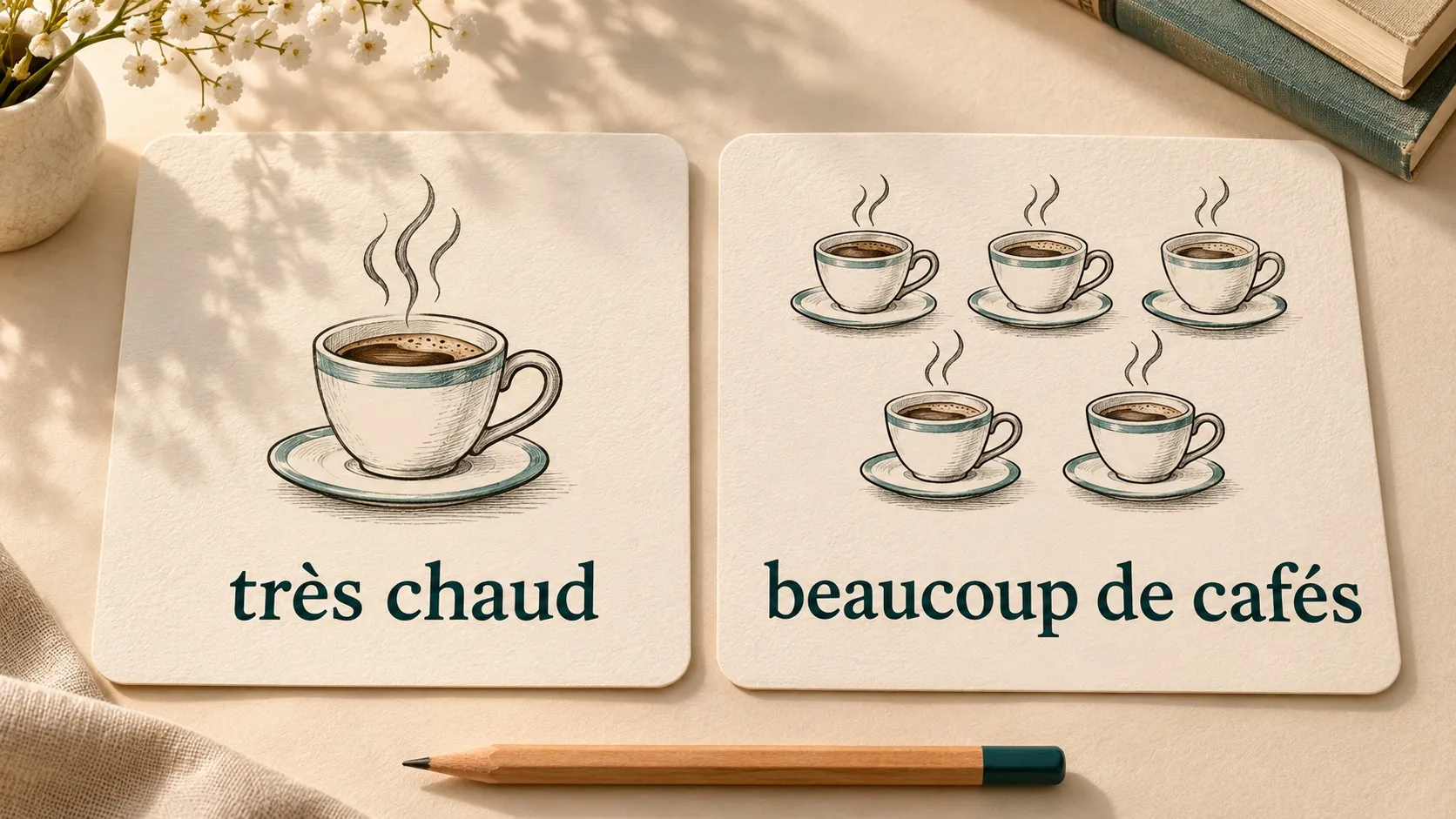
You want to say “very” or “a lot” in French. Why is it très bien, beaucoup travailler, but beaucoup de travail? The useful question is what you are making stronger: a description, an action, or a quantity.
Use the decision guide below, check the common exceptions, then try ten exercises with explanations.
The basic choice: what are you modifying?
| Your meaning | Usual pattern | Example |
|---|---|---|
| a stronger quality | très + adjective | Ce thé est très chaud. — This tea is very hot. |
| a stronger description of how | très + adverb | Lina lit très lentement. — Lina reads very slowly. |
| a large amount of an activity | verb + beaucoup | Lina lit beaucoup. — Lina reads a lot. |
| a large unspecified quantity | beaucoup de + noun | Lina a beaucoup de livres. — Lina has lots of books. |
Le Point du FLE and A Cup of French explain these contrasts. Neither word changes for gender or number.
Très: very hot, very well, very slowly
Use très to strengthen an adjective or adverb. Look at the word it modifies:
- La salle est très calme. — The room is very quiet.
- Vous expliquez très bien. — You explain very well.
- Le bus arrive très tôt. — The bus arrives very early.
Simply spotting a verb in the sentence will not settle the choice. In Vous expliquez très bien, très modifies bien, rather than the verb directly. Remove bien, and “You explain a lot” becomes Vous expliquez beaucoup.
If bon and bien themselves are the problem, see Bon vs bien for the difference between quality and manner.
Beaucoup: doing a lot or liking something a lot
When the emphasis concerns the activity itself, beaucoup is often the choice:
- Nous marchons beaucoup pendant les vacances. — We walk a lot on vacation.
- J’aime beaucoup ce quartier. — I really like this neighborhood.
- Elle a beaucoup étudié cette semaine. — She has studied a lot this week.
English can tempt you to use “very” with “like.” French still uses aimer beaucoup, not J’aime très ce quartier. Learn the whole phrase rather than replacing one English word at a time.
In simple present-tense sentences, beaucoup normally follows the verb. In the passé composé, it usually goes between the auxiliary and past participle: Elle a beaucoup étudié. Keep that word order as a reusable pattern.
Beaucoup de: connecting a quantity to a noun
For a large unspecified quantity before a noun, use beaucoup de:
- beaucoup de temps — a lot of time
- beaucoup de questions — many questions
- beaucoup d’eau — a lot of water
Before a vowel, de becomes d’. In this basic quantity pattern, do not insert an indefinite or partitive article: beaucoup de questions, rather than beaucoup des questions, when you simply mean “many questions.”
Compare three café sentences:
- Ce café est très chaud. — You describe the temperature.
- Je bois beaucoup de café. — You describe the amount of coffee.
- Je bois beaucoup. — You describe how much you drink, without naming the drink.
Important expressions: J’ai très faim
Some fixed expressions with avoir take très, even though words such as faim are not ordinary adjectives. Learn these chunks together:
- J’ai très faim. — I’m very hungry.
- Tu as très soif. — You’re very thirsty.
- Elle a très peur. — She’s very afraid.
- Nous avons très envie de sortir. — We really feel like going out.
So “always use beaucoup after a verb” is not a reliable rule. Compare j’ai très faim with je mange beaucoup: a state expressed through a fixed phrase versus the amount of an activity.
Plus and moins: much more and much less
Use beaucoup before plus and moins to strengthen a comparison:
- Ce trajet est beaucoup plus court. — This route is much shorter.
- Nous attendons beaucoup moins longtemps. — We spend much less time waiting.
This emphasizes a difference; it is not the same pattern as très court. You can also say beaucoup trop cher: far too expensive. However, do not stack très beaucoup to mean “a very large amount.” A phrase such as vraiment beaucoup can add emphasis instead.
For “much better,” see the special comparison forms in Meilleur vs mieux.
Ten exercises: decide before checking
Fill each blank with très, beaucoup, beaucoup de, or beaucoup d’. Each blank replaces the entire expression needed. Also name the reason: quality, manner, activity, quantity, fixed expression, or comparison.
- Cette valise est ___ lourde.
- En été, nous voyageons ___.
- Il reste ___ soupe dans la casserole.
- Tu réponds ___ poliment.
- Après la promenade, j’ai ___ soif.
- Nora aime ___ ce petit jardin.
- Nous avons ___ idées pour dimanche.
- Ce chemin est ___ plus long que l’autre.
- Ils ont ___ discuté après le cours.
- Vous avez ___ envie de découvrir Lyon.
Answers explained
- très — Lourde is an adjective: very heavy.
- beaucoup — The emphasis concerns the amount of traveling.
- beaucoup de — You give a quantity of soup.
- très — Poliment describes manner: very politely.
- très — The expression is avoir très soif.
- beaucoup — You strengthen the verb aimer.
- beaucoup d’ — A quantity before idées, which starts with a vowel.
- beaucoup — It strengthens the comparison with plus.
- beaucoup — The amount of discussion; in the passé composé it sits between ont and discuté.
- très — The expression is avoir très envie de.
Turn the rule into a phrase you can use
On paper, write three sentences of your own: a quality with très, an activity with beaucoup, and a quantity with beaucoup de. Cover them and say them from memory. Then change one element: très chaud → très froid, or beaucoup de livres → beaucoup de questions. You are practicing a sentence-level choice, rather than two isolated words.
In Lingo Phrase Cards, you can choose English → French and explore a set preview. Words are presented in phrases, with IPA and audio for the target-language phrases. Use a set you have access to, attempt the answer before turning the card, and assess it in the regular Leitner learning mode. Certain categorized sets require a license.
Explore the available language directions and sets in Lingo Phrase Cards. For your next sentence, keep asking: what am I making stronger?