C'è or ci sono? Ten Italian exercises with explained answers
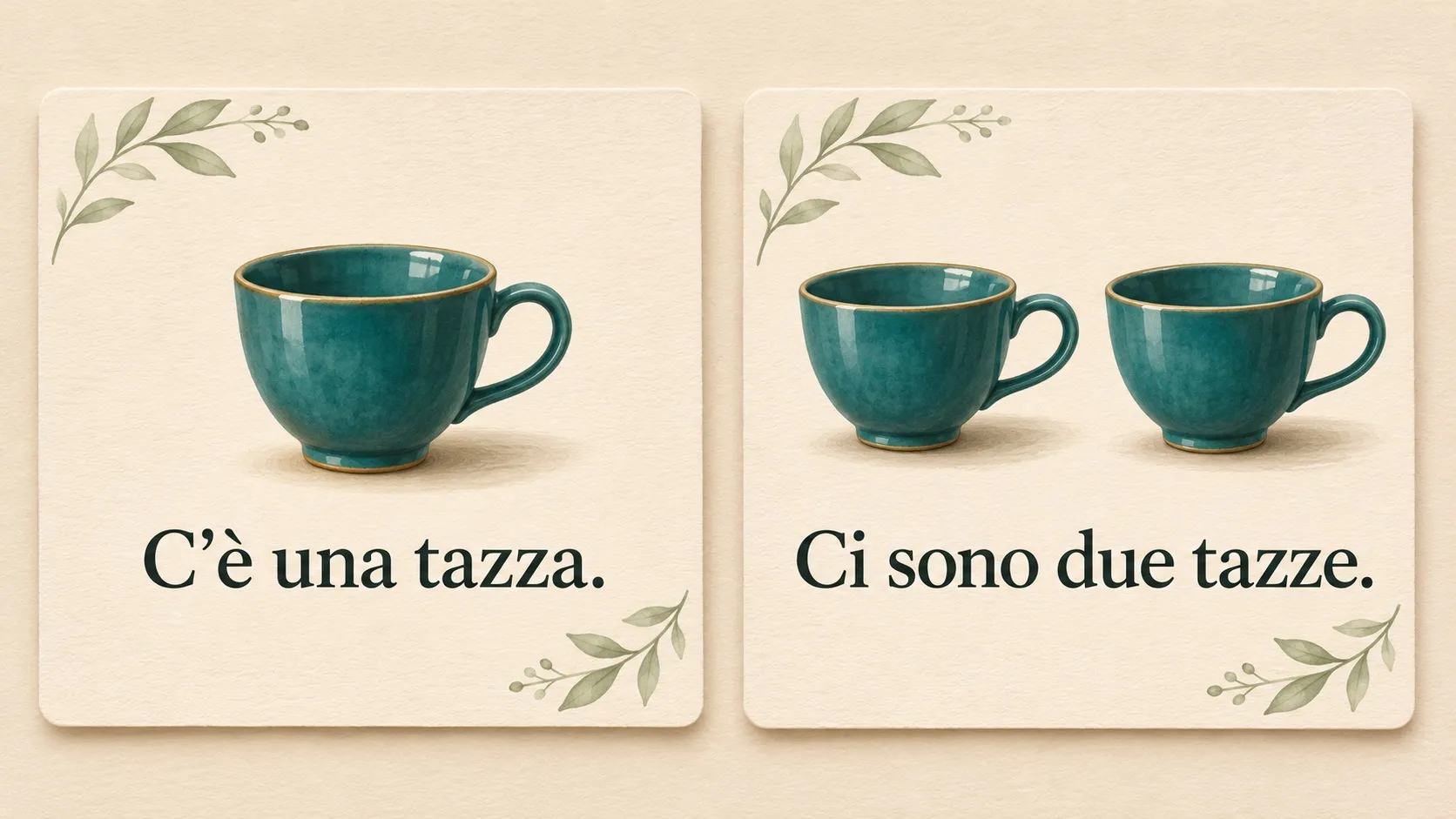
C’è una tazza. — There is a cup. Ci sono due tazze. — There are two cups. To say that someone or something is present, Italian uses c’è with a singular subject and ci sono with a plural subject. The distinction often matches English there is / there are.
These ten original exercises help you use that rule in questions, negatives and error corrections. For a quick introduction before practising, see the short grammar reference on c’è and ci sono.
A quick check: what is actually there?
Find the person or thing being introduced, rather than the place. In In cucina ci sono due tazze, cucina is singular, but the things present are due tazze, two cups. That is why the verb is plural.
| What are you introducing? | Form | Original example |
|---|---|---|
| One person or thing | c’è | C’è una lampada sul tavolo. |
| Several people or things | ci sono | Ci sono tre libri sul tavolo. |
| A substance expressed by a singular noun | c’è | C’è acqua nella bottiglia. |
| One thing that is absent | non c’è | Non c’è una sedia libera. |
| Several things that are absent | non ci sono | Non ci sono sedie libere. |
Acqua takes the singular here because the noun is grammatically singular, not because the water is one countable object. LearnAmo’s Italian lesson explains the basic singular–plural distinction and how the expressions indicate presence.
Questions keep the same word order
C’è una farmacia qui vicino. means “There is a pharmacy nearby.” To ask “Is there a pharmacy nearby?”, write C’è una farmacia qui vicino? In this simple yes/no question, you keep the Italian word order. Your intonation signals a spoken question; the question mark signals it in writing.
- Ci sono posti liberi? — Are there any seats available?
- Sì, ci sono due posti liberi. — Yes, there are two seats available.
- No, non ci sono posti liberi. — No, there are no seats available.
Do not copy the English inversion in is there / are there into the Italian sentence.
Negatives: put non before the expression
Learn non c’è and non ci sono as short units. A plural noun still takes the plural verb when you say that none of those things are present:
- Non c’è latte. — There is no milk.
- Non ci sono biscotti. — There are no biscuits.
You can also ask whether something is still there: Ci sono ancora biscotti? — Are there any biscuits left? No, non ci sono più. — No, there aren’t any left. Non … più expresses “not any more”; it does not change the number the verb refers to.
Three mistakes to watch for
1. Counting the place instead of the subject. In In questa stanza ci sono quattro persone, the form follows quattro persone. One room does not make the verb singular.
2. Looking only at the noun ending. Italian bar does not change its spelling in the plural: C’è un bar, but Ci sono due bar. The number and context tell you which form to use.
3. Losing the apostrophe or accent. Write c’è, with an apostrophe and è, not ce or c’é. Ci sono has no apostrophe: ci remains a full word.
For other uses of ci, such as “there” in ci vado, see the separate article on ci and ne. This practice focuses on present-tense esserci, rather than every meaning of ci.
Ten exercises: choose before checking
Fill 1–6 with c’è or ci sono. For 7–8, write the complete negative sentence. For 9–10, correct the complete statement. Keep the other words unchanged.
- Sul vassoio ___ una tazza.
- Sul vassoio ___ due tazze.
- Nella bottiglia ___ acqua.
- In questa strada ___ tre bar.
- ___ una fermata qui vicino?
- ___ studenti in biblioteca?
- Make negative: C’è una piscina in albergo.
- Make negative: Ci sono ascensori in questo edificio.
- Correct: In cucina c’è quattro sedie.
- Correct: Sul tavolo ci sono un piatto.
Answers and reasons
- C’è: una tazza is singular. The full sentence is Sul vassoio c’è una tazza.
- Ci sono: due tazze is plural. Using the same tray does not change the agreement.
- C’è: acqua is grammatically singular; the sentence does not present individually counted units.
- Ci sono: tre bar is plural even though bar has no different plural ending.
- C’è: you are asking about one stop, una fermata. C’è una fermata qui vicino?
- Ci sono: studenti is plural. The question uses the same form as the statement.
- Non c’è una piscina in albergo. Put non before c’è; una piscina remains singular.
- Non ci sono ascensori in questo edificio. Ascensori remains grammatically plural even when there are no lifts.
- In cucina ci sono quattro sedie. Four chairs require ci sono, not c’è.
- Sul tavolo c’è un piatto. One plate requires c’è, not ci sono.
Describe your own room
Look around and make four sentences: one thing, several things, a question and a negative. For example: C’è una lampada. Ci sono due finestre. C’è un balcone? Non ci sono piante. Say them from memory, then check which noun determines your verb form.
The guide to learning vocabulary in context with phrase flashcards offers a broader practice routine. Instead of memorising one gap-fill answer, change una tazza to due tazze and rebuild the whole sentence.
In Lingo Phrase Cards, you can choose an offered language direction and an available set of prepared phrases. Target-language phrases include IPA and audio generated with Amazon Polly Neural. Try recalling a phrase before turning the card over. Regular study updates Leitner progress and due dates; free pool, box and mistake-card practice provides extra review without changing that assessment. Categorised sets may require a licence.
Explore the available language directions and sets in Lingo Phrase Cards.