Comparative and superlative adjectives: -er/-est or more/most?
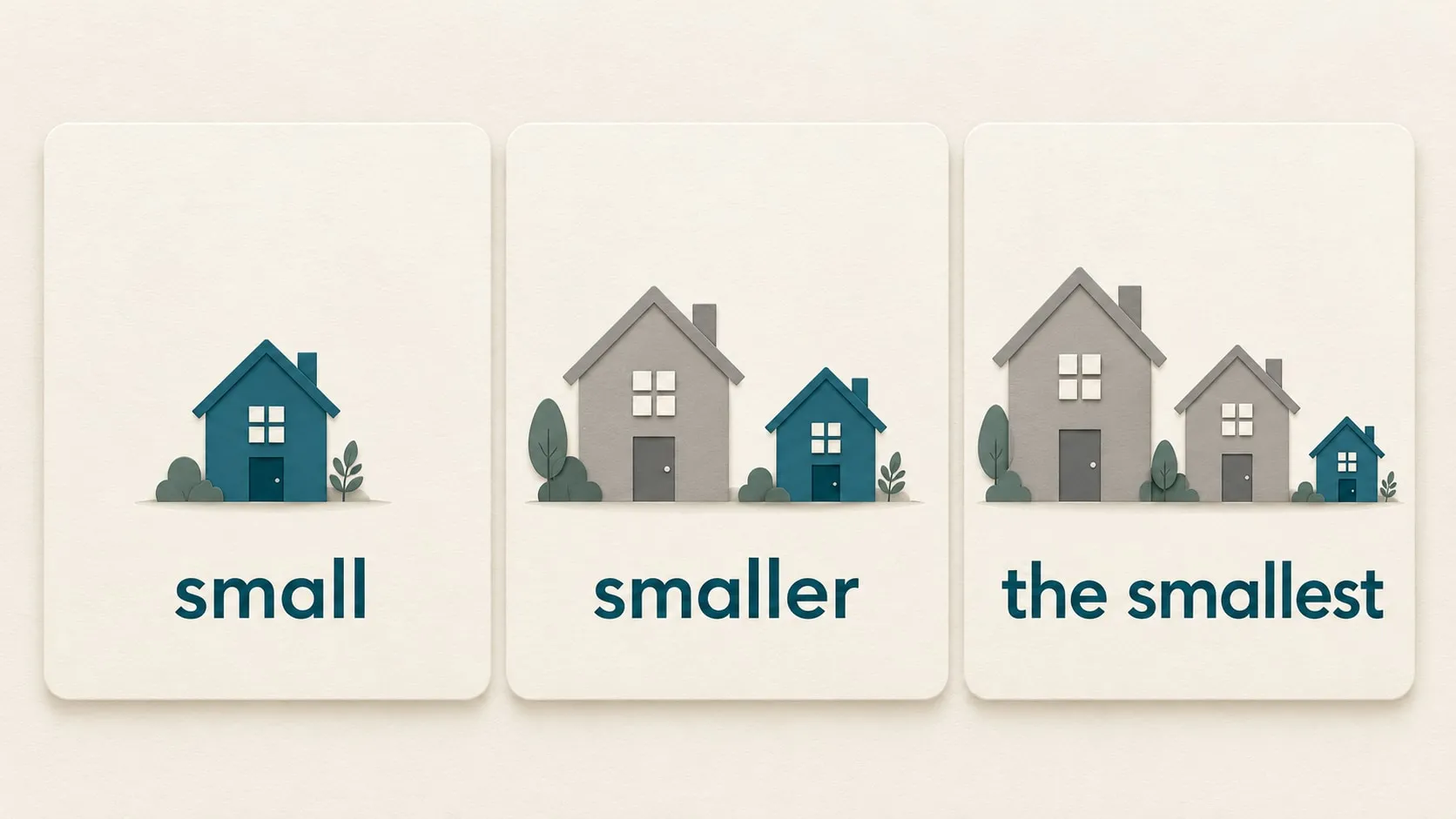
This room is smaller than that one. It is the smallest room in the house. The first sentence compares one room with another. The second picks it out from every room in the house. Both need a comparison form, but they don’t need the same one.
Start with what you want to compare, then choose how the adjective forms its comparison. Here’s a practical guide to the main patterns, useful exceptions and eight exercises with explained answers.
A comparison with another item or with a whole group?
The base form describes a quality: a small room. A comparative expresses a difference: a smaller room. Use than when you name the other item:
- This room is smaller than the kitchen. Compare two spaces.
- The blue chair is more comfortable than the red one. Compare their comfort.
A superlative places an item at the top or bottom of a scale within a group:
- This is the smallest room in the house. Compare it with all the house’s rooms.
- It is the most comfortable chair in the shop. Pick it out from the shop’s chairs.
Learn the combinations smaller than and the smallest in. “Compare A with B” versus “pick one out from a group” is a useful starting point, rather than an absolute rule based only on counting objects. Cambridge’s comparison guide explains the difference in more detail.
The main adjective patterns
| Pattern | Base form | Comparative | Superlative with the |
|---|---|---|---|
| usually one syllable | small | smaller | the smallest |
| already ends in -e | nice | nicer | the nicest |
| short vowel + single final consonant, as in big | big | bigger | the biggest |
| two syllables, consonant + y | easy | easier | the easiest |
| longer adjective | expensive | more expensive | the most expensive |
| irregular | good | better | the best |
| irregular | bad | worse | the worst |
With nice, just add -r/-st. Double the final consonant in big and hot: bigger/biggest, hotter/hottest. Change y to i in easy and happy: easier/easiest, happier/happiest. Don’t double every final consonant: cheap → cheaper, not cheapper.
Long adjectives such as expensive, interesting and comfortable keep their base form after more or most. Don’t add -er or -est as well.
Two syllables aren’t a rigid dividing line
“Short words take -er, long words take more” is a helpful starting point, but two-syllable adjectives need closer attention:
- easy → easier → the easiest: the common y pattern.
- careful → more careful → the most careful: not carefuller.
- quiet → quieter → the quietest: endings work here too.
- clever → cleverer / more clever: both patterns occur, with cleverest / most clever for the superlative.
Learn an uncertain form in a short phrase or check a dictionary. Don’t treat syllable count as an exception-free rule. Even the one-syllable adjective bored normally uses more bored / the most bored.
Never combine the two patterns: use better, not more better, and the biggest, not the most biggest.
Using than, the and as … as
A difference takes than: bigger than, not bigger as. For equality, use as + base adjective + as:
- This room is as small as mine. The rooms are equally small.
- This chair is not as comfortable as that one. This chair has a lower level of comfort.
Keep the base adjective between as and as: as small as, not as smaller as.
A superlative before a noun normally takes the: the best option. A possessive replaces that article: my best friend, not my the best friend. You can identify the group with in the house or of the three: the cheapest of the three options.
To strengthen a comparative, use much: This room is much smaller. For a small difference, try a little smaller. Don’t use very smaller. Much describes the size of the difference here.
Eight exercises with explained answers
Supply the right form or correct the sentence. Use the context to choose the type of comparison.
- Compare two bags: This bag is ___ than mine. (small)
- Pick the lowest-priced ticket from three: This is ___ ticket of the three. (cheap)
- Compare today’s temperature with yesterday’s: Today is ___ than yesterday. (hot)
- Exercise 2 needs less effort: Exercise 2 is ___ than exercise 1. (easy)
- Compare two chairs: This chair is ___ than that one. (comfortable)
- Correct: This route is more better than the old one.
- Both rooms have the same size: This room is as ___ as yours. (big)
- Correct: She is my the best friend.
Answers:
- Smaller: add -er for the comparative; than introduces the other bag.
- The cheapest: a superlative picks one out from all three tickets.
- Hotter: double the final t after the short vowel.
- Easier: change y to i and add -er.
- More comfortable: use more with the longer adjective.
- This route is better than the old one. Better is already the irregular comparative of good.
- Big: as … as uses the base form.
- She is my best friend. My replaces the article the.
Practice complete comparisons
On paper, list three rooms, bags or tickets. Write a comparison with than, a superlative with a clear group, and a sentence with as … as. Cover the adjective together with any more/most, then supply the complete form from memory. This is a suggested personal exercise. Change the objects and qualities so you’re choosing forms rather than repeating one memorized sentence.
Lingo Phrase Cards provides prepared words in phrases, with IPA and audio for target-language phrases. Choose an offered language direction and preview suitable sets; some categorized sets require a license. In an unlocked set’s regular learning mode, try your answer before turning over the card, then rate it. Free practice views let you review without changing card progress.
If you’re still deciding whether a word describes a thing or an action, read adjective or adverb in English. For today’s comparisons, ask: Am I comparing A with B, picking one out from a group, or describing equality? Explore available language directions and sets on the Lingo page.