Hear vs listen: the difference and ten exercises with answers
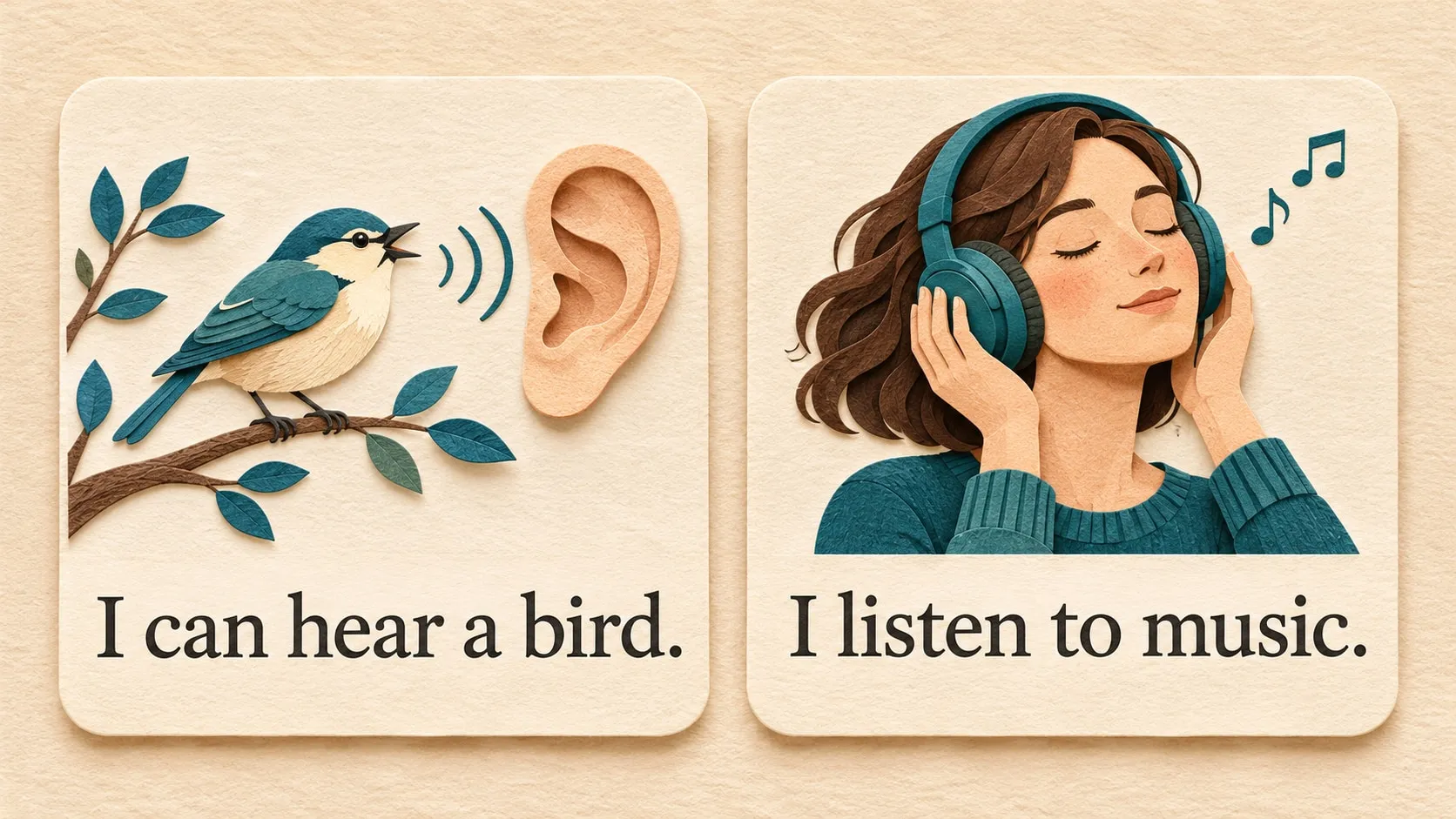
Hear describes perceiving a sound. Listen describes directing your attention to something you can hear. Compare I can hear music, meaning that music reaches your ears, with I listen to music, which describes a listening activity.
Learn the sentence pattern along with the meaning: hear something, but listen to something. With a person, the same contrast gives you I can hear you and I’m listening to you.
The difference at a glance
| Your meaning | Pattern | Example |
|---|---|---|
| A sound is audible to you | can hear + sound | I can hear a bird. |
| You give a sound or person your attention | listen to + person/thing | I listen to music. |
| You ask someone to pay attention | Listen! | Listen! I have an idea. |
Cambridge English Grammar Today explains this as a contrast between an event and a conscious action. It is a useful starting point, rather than a rigid division covering every meaning of the verbs.
Hear: what sound reaches you?
Use hear to say that you perceive a sound. You do not need to have chosen to pay attention first:
- I can hear a bird outside. A bird’s song is audible from where you are.
- We heard a crash in the kitchen. You became aware of a sudden sound.
- Can you hear me now? You are checking whether your voice is getting through.
On a phone call, I can’t hear you is about audibility. You may be paying attention, but the connection is too quiet. I’m listening, but I can’t hear you clearly combines the two ideas naturally.
For ordinary sound perception happening now, can hear is common: I can hear the rain, rather than I am hearing the rain. Avoid turning this into “hear can never be continuous”: the verb has other uses too. It can also mean receiving information: I heard that Mia has a new job.
Listen: what are you paying attention to?
Listen presents listening as an action. When you name the person or thing receiving your attention, use to in this basic pattern:
- Listen to the instructions before you start. Give the instructions your attention.
- She’s listening to a podcast. This is her current listening activity.
- Please listen to me. The speaker wants your attention.
The correction is I listen to music, not I listen music. Treat listen to music as a whole phrase, rather than remembering only the verb.
When you do not name an object, leave out to: Please listen. I’m listening. Listen! is also a complete instruction. Listen to! on its own leaves the listener waiting to find out who or what you mean.
Can both verbs work?
Yes. Consider the same radio interview from two perspectives:
- I heard the interview on the radio. The focus is the experience of hearing it.
- I listened to the interview on the radio. The focus is the action of listening.
A podcast, song, or interview therefore does not automatically require listen. Your intended emphasis matters. “Hear is accidental” is a helpful beginner shortcut, but it is too narrow as an absolute rule.
Heard, listened, and pronunciation
| Base form | he/she/it | Past simple / past participle |
|---|---|---|
| hear | hears | heard / heard |
| listen | listens | listened / listened |
Use heard, not heared. After did/didn’t, return to the base form: Did you hear that? and I didn’t listen to the recording. For more practice, see questions with do, does, and did.
The t in listen is silent: /ˈlɪsn/. Listened /ˈlɪsnd/ does not have an extra -ed syllable. In British English, heard /hɜːd/ also has a different vowel from hear /hɪə(r)/. Oxford’s dictionary entries provide audio for these forms.
Ten hear-or-listen exercises
Choose the correct option without changing the other words. Check the situation and any preposition already supplied.
- The connection is poor. I can’t ___ you clearly. (hear / listen)
- Please ___ to the safety instructions before you begin. (hear / listen)
- Be quiet for a moment and ___! (hear / listen)
- Yesterday, we ___ a sudden crash upstairs. (heard / listened)
- She’s ___ to an English lesson right now. (hearing / listening)
- Did you ___ that strange noise? (hear / heard)
- I always listen ___ music on the train. (to / —)
- Can you hear ___ the birds outside? (to / —)
- You want to stress that you are paying attention: I’m ___ to you carefully. (hearing / listening)
- You notice a dog making a sound outside: I ___ a dog outside. (can hear / am hearing)
Answers explained
- hear — The problem is whether the voice is audible.
- listen — This is deliberate listening, with to before the object.
- listen — An instruction without a named object needs no to.
- heard — You perceived a sound; heard is the past of hear.
- listening — The action is in progress: is listening to.
- hear — Use the base form after did.
- to — The phrase is listen to music.
- — — Hear the birds needs no to here.
- listening — The intended meaning is giving someone attention.
- can hear — This is the usual way to describe present sound perception.
Extra challenge: write two sentences about the same song, one with heard and one with listened to. Both can be correct. Explain whether you are emphasizing the hearing experience or the deliberate action.
Practice complete phrases
On paper, write three situations: a noise in the next room, a focused listening exercise, and a poor phone connection. Say a complete English sentence for each before checking your answer. Review the verb, to, and tense separately.
In Lingo Phrase Cards, you can explore the available language directions and choose a suitable set. The prepared content presents words in phrases, with IPA and audio generated using Amazon Polly Neural for target-language phrases. Answer before turning a card over, then rate your answer in the regular Leitner study mode to schedule later reviews. Categorized sets may require a license.
For another word-choice question, try the say vs tell exercises. Explore the available language directions and sets in Lingo Phrase Cards.