Learn, teach, or study? Differences and ten exercises with answers
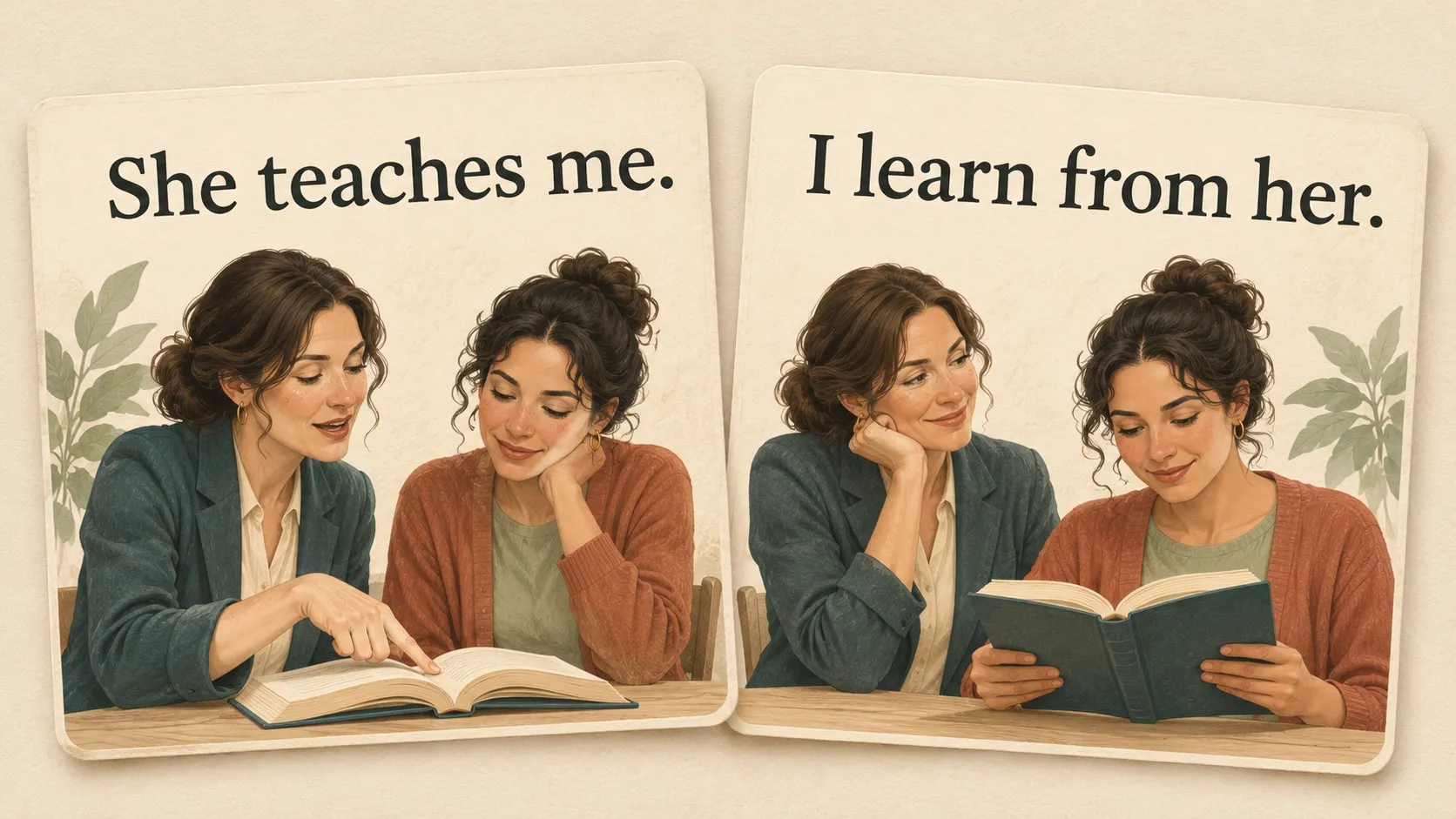
Learn means to gain knowledge or a skill, teach means to help someone gain it, and study describes spending time working on a subject or learning material. Compare She teaches me with I learn from her: the same situation, seen from two different roles.
Start by identifying who is gaining knowledge and who is passing it on. Then look at the words following the verb. For exam preparation, for example, the usual phrase is study for an exam.
Three verbs at a glance
| Verb | Main focus | Example |
|---|---|---|
| learn | Gaining knowledge or a skill | I’m learning to swim. |
| teach | Helping someone gain knowledge or a skill | Maya teaches children to swim. |
| study | Working on a subject or learning material | I’m studying for my biology exam. |
Cambridge’s English Grammar Today explains this distinction. Learning and studying can happen together: you may learn something while studying a chapter. Your choice depends on the aspect you want to emphasize.
Learn: who gains the knowledge?
The subject of learn is the learner. You can name the topic, the skill, or the source:
- I learn new words every week. — New vocabulary is what I acquire.
- Nora is learning to cook. — Nora is developing a practical skill.
- We learned how to use the camera. — We found out how to operate it.
- I learned a lot from my colleague. — My colleague was the source of that knowledge.
Useful patterns are learn to + verb, learn how to + verb, and learn from + person or experience. For practical abilities, say learn to swim or learn to drive, rather than study to swim/drive with that meaning.
Learning does not have to be complete: I’m learning English describes an ongoing process. The shortcut “study is the process; learn is the result” is therefore too rigid. Another common use is memorizing: learn a poem by heart.
Teach: who helps someone else learn?
With teach, the subject gives instruction or helps another person develop a skill. Learn the whole pattern:
| Pattern | Example |
|---|---|
| teach + person + subject | Leo teaches us English. |
| teach + subject + to + person | Leo teaches English to adults. |
| teach + person + to + verb | Can you teach me to cook? |
| teach + person + how to + verb | Can you teach me how to use this camera? |
Do not put to before the person in the first pattern: She teaches me English, not She teaches to me English. She teaches English to me is grammatically possible, but the version with me directly after the verb is usually more natural with this short pronoun.
In standard English, use She taught me that, not She learned me that, for giving instruction. You can also teach yourself: I taught myself to cook. Compare I learned to cook from my aunt with My aunt taught me to cook. The learner and teacher have changed places as the subject.
Study: what are you working on?
Study fits academic subjects, reading, coursework, and focused preparation:
- Sam studies biology at university.
- I’m studying for an exam tonight.
- We studied the chapter together.
With languages, both verbs can work. I study English every evening emphasizes your study activity; I’m learning English emphasizes acquiring the language. Study is not limited to university, and learn does not mean learning without classes.
Ask yourself whether you want to describe what you are acquiring or the work you are doing. If you are busy preparing lessons or reviewing notes, I need to study is a useful sentence even without naming a subject.
Teaches, taught, learned, and studied
| Base form | he/she/it in the simple present | Simple past / past participle |
|---|---|---|
| learn | learns | learned / learned; also learnt / learnt |
| teach | teaches | taught / taught |
| study | studies | studied / studied |
Learnt is especially common in British English; learned is also correct. Teached is not a standard form. After did/didn’t, use the base form: Did she teach you? and I didn’t study yesterday. Review the pattern in our guide to questions with do, does, and did.
Ten practice questions
Choose the correct form of a verb in parentheses. For 1–8, choose between learn and teach; for 9–10, choose between study and learn. Keep the other words unchanged.
- Every Monday, Eva ___ us English. (learn / teach)
- I want to ___ to swim. (learn / teach)
- My uncle ___ me to cook last summer. (learn / teach)
- We ___ a lot from our guide yesterday. (learn / teach)
- Can you ___ me how to use this app? (learn / teach)
- Did your sister ___ you to drive? (learn / teach)
- I ___ myself to play the guitar when I was sixteen. (learn / teach)
- You can ___ from your mistakes. (learn / teach)
- I can’t go out tonight. I need to ___ for tomorrow’s exam. (study / learn)
- The actor has to ___ these lines by heart. (study / learn)
Answers explained
- teaches — Eva gives instruction; third-person singular.
- learn — The speaker wants to gain a skill: learn to swim.
- taught — The uncle gave instruction in the past.
- learned / learnt — We gained knowledge; from our guide gives the source.
- teach — The person is being asked to show me how: teach me how to.
- teach — The sister gave instruction; use the base form after did.
- taught — Teach myself means to develop a skill without another person teaching it; past tense here.
- learn — The expression is learn from your mistakes.
- study — The focus is exam preparation: study for an exam.
- learn — The expression learn by heart means memorize.
One extra challenge: rewrite Maya taught me to swim with the learner as the subject. I learned to swim from Maya works. Notice that changing the verb also changes the subject and requires from.
Review complete patterns
Hide the verb in three examples of your own and say each complete sentence aloud. Explain your choice: gaining knowledge, helping someone learn, or working on study material. This short practice suggestion is about applying the distinction, not meeting a daily quota.
Lingo Phrase Cards offers prepared language sets with words in phrases, IPA, and audio generated with Amazon Polly Neural for target-language phrases. Choose an available language pair and a suitable set. Attempt an answer before turning the card over, then rate it in regular Leitner study for later reviews. Categorized sets may require a license.
For another word-choice challenge, try the say and tell exercises. Explore the available language pairs and sets in Lingo Phrase Cards.