Say vs tell: sentence patterns and exercises with answers
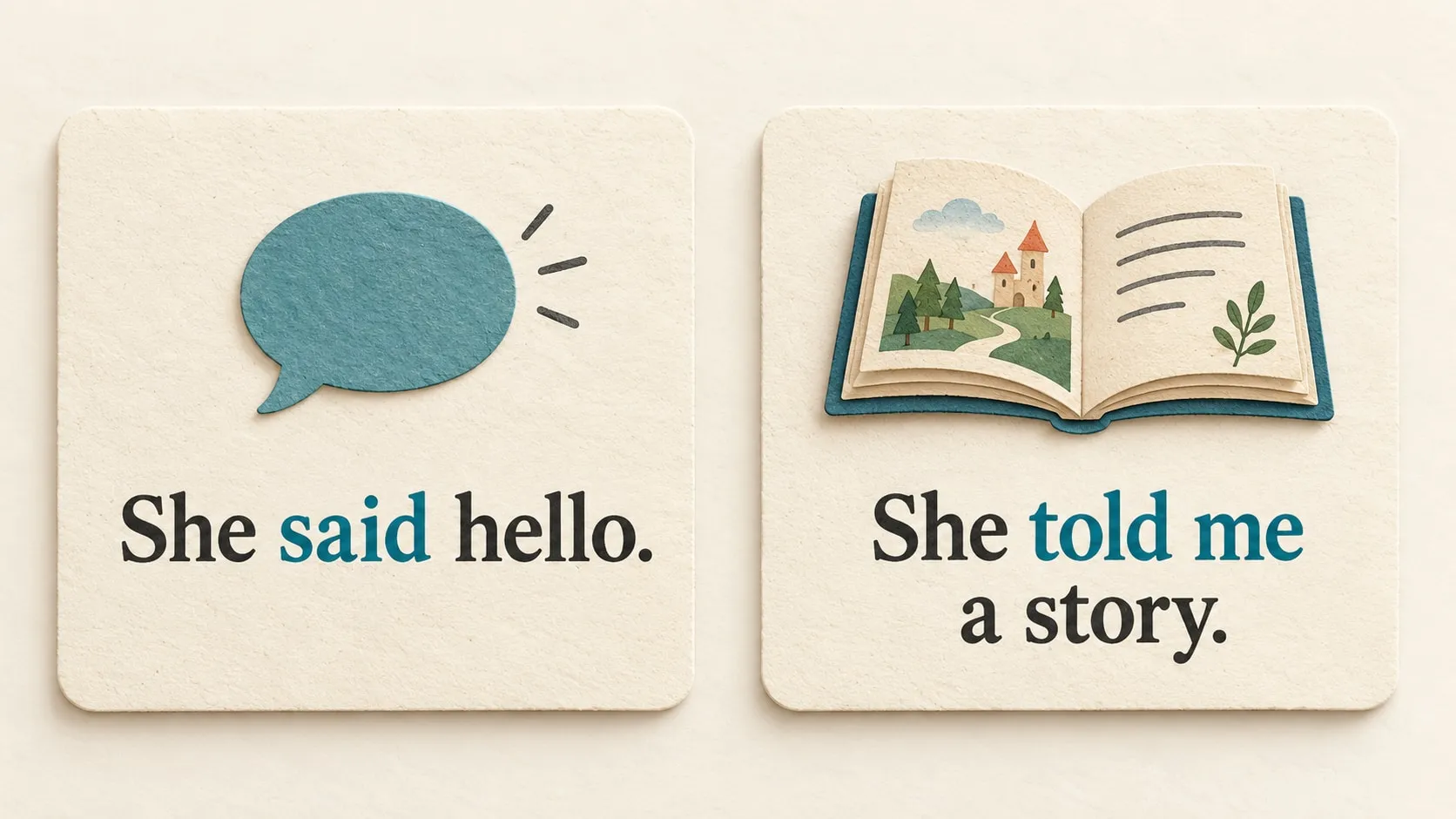
You can write She said hello and She told me a story, but not She said me a story. The difference becomes much easier to use when you learn the words that follow each verb, rather than treating say and tell as interchangeable synonyms.
Start with four patterns: say something, say something to someone, tell someone something, and tell someone to do something. Then add common combinations such as tell the truth.
The core patterns
| Purpose | Pattern | Example |
|---|---|---|
| Give someone’s words | say + message | She said hello. |
| Include the listener | say + message + to + person | She said hello to me. |
| Give someone information | tell + person + message | She told me the news. |
| Report an instruction | tell + person + to + verb | She told me to wait. |
The distinction is not whether somebody is listening. She said hello probably has a listener too. What matters is how you include that listener in the sentence. Cambridge’s English Grammar Today explains these different complements.
Say: focus on the words
Use say with a word, a short expression, or a clause:
- Please say your name slowly.
- Nora says that the shop is closed.
- “I’ll call later,” he said.
You may leave out that: Nora says the shop is closed. To name the listener, use to: What did Nora say to you? Not What did Nora say you?
Be precise about the rule. Say does not take a listener directly as its object in this pattern. That does not mean all object pronouns are impossible: Say it again, please is correct. Here, it refers to the message, not the person hearing it.
Tell: include the person receiving the message
When tell means giving someone information, the person normally comes directly after it:
- Tell me your name, please.
- Nora told us that the shop was closed.
- Did you tell Leo about the meeting?
Do not put to before this person. Compare two correct sentences:
- She said to me that she was ready.
- She told me that she was ready.
The meaning is similar, but the structure changes with the verb. Avoid she said me and she told to me in this message-giving pattern.
Fixed expressions: tell the truth, tell a story
The shortcut “tell always needs a person” goes too far. Several common combinations work without a named listener:
| Expression | Example |
|---|---|
| tell the truth | Please tell the truth. |
| tell a lie | He told a lie. |
| tell a story | Can you tell a story? |
| tell a joke | Mia told a funny joke. |
You can still add the listener: Tell me the truth. Learn these expressions as chunks. Add useful say combinations too: say hello, say goodbye, say thank you. A general distinction between words and information helps, but it does not replace learning the actual phrase.
Tell someone to: reporting instructions
Use tell + person + to-infinitive to report an instruction:
- The guide told us to wait outside.
- I told Ben not to open the window.
For a negative instruction, use not to + verb. Told us to wait is the straightforward learner pattern; said us to wait is incorrect. Informal English sometimes uses say + to-infinitive, but that does not make say + person + to-infinitive a correct substitute.
Said and told: past forms and questions
| Base form | Past simple | Past participle |
|---|---|---|
| say | said | said |
| tell | told | told |
After did/didn’t, return to the base form: What did she say? and She didn’t tell me. Not did she said or didn’t told. The guide to questions with do, does, and did covers this question structure in more detail.
Ten exercises
Fill each gap with the correct form of say or tell. Keep the other words unchanged. Try all ten before reading the answers.
- Every morning, Ava ___ hello to her neighbours.
- Please ___ me your address.
- Yesterday, Leo ___ that he was tired.
- Yesterday, Leo ___ us that he was tired.
- What did you ___ to the driver?
- The nurse ___ me to sit down yesterday.
- Please ___ the truth.
- My grandfather ___ us a story last night.
- Don’t ___ anything yet.
- I didn’t ___ her about the delay.
Answers and reasons
- says — say hello to someone, third-person singular.
- tell — tell + me + information; the imperative uses the base form.
- said — a past statement without a named listener object.
- told — us comes directly after the verb.
- say — the listener follows to; did takes the base form.
- told — tell someone to sit down, in the past.
- tell — the fixed expression tell the truth.
- told — tell someone a story, in the past.
- say — anything is the content, not the listener.
- tell — her receives the information; didn’t takes the base form.
Extra challenge: correct She said me the news. Use She told me the news. She said the news to me is also structurally possible, but told me the news sounds more natural for giving someone news.
Practise whole phrases
Cover the verb in an example and then say the complete sentence. When checking, identify the clue: to me, me, the truth, or me to wait. Separate a verb-choice error from a word-order error or a wrong past form.
In Lingo Phrase Cards, choose an available course with English as the target language and a suitable set. Prepared content presents words in phrases, with IPA and audio generated using Amazon Polly Neural for target-language phrases. Attempt the answer before turning the card over, then use regular Leitner study for reviews. Incorrect-card practice lets you go through difficult cards again without changing their learning progress. Categorized sets may require a licence.
For another practical word-choice question, try borrow vs lend with exercises. Explore the available language directions and sets in Lingo Phrase Cards.
Sources
- Cambridge Dictionary: Say or tell?
- Lingolia: Say/Tell — German-language explanation.